
Written by Alex Turner
Quick Answer:
The main difference between a percussion massager and a vibrating massager is how the head delivers mechanical energy. A percussion device repeatedly moves into tissue, while a vibration device mainly sends rapid oscillations through a contact surface. They can feel very different and may suit different comfort and recovery preferences.
Percussion and Vibration: Similar Goal, Different Feel
Both types of handheld massagers are designed to create mechanical stimulation that many people use as part of a relaxation, mobility, warm-up, or post-exercise routine. The important distinction is not simply whether a device “vibrates.” Both can vibrate. The distinction is how the moving head interacts with the body.
A percussion massager, often sold as a massage gun, uses repeated striking or thrusting movements. A vibrating massager generally keeps its contact surface closer to the skin while producing rapid oscillations. Because the mechanical action differs, the sensation, pressure requirements, head design, and practical use can differ too.
Trust & safety: This article is for general educational information only. It does not diagnose, treat, cure, or prevent any condition. It does not replace advice from a licensed healthcare professional. Readers should seek professional help for severe, worsening, unusual, or persistent symptoms.
What Is a Percussion Massager?
A percussion massager uses a motor to create repeated back-and-forth movements of an attachment. The head does more than simply buzz against the skin: it moves toward and away from the body in a rhythmic, striking pattern. Massage guns are the most familiar example.
The sensation is usually more pronounced than ordinary vibration. Users may describe it as tapping, thumping, pounding, or a rapid rhythmic pressure. The device is commonly moved across larger muscle areas rather than held aggressively on one small point.
Clinical guidance from Cleveland Clinic describes massage guns as percussive devices that can be used around muscles for relaxation, warm-up, and post-exercise comfort when used properly. It also recommends keeping the device on muscle rather than bony areas and discussing use with a healthcare team when an underlying condition or injury is involved.
Note: “Deep” should not automatically mean “better.” A stronger sensation can simply mean more mechanical pressure or movement. Comfort, control, and appropriate placement matter more than trying to make the device feel as intense as possible.
What Is a Vibrating Massager?
A vibrating massager produces rapid oscillations that are transferred through a contact surface. Depending on the design, the contact area may be relatively flat, broad, padded, or shaped for a particular body area.
Instead of repeatedly driving the head into the body, the device primarily creates a vibration sensation through the tissues underneath its contact point. This can feel gentler and more uniform, although intensity varies widely between products.
One important point when comparing devices is that manufacturers and retailers do not always use the terms “vibration,” “percussion,” and “massage gun” consistently. A device may advertise vibration while also using a moving attachment. Looking at the actual head movement and product specifications can therefore be more useful than relying on the product name alone.
Warning: Avoid treating a massager as a substitute for evaluation of an unexplained injury or persistent pain. Do not deliberately increase pressure to chase a stronger sensation, and do not use a massager directly over bones, open wounds, recently injured areas, or other areas your healthcare professional has told you to avoid.
The Main Differences at a Glance
The easiest way to understand the difference between percussion massager and vibrating massager is to compare the movement of the head rather than the marketing name. Percussion emphasizes repeated mechanical strokes; vibration emphasizes rapid oscillation transmitted through the contact surface.
Swipe left/right to see the full table →
| Feature | Percussion | Vibration |
|---|---|---|
| Head action | Repeated strokes | Rapid oscillation |
| Typical feel | Tapping or thumping | Buzzing or shaking |
| Contact style | Moving attachment | Often broader pad |
| Pressure need | Usually light to moderate | Usually lighter |
The table describes the general mechanical distinction, not every product on the market. Hybrid devices exist, so the manufacturer’s specifications and the actual movement of the head can matter.
Current comparison articles commonly focus on amplitude, head shape, penetration claims, and safety. Those are useful shopping clues, but claims about “deeper” action should not be interpreted as proof that one type provides better results for every person or purpose.
What to Look for on the Device
When the product label is vague, check whether the head visibly travels into and away from the body or mainly oscillates at the contact surface. Head shape can provide another clue: broad, flatter contact surfaces are commonly associated with vibration-focused designs, while massage-gun attachments often have compact, rounded or specialized shapes.
Swipe left/right to see the full table →
| If you want… | Look for | Why it matters |
|---|---|---|
| Gentle contact | Broad, soft surface | Spreads contact |
| Percussive feel | Moving attachment | Creates repeated strokes |
| Easy control | Adjustable intensity | Helps match comfort |
| Clear specifications | Movement and speed details | Reduces marketing ambiguity |
Where the Two Types Overlap

Despite the mechanical difference, both devices can be used as part of a general muscle-care routine. People may use them before activity to prepare a particular muscle group, after activity as part of a cool-down, or during a routine intended to reduce the feeling of muscle tightness.
Massage therapy itself has been studied for relaxation, muscle tension, pain, and other concerns, but evidence and results vary by condition and technique. A handheld massager should therefore be viewed as a comfort or wellness tool rather than a guaranteed solution for a specific medical problem.
That distinction matters when reading product claims. A device can produce a strong sensation without that sensation proving that it is reaching a particular tissue layer or producing a specific therapeutic effect.
Shared vs. Distinct: Practical Overlap Panel
Both can
Provide mechanical stimulation, fit into a personal recovery routine, and feel useful for temporary relaxation or muscle comfort.
Percussion emphasizes
Repeated movement of the head, creating a tapping or thumping sensation that can feel more forceful.
Vibration emphasizes
Rapid oscillation transmitted through the contact surface, often creating a more continuous buzzing sensation.
Neither guarantees
A particular medical outcome. Personal response depends on the device, use, body area, and individual circumstances.
This overlap is why shopping by appearance alone can be misleading. Two devices may look similar while producing noticeably different movement patterns.
How to Tell Which One You Are Holding
If you are comparing two products in a store or at home, start with the simplest test: watch the head from the side while it runs. If the attachment visibly travels back and forth toward and away from the body, it is showing a percussive movement. If the contact area mainly buzzes or oscillates with little visible travel, it is more consistent with vibration-focused operation.
Practical Identification Path
Specifications can be useful, but there is no single number that automatically makes a product safe or appropriate. Design, control, pressure, body location, and the user’s health circumstances all matter.
Common Self-Assessment Mistakes
The most common mistake is assuming that a stronger sensation means better muscle work. Another is assuming that every massage gun and every vibration device operates in exactly the same way. A third is using a device on a painful spot without first considering whether the pain could reflect an injury or another condition.
Swipe left/right to see the full table →
| Mistake | Better choice |
|---|---|
| Chasing maximum intensity | Use the lowest comfortable setting |
| Pressing harder for “depth” | Let the device provide its intended action |
| Using it on bone | Keep contact on appropriate soft tissue |
| Ignoring unusual pain | Stop and consider professional evaluation |
When Both Can Be Used in the Same Routine
Some people may prefer different sensations at different times. For example, someone who dislikes a pronounced tapping sensation may favor a vibration-focused device for general relaxation, while another person may prefer the distinct rhythmic feel of percussion after exercise.
There is no need to use both simply because both exist. If one device is comfortable, easy to control, and appropriate for the intended use, adding a second device does not automatically create a better routine.
Typical Routine Priority — Practical Guide
Values show typical routine priority, not scientific measurements.
The practical lesson is simple: prioritize safe placement and comfortable control before choosing a particular mechanical style.
Safety: When a Massager Is Not the Right Tool
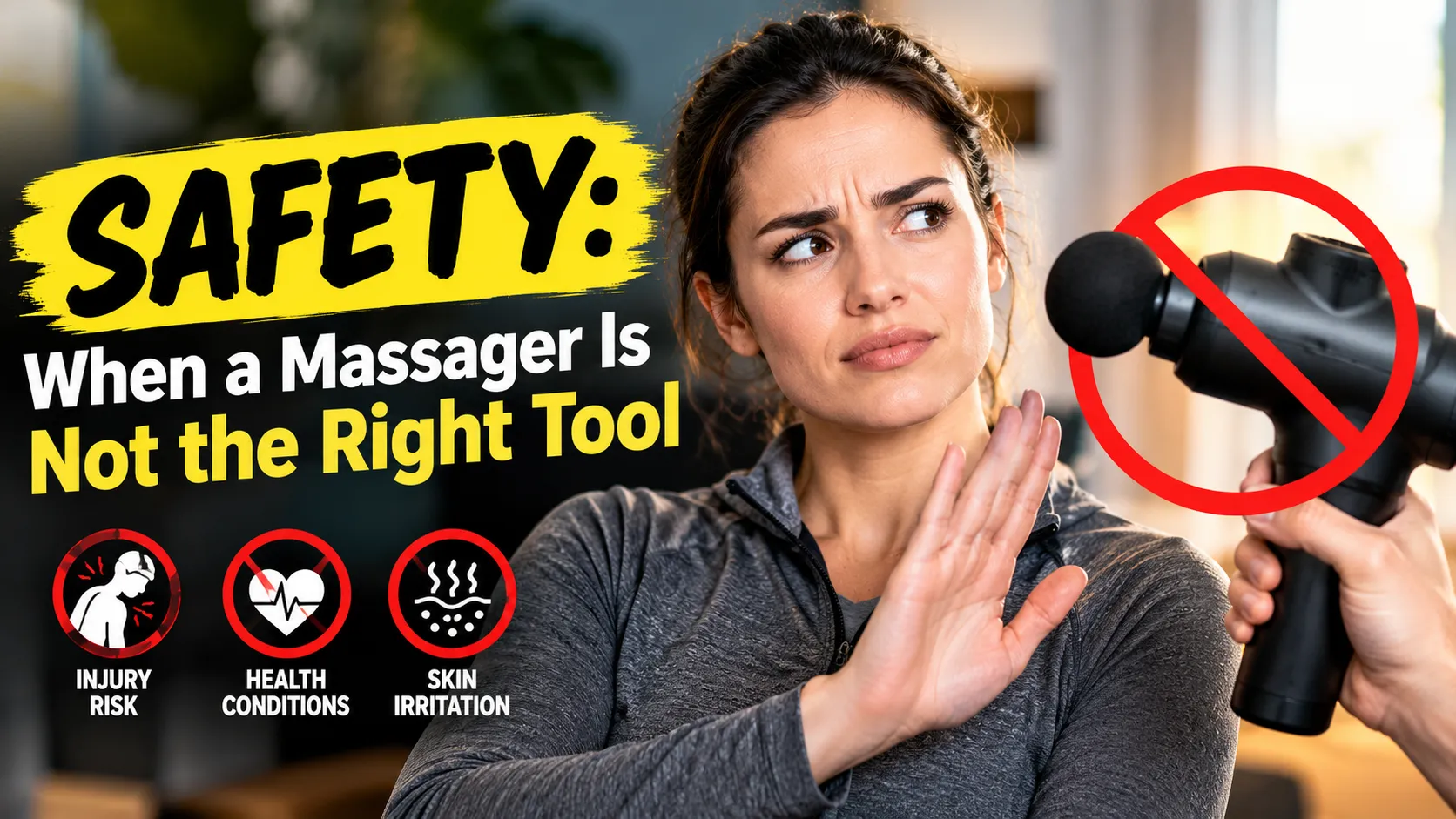
Massage devices should not be treated as risk-free simply because they are sold for home use. Mayo Clinic notes that massage can be inappropriate or require professional guidance in situations such as recent heart attack, bleeding disorders, blood-thinning medication, recent blood clots, burns, broken bones, severe osteoporosis, healing wounds, or nerve damage.
Those cautions are particularly important when comparing a device that creates repeated physical impacts with one that primarily creates vibration. If you have a medical condition, are recovering from an injury or surgery, have reduced sensation, or are unsure whether a body area is appropriate, ask your healthcare professional before using either type.
Safety Decision Path
Normal muscle comfort
Use only as directed, on appropriate soft tissue, with comfortable pressure.
Recent injury or surgery
Ask your healthcare team before using a massage device on or around the affected area.
Medical risk factors
Conditions involving bleeding, clots, fragile bones, nerve damage, or implanted devices warrant professional guidance.
Unusual symptoms
Do not use the device to test or mask severe, unexplained, worsening, or persistent symptoms.
Cleveland Clinic similarly advises people with relevant underlying conditions or active injuries to consult their healthcare team and recommends avoiding bony areas when using a massage gun.
When to Contact a Professional
Seek professional medical advice rather than relying on a massager if you have severe or worsening pain, numbness, weakness, significant swelling, a recent injury, fever, chest pain, or loss of bladder or bowel control. Professional guidance is also appropriate when symptoms persist or when you have a condition or medication that may increase the risks of massage or pressure.
Swipe left/right to see the full table →
| Situation | General approach | Decision |
|---|---|---|
| Ordinary muscle tightness | Gentle use as directed | Self-care may be reasonable |
| Recent injury | Avoid unsupervised use on affected area | Ask a professional |
| Blood-thinning medicine | Do not assume pressure is harmless | Ask healthcare team |
| Severe or persistent symptoms | Do not mask symptoms | Seek evaluation |
So Which Type Fits Your Routine?
Rather than asking which device is universally better, start with the sensation and mechanical action you actually want. If you like the distinct tapping sensation of a massage gun and can comfortably control it on suitable muscle areas, percussion may fit your routine. If you prefer a continuous buzzing sensation and a broader contact surface, a vibration-focused device may feel more suitable.
Also consider reach and handling. A device that is difficult to position safely on your own body may be less practical than one that is easier to control. Product shape, handle design, noise, weight, intensity controls, and instructions can matter just as much as the basic technology.
The difference between percussion massager and vibrating massager therefore comes down to more than “deep versus shallow.” It is fundamentally about the movement pattern and how that movement is transferred into the body.
Frequently Asked Questions
What is the difference between percussion massager and vibrating massager?
A percussion massager repeatedly moves its head toward and away from the body, while a vibration-focused massager mainly transfers rapid oscillations through its contact surface.
Is a massage gun the same as a percussion massager?
Usually, yes. “Massage gun” commonly refers to a handheld device that delivers repeated percussive movements through an attachment.
Does a vibrating massager penetrate deeper than a percussion massager?
“Depth” is not a simple way to compare devices. Vibration and percussion transfer mechanical energy differently, and marketing claims about penetration should not be treated as proof of a better result.
Can I use a percussion massager every day?
Frequency depends on the device, body area, intensity, and individual circumstances. Follow the manufacturer’s instructions and stop if use causes significant pain or unusual symptoms.
Can massage guns be used on bones?
They should not be used directly over bony areas. Cleveland Clinic specifically advises keeping massage-gun use on muscle rather than bone.
Who should ask a healthcare professional before using a massager?
People with certain conditions or risks, including recent surgery, blood clots, bleeding disorders, blood-thinning medication, fractures, severe osteoporosis, nerve damage, or implanted medical devices, should seek individualized guidance first.
Which is better for muscle recovery: percussion or vibration?
There is no universal answer. The useful choice depends on the device’s mechanical action, your comfort, the intended body area, and any relevant health considerations.
Final Thoughts
The difference between percussion massager and vibrating massager is mainly the way each device moves and transfers mechanical energy. Percussion creates repeated strokes, while vibration focuses on rapid oscillation through the contact surface. Choose based on comfort, control, intended use, and safe placement rather than assuming a stronger sensation is automatically better. Seek professional guidance for severe, worsening, unusual, or persistent symptoms or when a health condition could affect massage safety.
Author
-

I’m Alex Turner, a massage product reviewer and wellness writer at RemedyTip. I specialize in researching, evaluating, and comparing massage and recovery products to help readers make informed purchasing decisions. My focus is on practical, evidence-informed product guidance covering muscle recovery, relaxation, everyday comfort, and wellness.
I take a research-driven approach to every product I review. I examine product specifications, features, materials, performance claims, user feedback, durability, comfort, ease of use, and overall value. When appropriate, I also consult trusted industry and health-related sources to verify important information and provide readers with a more complete and balanced view.
I cover a wide range of products, including massage guns, handheld massagers, neck and shoulder massagers, foot massagers, massage chairs, foam rollers, and other recovery tools. Rather than focusing only on marketing claims, I look at how products compare in real-world use and who they are actually suitable for. I also consider different budgets, use cases, and user needs when making recommendations.
At RemedyTip, I’m committed to accuracy, transparency, and unbiased product information. I clearly distinguish between manufacturer claims, available evidence, and my own product analysis so readers can understand the basis of each recommendation. I continuously research new products, technologies, and developments in the massage and recovery space to keep my content current and useful.
My goal is simple: to provide trustworthy, easy-to-understand information that helps readers choose massage and recovery products with greater confidence.

