
By Alex Turner
People ask can a percussion massager break up scar tissue after seeing before-and-after videos online, hoping a handheld tool can undo months of healing in minutes. Scar tissue is dense, layered, and forms as the body’s natural repair response — it doesn’t behave like a knot in a muscle. This guide separates the marketing claims from what daily percussion use can realistically do, and when it’s safer to skip it.
The Myth vs. The Fact
The short version of whether a percussion massager can break up scar tissue: the “breaking up” image is mostly myth, but there’s a smaller fact underneath it worth knowing.
Swipe left/right to see the full table →
| Common Myth | Closer to the Fact |
|---|---|
| Percussion force “melts” or dissolves fibrous scar tissue | There’s no mechanism for a handheld device to dissolve collagen fibers; any softer feel is likely from warmth and circulation, not tissue breakdown |
| More pressure equals faster results | Higher intensity on scar tissue raises irritation risk without added benefit; low, brief sessions are the safer approach |
| Any scar, at any stage, is safe to target | Fresh, open, or infected areas and diagnosed keloids call for caution or professional guidance first |
| Percussion massage can make a scar disappear | It may support comfort and mobility around the area; visible scar appearance is a separate, longer-term process |
Myth: It Physically Breaks Apart the Scar
This is the core of why people ask if a percussion massager can break up scar tissue. Scar tissue forms from collagen laid down during healing, and it’s structurally different from surrounding skin. A percussive device delivers rapid, shallow taps — it doesn’t reach deep enough or generate the type of force needed to restructure collagen bonds.
Myth: Daily High-Intensity Use Speeds Things Up
Pushing the highest setting on a fresh or sensitive scar can irritate skin, cause redness, or trigger discomfort without any added benefit. A gentler, shorter approach is generally more comfortable and lower-risk.
Fact: It May Support Comfort and Mobility
Once a scar is fully closed and stable, some people find gentle percussion around (not directly on aggressive settings) the area supports a looser, more comfortable feel and helps with surrounding muscle tension. That’s a modest, indirect benefit — not tissue “breaking up.”
Evidence-Based Reality Dashboard (practical guide, not clinical data)
Circulation / warmth to the area
Perceived tissue pliability
Surrounding muscle tension relief
Visible scar reduction
Actual collagen “breakdown”
In practical terms, gentle use trends toward comfort and mobility support, not structural tissue change.
Which Scars Are Reasonable Candidates
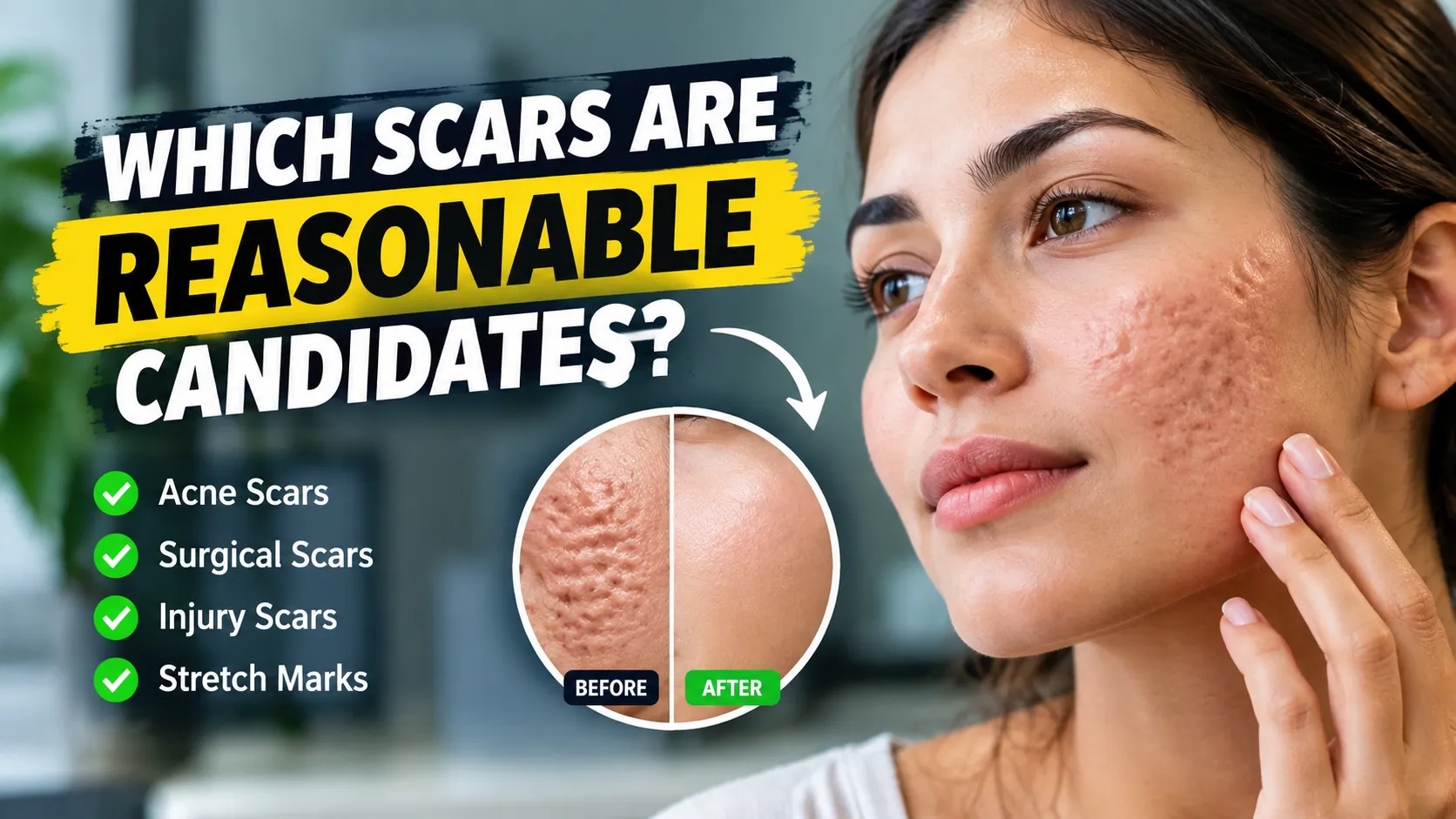
Before deciding whether a percussion massager can break up scar tissue for your situation, it helps to know which scar types are more or less suited to this kind of tool.
Swipe left/right to see the full table →
| Scar Type | General Fit |
|---|---|
| Fresh surgical incision (under 6 weeks) | Avoid; too early for percussion |
| Fully closed, flat mature scar | May be reasonable at low intensity |
| Raised, hypertrophic scar | Use caution; ask a professional first |
| Diagnosed keloid | Avoid without clinician guidance |
| Tight, adhered scar limiting movement | May support comfort around the area with care |
Safety Decision Path
① Is the scar fully closed with no scabbing? — If no, wait.
② Any redness, warmth, swelling, or drainage? — If yes, skip and check with a professional.
③ Diagnosed keloid or still-raised hypertrophic scar? — If yes, get guidance first.
④ Scar mature, flat, and comfortable to touch? — If yes, low-intensity, brief sessions are a reasonable starting point.
Use this as a general starting checklist, not a substitute for individual medical advice.
Safe Timing and Frequency

Whether a percussion massager can break up scar tissue safely often comes down to timing more than the tool itself.
Swipe left/right to see the full table →
| Healing Stage | Suggested Approach |
|---|---|
| 0–3 weeks post-closure | Avoid percussion entirely |
| 3–6 weeks | Gentle manual massage by hand, if any |
| 6–8+ weeks, fully mature | Low-intensity percussion, 30–60 seconds |
| Ongoing maintenance | A few short sessions weekly, as comfortable |
Common Mistakes to Avoid
Swipe left/right to see the full table →
| Mistake | Better Choice |
|---|---|
| Starting on the highest setting | Begin on the lowest setting for a few seconds |
| Using it while the wound is still healing | Wait until fully closed and comfortable to touch |
| Pressing directly on a raised or tender area | Work around the edges first, lightly |
| Ignoring pain or increased redness | Stop immediately and reassess |
Do’s and Don’ts at a Glance
Do
Wait until the scar is fully closed
Use the lowest intensity first
Keep sessions short (30–60 seconds)
Don’t
Use on open, healing, or infected skin
Push through pain or discomfort
Use on an undiagnosed keloid without guidance
Safe vs. Risky Routine
Swipe left/right to see the full table →
| Factor | Safer Routine | Riskier Routine |
|---|---|---|
| Timing | After full closure, 6+ weeks | Days after surgery or injury |
| Intensity | Lowest setting, brief use | High intensity, extended time |
| Skin check | Checked for redness/pain before and after | No monitoring, used regardless of symptoms |
Red-Flag Checklist
▲ Increasing redness or warmth around the scar
▲ Drainage, pus, or an open area
▲ Sharp or worsening pain during use
▲ Fever or feeling unwell
Any of these mean it’s time to stop and check in with a professional, not push through.
Compact Percussion Massager with Low-Intensity Settings
A smaller head and adjustable low speeds can make it easier to keep sessions gentle around a mature, fully healed scar.
Silicone Scar Sheets
May support daily scar-care consistency alongside a gentle routine, without adding mechanical pressure.
Frequently Asked Questions
Can a percussion massager break up scar tissue permanently?
No — it doesn’t have a mechanism to permanently dissolve or restructure scar tissue. Any effect is more about comfort and circulation.
How soon after surgery can I use one near a scar?
Most people wait until the incision is fully closed, typically 6 weeks or more, and only after a professional confirms it’s healed enough.
Is it safe to use on a keloid scar?
Not without checking with a professional first. Keloids can be sensitive to added pressure or friction.
Should it hurt when used on a scar?
No. Mild pressure sensation is possible, but sharp pain means the setting is too high or the area isn’t ready yet.
Can I use it on a C-section scar?
Only after your provider confirms the incision has fully healed, and starting with the gentlest setting available.
What settings work best for scar tissue?
The lowest intensity level, used briefly, is the generally recommended starting point around scars.
Is manual massage better than a percussion massager for scars?
Manual massage offers more control over pressure, which some people prefer on sensitive or newly matured scars.
So, can a percussion massager break up scar tissue the way ads suggest? Not in the literal sense — but on a fully healed, mature scar, gentle and brief use may support comfort and a looser feel around the area. Start low, stay patient, and skip it entirely on fresh, irritated, or diagnosed keloid scars. If anything feels off — more pain, redness, swelling, or symptoms that don’t improve — check in with a healthcare professional rather than continuing on your own.
Author
-

I’m Alex Turner, a massage product reviewer and wellness writer at RemedyTip. I specialize in researching, evaluating, and comparing massage and recovery products to help readers make informed purchasing decisions. My focus is on practical, evidence-informed product guidance covering muscle recovery, relaxation, everyday comfort, and wellness.
I take a research-driven approach to every product I review. I examine product specifications, features, materials, performance claims, user feedback, durability, comfort, ease of use, and overall value. When appropriate, I also consult trusted industry and health-related sources to verify important information and provide readers with a more complete and balanced view.
I cover a wide range of products, including massage guns, handheld massagers, neck and shoulder massagers, foot massagers, massage chairs, foam rollers, and other recovery tools. Rather than focusing only on marketing claims, I look at how products compare in real-world use and who they are actually suitable for. I also consider different budgets, use cases, and user needs when making recommendations.
At RemedyTip, I’m committed to accuracy, transparency, and unbiased product information. I clearly distinguish between manufacturer claims, available evidence, and my own product analysis so readers can understand the basis of each recommendation. I continuously research new products, technologies, and developments in the massage and recovery space to keep my content current and useful.
My goal is simple: to provide trustworthy, easy-to-understand information that helps readers choose massage and recovery products with greater confidence.

