
Written by Alex Turner
Quick Answer: What size foam roller do I need?
For most beginners, an 18- to 24-inch roller with a 5- to 6-inch diameter is a practical starting point. Choose 36 inches for greater stability and full-back work, or 12 to 18 inches when portability and targeted areas matter most.
The right roller is less about your body size and more about how you plan to use it.
Length determines how much of your body the roller can support at once. Diameter changes the height, stability, and feel of the pressure. Firmness and surface texture then fine-tune how intense the session feels.
Safety note
This article is for general educational information only. It does not diagnose, treat, cure, or prevent any condition. It does not replace advice from a licensed healthcare professional. Readers should seek professional help for severe, worsening, unusual, or persistent symptoms.
Start With Length: The Most Important Size Decision
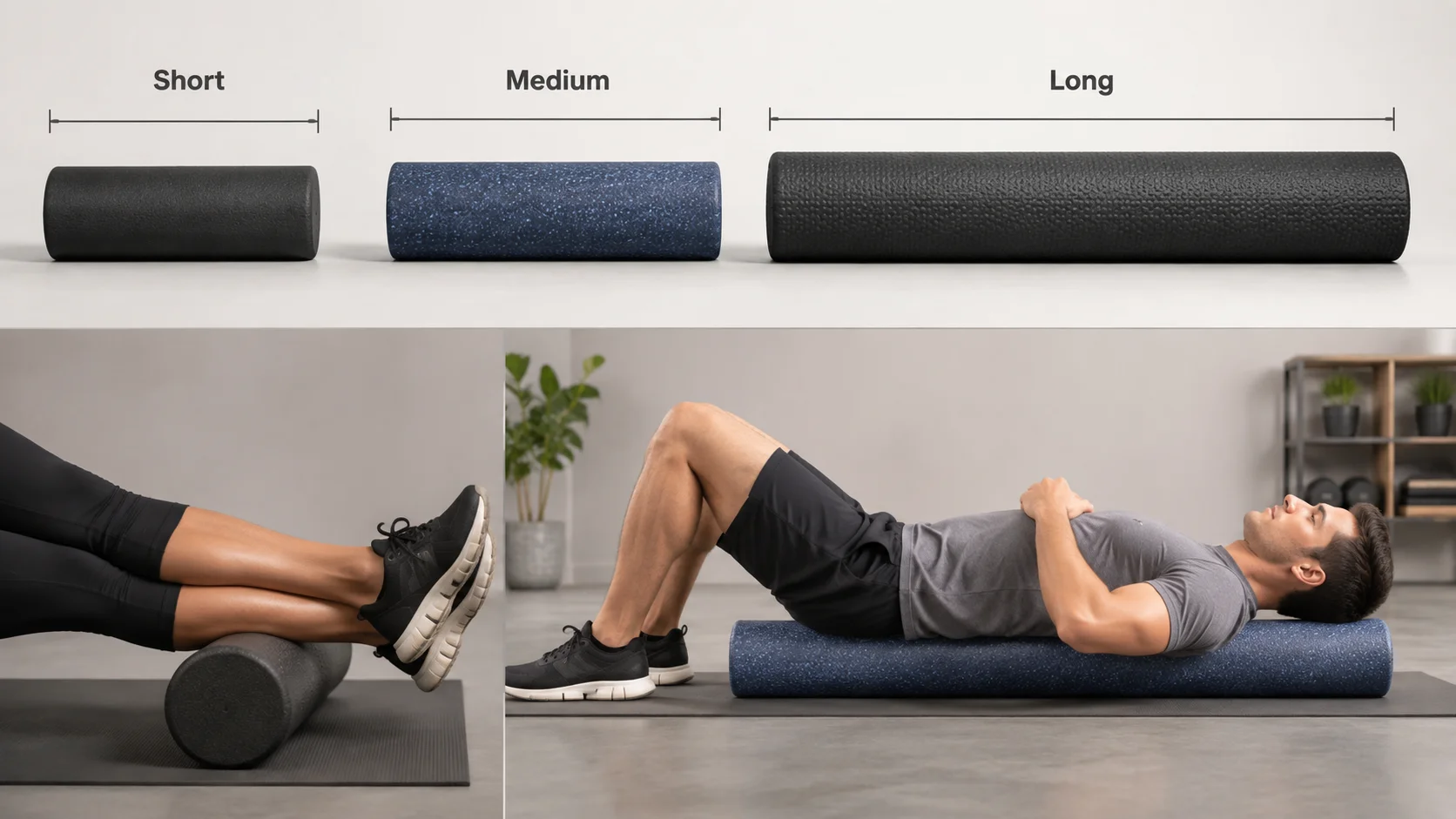
When choosing a foam roller, length is usually the easiest place to start. A longer roller gives you more surface to work with and generally feels more stable during exercises involving your back, thighs, or both legs. A shorter roller takes up less room and is easier to carry.
REI describes rollers around 36 inches as versatile and useful for full-back work, while shorter options around 24 inches can be useful for smaller areas such as the arms and calves. Very short rollers, roughly 4 to 12 inches, prioritize portability and targeted work.
Foam roller length guide
Swipe left/right to see the full table →
| Length | Best fit | Main trade-off |
|---|---|---|
| 36 in | Full back, legs, home use | Bulky to carry |
| 24 in | General use, legs, glutes | Less back coverage |
| 12–18 in | Calves, arms, travel | Less stable for large areas |
| 4–12 in | Maximum portability | Limited coverage |
The practical rule is simple: choose the longest roller you can comfortably store and carry if you want one general-purpose option. If you already know you will mostly work on calves or travel with it, going shorter can be more convenient.
Practical size ladder
4–12 in
Targeted
12–18 in
Portable
24 in
Versatile
36 in
Full-body stability
This is a practical guide rather than a scientific scale. Longer does not automatically mean better; it simply gives you more support and coverage.
Does Diameter Matter?
Yes. Diameter changes how high your body sits above the floor and can affect how pressure feels. Most conventional foam rollers are about 5 or 6 inches in diameter. Smaller diameters can provide a lower position and more targeted feel, while standard diameters offer a familiar balance of height and control.
Diameter and practical pressure
Swipe left/right to see the full table →
| Diameter | General feel | Choose it if |
|---|---|---|
| 3–4 in | Lower, targeted | You want more precision |
| 5–6 in | Standard, balanced | You want one general roller |
Note
Do not assume a smaller diameter is automatically better. If a slimmer roller feels too intense or awkward to control, a standard 5- to 6-inch model may be easier to use consistently.
Match the Roller to What You Actually Want to Roll
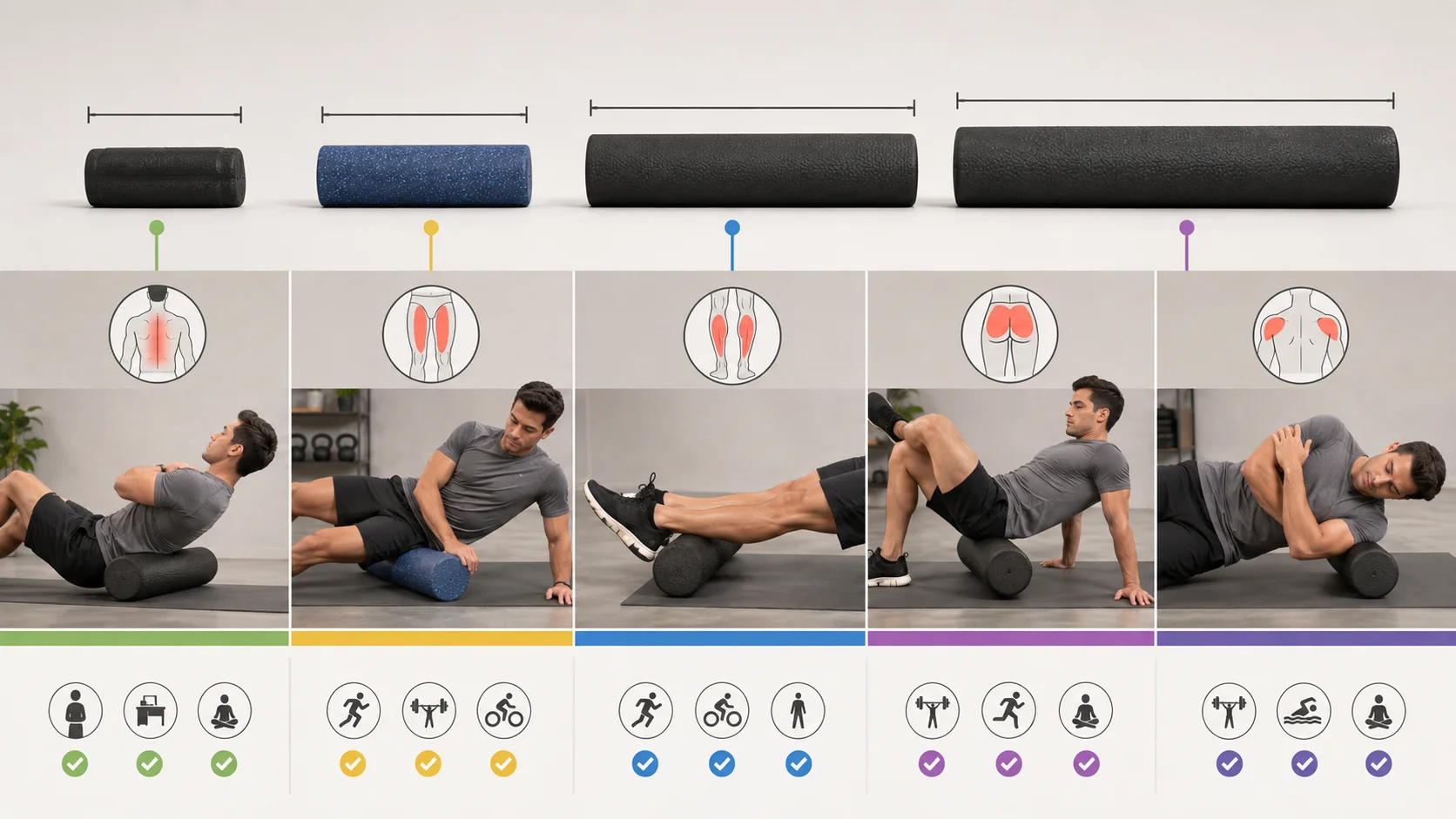
The best size depends heavily on your main target area. A roller used mostly for quads and hamstrings does not need the same portability as one that lives in a gym bag. A roller intended for back work also benefits from extra length and stability.
Which size fits your goal?
Swipe left/right to see the full table →
| Main use | Good starting size | Why |
|---|---|---|
| Full back | 24–36 in | More support and coverage |
| Quads / hamstrings | 18–24 in | Good balance of support and storage |
| Calves / arms | 12–18 in | Easy to position and carry |
| Travel | 12–18 in | Prioritizes portability |
Product-fit dashboard
Prioritize 24–36 inches and standard diameter.
18–24 inches is usually enough.
Choose a compact 12–18-inch model.
Consider a smaller diameter or specialized tool.
The dashboard is a practical selection guide, not a rule based on body height or weight. If two options fit your needs, the one you will actually use regularly is usually the more sensible choice.
Firmness and Texture Matter After Size
Size is only half the buying decision. Foam rollers also vary in density and surface texture. REI notes that softer rollers can be friendlier for beginners, while denser rollers can provide more intense pressure and may be more durable. Smooth surfaces generally provide more even pressure, whereas ridges and knobs can make pressure more targeted.
Firmness and texture fit
Swipe left/right to see the full table →
| Feature | Good starting choice | Consider changing when |
|---|---|---|
| Firmness | Soft to medium | Too little or too much pressure |
| Surface | Smooth | You specifically want targeted pressure |
| Density | Moderate | The roller deforms excessively |
Tip
If possible, test firmness before buying. A roller that feels manageable encourages controlled movement, while one that feels excessively painful may make you rush, tense up, or avoid using it.
Typical routine priority — practical guide
These percentages are not measurements or scientific scores. They simply illustrate a useful buying priority: start with the areas you need to roll, then refine comfort and portability.
Common Foam Roller Buying Mistakes
A common mistake is buying the largest or hardest roller because it appears more versatile. Bigger is not automatically more useful, and harder is not automatically more effective for every person. The better choice is the one that matches your intended body areas and allows controlled use.
Mistake versus better choice
Swipe left/right to see the full table →
| Common mistake | Better choice |
|---|---|
| Buying the longest roller automatically | Choose length based on target areas and storage |
| Choosing the hardest foam | Start with manageable firmness |
| Ignoring diameter | Compare height, stability, and pressure feel |
| Buying for every possible use | Prioritize your two or three most common uses |
Five-question buying path
Back and large muscles favor longer rollers; small areas can use shorter ones.
Home use allows more length; frequent travel favors compact designs.
Use 5–6 inches as the general starting range unless you have a specific reason to go smaller.
Choose a pressure level you can control without excessive discomfort.
The most useful roller is the one that fits your space, routine, and comfort.
A Simple First-Time Choice
If you are completely unsure what to buy, a 24-inch roller with a 5- to 6-inch diameter is a reasonable middle-ground option. It is shorter than a full 36-inch roller but still long enough for many common leg and general rolling routines.
Choose 36 inches instead if you expect to roll your back frequently and have enough storage space. Choose 12 to 18 inches if your priorities are travel, calves, arms, or compact storage. REI and UCLA Health both describe longer rollers as more stable and versatile, while shorter rollers favor targeted work and portability.
Do’s and don’ts
DO
Match length to your main target areas, choose manageable firmness, and prioritize controlled movement.
DON’T
Assume the hardest or smallest roller is automatically better, or continue through sharp or unusual pain.
When Size Is Not the Problem
Sometimes changing the roller will not solve the issue. If a session consistently produces sharp pain, significant bruising, numbness, weakness, or symptoms that keep getting worse, stop and consider professional guidance rather than simply buying a firmer or smaller roller.
Foam rolling is generally considered safe when used appropriately, but Cleveland Clinic advises caution around injured muscle or broken bone and recommends avoiding direct pressure on joints such as the knees, ankles, and elbows.
When to self-care vs. when to seek help
Swipe left/right to see the full table →
| Situation | Reasonable next step | Decision |
|---|---|---|
| Mild routine discomfort | Reduce pressure and slow down | Self-care may be reasonable |
| Sharp or unusual pain | Stop the session | Consider professional advice |
| Numbness or weakness | Stop and do not press harder | Seek professional evaluation |
| Recent significant injury | Avoid experimenting with pressure | Ask a healthcare professional |
General risk-level guide
Lower concern
Comfortable pressure, controlled movement, no unusual symptoms.
Use caution
Persistent soreness, excessive pressure, or uncertainty about technique.
Seek help
Severe pain, numbness, weakness, injury, or worsening symptoms.
This is a general practical guide, not a diagnosis tool. If symptoms are severe, worsening, unusual, or persistent, changing roller size should not replace professional evaluation.
Warning
Do not use a larger, harder, or more textured roller simply to push through discomfort. More pressure is not automatically better, and foam rollers should not be used directly over painful joints or areas affected by a significant injury.
What Size Foam Roller Do I Need? A Quick Decision
If you want the shortest possible answer, start with the job rather than the number printed on the package. For a first general-purpose roller, 18 to 24 inches and 5 to 6 inches in diameter is a practical middle ground. For frequent back work and maximum stability, move toward 36 inches. For travel or small areas, move toward 12 to 18 inches.
Then choose firmness based on comfort and control. A smooth, moderate-density roller is often the simplest starting point because it does not add extra texture to the learning curve. Once you know what works for you, you can decide whether a different diameter, density, or textured surface makes sense.
For additional general guidance, Cleveland Clinic discusses foam-rolling safety and REI provides a detailed overview of roller sizes, density, and texture. [Cleveland Clinic foam-rolling guidance](https://health.clevelandclinic.org/foam-rolling?slug=foam-rolling%2F&utm_source=chatgpt.com) [REI foam-roller sizing guide](https://www.rei.com/learn/expert-advice/foam-rollers.html?msockid=078a62fef18c642d2169743cf0066541&utm_source=chatgpt.com)
Frequently Asked Questions
What size foam roller is best for beginners?
An 18- to 24-inch roller with a 5- to 6-inch diameter is a practical starting point for many beginners. Choose a softer or moderate firmness if you are still learning how much pressure feels comfortable.
Is a 36-inch foam roller better?
Not automatically. A 36-inch roller offers more coverage and stability, especially for back work, but it is less portable and takes more storage space.
What diameter should a foam roller be?
Most standard rollers are around 5 to 6 inches in diameter. Smaller diameters can offer a lower, more targeted feel, while standard diameters are versatile for general use.
What size foam roller is best for travel?
A 12- to 18-inch roller is easier to pack and carry than a full-length model. The trade-off is less stability and coverage for larger body areas.
Is a smaller foam roller more intense?
A smaller diameter can create a more targeted pressure feel, but intensity also depends on firmness, body position, and how much weight you place on the roller.
Should I choose a hard or soft foam roller?
A softer or moderate roller can be easier for beginners, while denser rollers can provide a firmer feel. Choose a level you can control without excessive or sharp discomfort.
When should I avoid using a foam roller?
Avoid rolling over significant injuries or directly over painful joints, and stop if you develop sharp pain, numbness, weakness, or worsening symptoms. Ask a healthcare professional when symptoms are severe, unusual, or persistent.
Final Thoughts
The right foam roller size depends on what you want to roll, where you will use it, and how portable it needs to be. For most first-time buyers, 18 to 24 inches with a standard 5- to 6-inch diameter is a useful starting point, while 36 inches makes more sense for stability and full-back work. If rolling causes severe, unusual, worsening, or persistent symptoms, stop and seek professional guidance rather than simply changing roller size.
Author
-

I’m Alex Turner, a massage product reviewer and wellness writer at RemedyTip. I specialize in researching, evaluating, and comparing massage and recovery products to help readers make informed purchasing decisions. My focus is on practical, evidence-informed product guidance covering muscle recovery, relaxation, everyday comfort, and wellness.
I take a research-driven approach to every product I review. I examine product specifications, features, materials, performance claims, user feedback, durability, comfort, ease of use, and overall value. When appropriate, I also consult trusted industry and health-related sources to verify important information and provide readers with a more complete and balanced view.
I cover a wide range of products, including massage guns, handheld massagers, neck and shoulder massagers, foot massagers, massage chairs, foam rollers, and other recovery tools. Rather than focusing only on marketing claims, I look at how products compare in real-world use and who they are actually suitable for. I also consider different budgets, use cases, and user needs when making recommendations.
At RemedyTip, I’m committed to accuracy, transparency, and unbiased product information. I clearly distinguish between manufacturer claims, available evidence, and my own product analysis so readers can understand the basis of each recommendation. I continuously research new products, technologies, and developments in the massage and recovery space to keep my content current and useful.
My goal is simple: to provide trustworthy, easy-to-understand information that helps readers choose massage and recovery products with greater confidence.

