
Massage guns can help loosen tight muscles, support recovery after exercise, and reduce the need for hands-on massage. They use a motor and foam or rubber attachment to apply repeated pressure to the body. A quiet model works well for people who share a home, live in an apartment, or want to use one while watching TV.
The best quiet massage guns balance low noise with useful power, comfortable handling, long battery life, and attachments suited to different muscle groups. Buyers should also check the gun’s weight, speed settings, stall force, charging method, and return policy. Very strong pressure is not always better, and people with injuries or certain health conditions should ask a medical professional before use.
I compared quiet massage guns for noise, performance, comfort, and ease of use to identify the models that make recovery more convenient without disturbing the surrounding space.
Best Quiet Massage Guns
I selected the best quiet massage guns based on noise level, comfort, power, and ease of use. My list includes options for recovery, daily muscle care, and relaxing massages at home.
Youdgee Quiet Massage Gun

I recommend this massage gun if you want strong muscle relief without much noise and prefer plenty of speed and head options.
Pros
- Runs quietly enough for TV or casual conversation
- Offers 30 speeds and six interchangeable heads
- Comfortable grip and useful battery life
Cons
- The battery indicator may act oddly under heavy pressure
- The strongest settings can feel intense
- The plastic body may not feel as premium as metal models
I found the Youdgee easy to control during use. The handle felt balanced, and my hand did not tire quickly while I worked on my calves, shoulders, and thighs.
The low noise stood out most. It was noticeable, but it did not overpower the TV or disturb someone nearby. The 30 speed levels also made it easy to start gently and increase pressure as my muscles relaxed.
Each head changed with little effort, which helped me switch between larger muscle areas and smaller tight spots. The motor stayed powerful during normal use, though pressing very hard may cause the battery display to flash or show an inaccurate level.
The compact design makes this a practical choice for home use, travel, or post-workout recovery. I would avoid using it directly on the spine or other sensitive areas, and I would follow medical advice for ongoing pain or injuries.
arboleaf Mini Massage Gun

I recommend this massage gun if you want quiet, portable relief with enough power for tight muscles.
Pros
- Quiet enough for use at home or in an office
- Lightweight metal body feels sturdy and easy to hold
- Four washable silicone heads suit different muscle areas
Cons
- The small size may feel less comfortable during long sessions
- Strong settings can feel intense on sensitive muscles
- Charging takes several hours
I noticed the low noise first. It produces a soft hum instead of the harsh buzz common with larger massage guns, so I could use it while watching television or talking without raising my voice.
Despite its compact size, the arboleaf delivers firm pressure. I used the broader head on my legs and the smaller head around my shoulders. The pressure-responsive setting increased the intensity when I pressed harder, while the manual speeds gave me better control for lighter areas.
The light design made it easy to carry in a gym bag or suitcase. I also liked the silicone heads because they felt comfortable against my skin and cleaned up quickly. The automatic shutoff helped keep each session short, although I sometimes wanted more time before restarting it.
The handle remained manageable during use, but reaching my back still required some effort. Overall, this is a practical choice for people who want a quiet massage gun that balances portability, control, and useful power.
Mebak 3 Massage Gun
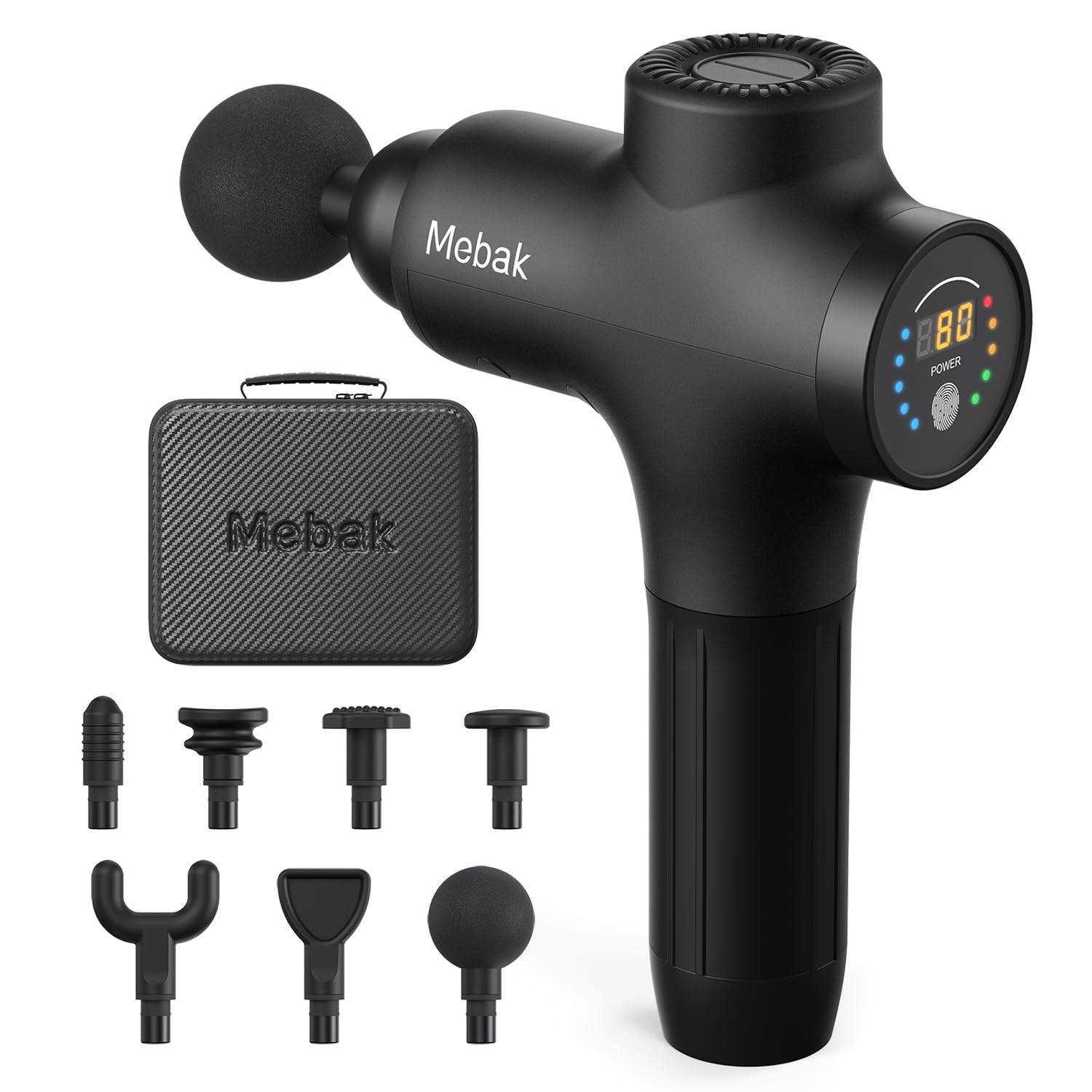
I recommend the Mebak 3 if you want a quiet, versatile massage gun with strong pressure and useful controls.
Pros
- Quiet enough for home, office, or gym use
- Seven heads and five speed settings
- Pressure lights make it easier to control intensity
Cons
- Charging adapter is not included
- The larger case adds bulk for travel
- Some users report battery problems over time
The Mebak 3 felt sturdy in my hand without becoming tiring during longer sessions. I used the lower settings around my neck and shoulders, then increased the speed for my legs after exercise. Its pressure lights helped me avoid pressing too hard.
Noise stayed low enough that I could use it while watching television or talking with someone nearby. The motor still delivers firm pressure, but I found the strongest setting too intense for smaller or more sensitive areas.
I liked having seven attachments for different muscle groups. The carrying case keeps everything organized, although it takes up more room than the gun itself. The battery worked well during regular use, but I would plan ahead because the package includes a charging cable rather than a wall adapter.
The Mebak 3 offers a good balance of quiet operation, power, and adjustment. I would choose it for general muscle soreness, but I would not use it directly on bones, joints, or injured areas.
Theragun Relief Massage Gun

I recommend the Theragun Relief if you want a quiet, gentle massage gun that feels simple to use and easy to control.
Pros
- Quiet motor suits use while watching TV or working.
- Comfortable grip makes it easier to reach my back and shoulders.
- Three attachments cover tender muscles, general tension, and trigger points.
Cons
- The gentler action may not satisfy users seeking strong deep-tissue pressure.
- Its larger body feels less portable than compact massage guns.
- A few users reported plastic noises or limited effectiveness.
I found the Relief comfortable to hold, especially when working on my shoulders and legs. Its triangle-shaped grip gave me several ways to hold it, so I did not need to twist my wrist as much.
The three speed settings kept the massage easy to adjust. I used the softer setting on sensitive areas and increased the speed for larger muscle groups. The Dampener attachment felt best on tender spots, while the Thumb attachment worked well around the lower back.
Noise stayed low during use, which made the gun less distracting than many models I have tried. The battery also held up well during repeated sessions, and switching attachments took little effort.
This model focuses on mild daily relief rather than intense treatment. I would choose it for routine muscle tightness, desk-related stiffness, and post-workout soreness, but users who want forceful pressure may prefer a stronger Theragun model.
AERLANG Heated Massage Gun

I recommend this massage gun if you want quiet percussion, adjustable pressure, and a useful heat option in one compact device.
Pros
- Heat adds comfort for tight muscles
- Twenty speed levels provide precise control
- Multiple heads and a carrying case improve versatility
Cons
- The body feels somewhat heavy during longer sessions
- Some users report charging or power issues
- It may stop early if it gets too warm
I found the AERLANG easy to control during use. The LCD screen showed the pressure level clearly, while the broad speed range let me start gently and increase the intensity as needed. Its motor stayed quiet enough for use near other people.
The heated head made the biggest difference for my shoulders and lower back. I liked being able to turn heat on separately and choose among three temperature levels. The warmth felt soothing, but I would still start low and avoid holding it in one spot for too long.
The included heads worked well for different areas, from broad muscles to smaller tight spots. At about 2.2 pounds, it was portable but not especially light. The case helped keep everything organized for travel.
Most buyers rate it positively, though some report charging failures, early shutoffs, or concerns about the charging connection. I would charge the main unit and heated head fully before the first use and follow the care instructions.
Buying Guide
I look for a massage gun that balances low noise, useful power, and easy handling. A quiet motor matters most if I plan to use the device while watching television, working, or sharing a room.
| Feature | What I check |
|---|---|
| Noise level | A clear decibel rating or independent test results |
| Speed settings | Several speeds for gentle and deeper massage |
| Stall force | Enough resistance before the motor stops |
| Battery | Runtime that fits my usual sessions |
| Weight | Light enough for comfortable one-handed use |
| Attachments | Heads suited to large and small muscle groups |
| Controls | Simple buttons and easy-to-read settings |
I check the product’s noise rating carefully because testing methods can differ. Reviews that describe sound at low and high speeds help me judge how the gun may perform in daily use.
I also consider amplitude, which shows how far the attachment moves into the muscle. A longer range may feel more intense, while a shorter range can suit gentle use. I choose settings that match my comfort level rather than selecting the strongest model.
A comfortable grip and balanced shape make a difference during longer sessions. I prefer a device with clear controls, a secure case, and attachments that are easy to clean.
I review the warranty, return policy, charging method, and safety instructions before buying. I avoid models that make unclear claims about medical treatment or provide limited product information.
FAQs
What makes a massage gun quiet?
I look for a low noise rating, a brushless motor, and several speed settings. A soft attachment can also reduce tapping sounds during use.
How quiet should a massage gun be?
I prefer models that stay below about 55 decibels at low or medium speeds. They may still make more noise at the highest setting, so I check reviews that test sound during use.
Can I use a quiet massage gun at night?
Yes. I use the lowest setting and avoid hard surfaces that can increase vibration. I also keep the device away from shared walls or sleeping areas.
Does a quiet motor reduce power?
Not always. Many quiet models provide enough force for normal muscle relief, but I check the stall force and speed range before buying.
Which attachment should I use?
I start with the standard ball attachment for large muscles. I use softer attachments on sensitive areas and avoid bones, joints, the front of my neck, and open wounds.
How long should I use a massage gun?
I usually spend one to two minutes on each muscle group. I keep the device moving and stop if I feel sharp pain, numbness, or unusual discomfort.
Can everyone use a massage gun?
I ask a health professional before using one if I have an injury, circulation problem, nerve condition, or a medical device. I also avoid using it on areas with swelling or unexplained pain.
Conclusion
I look for a massage gun that fits easily into my daily routine. A quiet motor lets me use it while watching TV, working, or sharing a room without creating much noise.
I also check the comfort, battery life, speed settings, and attachments. A lighter model may suit me better for travel, while a stronger device may work well after exercise. The best choice depends on how I plan to use it.
Before buying, I read noise ratings and user reviews, then compare the warranty and return policy. I use the lowest comfortable setting first and avoid placing the device directly on bones, joints, or injured areas.

