By Alex Turner
If you have ever searched “are infrared massagers good,” you have probably seen big claims on one side and outright dismissal on the other. The real picture sits in between. An infrared massager combines gentle heat with vibration or pressure, and for many people that combination can make a tight back, sore shoulders, or stiff legs feel more comfortable during a daily routine. This guide breaks down what the research-informed basics actually say, where the marketing oversells, and how to use one safely.
Common Myths About Infrared Massagers
Before deciding if an infrared massager is worth adding to a routine, it helps to separate what the heat and vibration can realistically do from what marketing copy sometimes implies. Here is a side-by-side look.
Swipe left/right to see the full table →
| Common Myth | Closer-to-Reality |
|---|---|
| It “melts away” chronic pain permanently | May offer short-term comfort during and shortly after use, not a lasting fix on its own |
| Infrared heat reaches deep into organs | Warms surface muscle and tissue; it is comfort-focused, not a medical treatment |
| More minutes always means better results | Short, consistent sessions are typically the more comfortable, safer pattern |
| Any infrared massager is safe for anyone, anywhere on the body | Certain areas and conditions call for caution or a professional check first |
Myth 1: It replaces stretching and movement
An infrared massager can make muscles feel looser right before you stretch, but the heat itself is not a substitute for movement. In a daily routine, I usually notice the most comfort when heat is paired with a short stretch afterward rather than used alone on the couch.
Myth 2: Stronger vibration always equals better relief
Higher intensity is not automatically more effective. Some people notice more comfort from a lower, steadier setting, especially over sensitive areas like the neck or lower back. Starting low and adjusting based on comfort is a more realistic approach than maxing out the setting.
Myth 3: Heat and vibration are interchangeable with ice
Heat-based tools, including most infrared massagers, generally suit stiffness and tension. Cold is usually preferred for fresh swelling or acute injury. Mixing these up can make discomfort feel worse rather than better.
Evidence-based reality dashboard: what an infrared massager may realistically offer
Short-term muscle comfort
Support for a wind-down routine
Pairing well with light stretching
Fixing the root cause of chronic pain
Practical guide only, not clinical data: an infrared massager tends to score well as a comfort tool and poorly as a stand-alone treatment for the underlying cause of pain.
Who Tends to Find an Infrared Massager Helpful
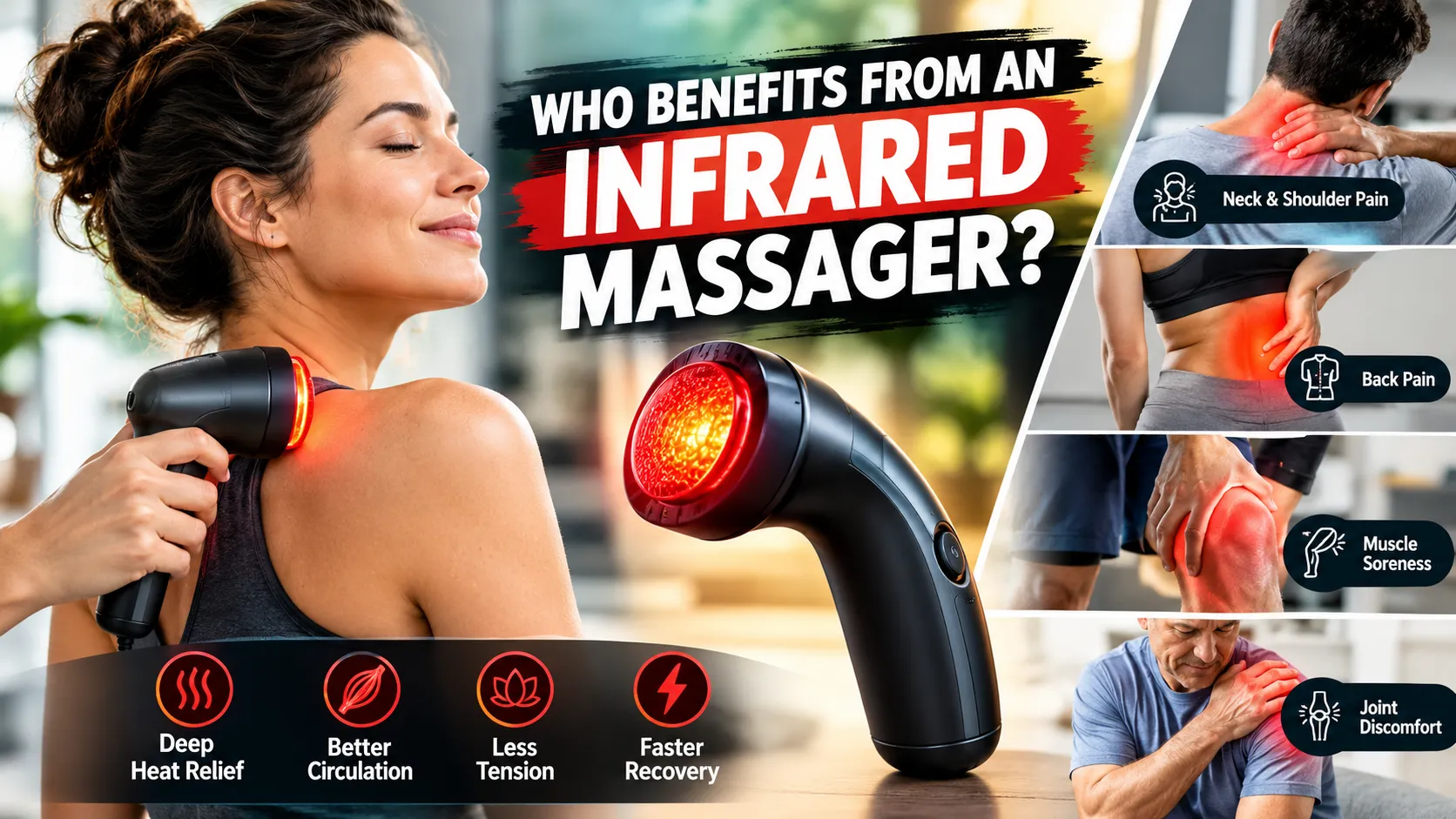
Fit really does vary by lifestyle and body. The grid below covers the groups who most often report that an infrared massager earns a place in their routine.
Desk workers
Long sitting can leave the neck and shoulders tight by evening. A short session on those areas may ease that end-of-day stiffness before a stretch routine.
Casual exercisers
Some people notice an infrared massager feels good on tired legs or a stiff lower back after a workout, used alongside normal rest and hydration.
People with occasional tension
Stress-related muscle tightness in the shoulders or upper back can sometimes feel more manageable with brief, regular heat and vibration sessions.
Anyone easing into a wind-down routine
A brief session before bed can support a calmer transition, similar to other relaxation habits, without acting as a sleep aid on its own.
Matching the tool to the area
Not every infrared massager style suits every body part. A handheld gun-style device fits large muscle groups like calves or the upper back, while a smaller pad or wrap is often more comfortable for the neck or a specific joint.
Swipe left/right to see the full table →
| Device Type | Best-Fit Area | Good For |
|---|---|---|
| Handheld gun-style | Calves, thighs, upper back | Post-activity comfort |
| Heated neck wrap | Neck, upper shoulders | Desk-day tension |
| Cushion or pad style | Lower back, seated use | Long sitting stretches |
| Compact travel massager | Feet, hands, small areas | On-the-go relief |
Using an Infrared Massager Safely
Getting comfort out of an infrared massager comes down to how it is used, not just whether you own one. The table below compares a safer pattern with common risky habits.
Swipe left/right to see the full table →
| Safer Routine | Riskier Habit |
|---|---|
| 10-15 minute sessions, 1-2 times daily | Leaving it on one spot for 30+ minutes |
| Starting on the lowest heat and intensity | Jumping straight to the highest setting |
| Keeping a thin layer of clothing between skin and device | Using directly on broken or irritated skin |
| Avoiding the front of the neck and spine directly | Applying firm pressure straight over the spine |
Safety decision path
Mild, everyday muscle tightness, no swelling or injury → a short infrared massager session may be a reasonable comfort option.
Pain after a recent injury, swelling, or bruising → skip heat for now; cold and rest are usually more appropriate.
Numbness, tingling, or pain that radiates down an arm or leg → pause use and check in with a healthcare professional.
Pregnancy, a pacemaker, a blood clot history, or diabetes-related nerve changes → talk with a professional before using any heat or vibration device.
A general practical guide only — always defer to your own healthcare provider’s specific guidance.
Common mistakes vs better choices
Swipe left/right to see the full table →
| Mistake | Better Choice |
|---|---|
| Using it as the only pain strategy | Combine with posture breaks, stretching, and rest |
| Falling asleep with it running | Set a timer and turn it off before dozing |
| Ignoring worsening pain during use | Stop immediately if discomfort increases |
| Skipping the manufacturer’s manual | Check heat limits and area-specific guidance first |
Do’s and don’ts at a glance
Do
Start low, keep sessions short, and stop if skin turns very red or uncomfortable.
Don’t
Don’t use over numb skin, a recent injury, or areas you cannot see clearly.
Red-flag checklist
☐ Pain that spreads or sharpens during use
☐ Skin that blisters, burns, or stays red long after use
☐ Numbness or tingling in the area
☐ Fever alongside the sore area
☐ Pain that has lasted several weeks without improvement
Any checked box is a reason to pause use and speak with a healthcare professional.
Self-Care or Professional Help?

Most people use an infrared massager for everyday tightness, but it helps to know where the line sits between at-home comfort and a visit to a professional.
Swipe left/right to see the full table →
| Self-Care Likely Fine | See a Professional |
|---|---|
| Mild tightness after sitting or light exercise | Sudden, severe, or unexplained pain |
| Comfort dips after a normal workday | Pain with weakness or loss of bladder or bowel control |
| Stress-related shoulder or neck tension | Pain plus fever, swelling, or a recent fall |
Where an infrared massager fits your routine
Everyday tension relief
Post-activity comfort
Substitute for medical evaluation
Practical guide only: think of an infrared massager as one small piece of a comfort routine, not a replacement for care.
For general background on safe heat use and muscle care, resources like MedlinePlus and the Mayo Clinic offer additional, professionally reviewed guidance.
Handheld Infrared Massage Gun
May support post-activity comfort in large muscle groups like calves and the upper back, with adjustable low-to-high settings.
Infrared Heated Neck and Shoulder Wrap
Can help make a daily wind-down routine feel more comfortable after long hours at a desk, with gentle adjustable warmth.
Frequently Asked Questions
Are infrared massagers actually good for pain relief?
They can offer short-term comfort for everyday muscle tightness when used alongside stretching and rest, but they are not a cure for the underlying cause of pain.
How long should I use an infrared massager each day?
Many people find 10 to 15 minute sessions, once or twice a day, comfortable and manageable — longer isn’t automatically better.
Can an infrared massager be used every day?
Daily short sessions are common for general tension, but it’s best to give the skin breaks and stop if any irritation appears.
Is an infrared massager safe during pregnancy?
Heat and vibration devices are generally not recommended without checking with a healthcare provider first during pregnancy.
Does an infrared massager help with chronic back pain?
It may ease day-to-day tightness, but chronic or worsening back pain should be evaluated by a professional rather than managed with heat alone.
What’s the difference between infrared heat and a regular heating pad?
Both provide surface warmth for comfort; an infrared massager typically adds vibration or percussion on top of that heat.
Who should avoid using an infrared massager?
People with a pacemaker, active blood clots, diabetes-related nerve loss, or reduced skin sensation should talk with a professional before use.
So, are infrared massagers good? For everyday tightness and a comfort-focused wind-down routine, many people find real value in one — as long as expectations stay realistic. Use short sessions, start on low settings, and pair the heat with movement rather than relying on it alone. If pain is severe, spreading, or not improving after a few weeks, that’s a sign to check in with a healthcare professional rather than reaching for the highest setting.
Author
-

I’m Alex Turner, a massage product reviewer and wellness writer at RemedyTip. I specialize in researching, evaluating, and comparing massage and recovery products to help readers make informed purchasing decisions. My focus is on practical, evidence-informed product guidance covering muscle recovery, relaxation, everyday comfort, and wellness.
I take a research-driven approach to every product I review. I examine product specifications, features, materials, performance claims, user feedback, durability, comfort, ease of use, and overall value. When appropriate, I also consult trusted industry and health-related sources to verify important information and provide readers with a more complete and balanced view.
I cover a wide range of products, including massage guns, handheld massagers, neck and shoulder massagers, foot massagers, massage chairs, foam rollers, and other recovery tools. Rather than focusing only on marketing claims, I look at how products compare in real-world use and who they are actually suitable for. I also consider different budgets, use cases, and user needs when making recommendations.
At RemedyTip, I’m committed to accuracy, transparency, and unbiased product information. I clearly distinguish between manufacturer claims, available evidence, and my own product analysis so readers can understand the basis of each recommendation. I continuously research new products, technologies, and developments in the massage and recovery space to keep my content current and useful.
My goal is simple: to provide trustworthy, easy-to-understand information that helps readers choose massage and recovery products with greater confidence.