By Alex Turner
Quick Answer: Massage cream usually combines a moisturizing base with ingredients that improve glide, texture, fragrance, or skin feel. Some formulas also contain menthol, camphor, botanical extracts, or other active ingredients. The exact formula varies, so the ingredient list and Drug Facts label matter.
Massage cream is more than just a slippery lotion.
It is usually designed to give the hands enough glide for massage while leaving the skin feeling conditioned rather than excessively oily. Depending on the product, the formula may also include ingredients intended to create a cooling or warming sensation.
If you are wondering what is in massage cream, the most useful answer is to separate the formula into its base, texture-support ingredients, fragrance or botanical ingredients, and any listed active ingredients.
Safety note: This article is for general educational information only. It does not diagnose, treat, cure, or prevent any condition. It does not replace advice from a licensed healthcare professional. Readers should seek professional help for severe, worsening, unusual, or persistent symptoms.
What Is Usually in Massage Cream?
There is no single standard recipe. A basic massage cream may contain water, oils or other emollients, fatty alcohols, humectants, emulsifiers, thickeners, preservatives, and fragrance. A specialty formula can add plant extracts or ingredients that create a noticeable cooling or warming sensation.
The important distinction is between inactive ingredients that help create the cream and active ingredients that are specifically listed for a topical drug purpose. For example, some over-the-counter pain-relief creams list menthol, camphor, or methyl salicylate as active ingredients, while the rest of the formula supports texture, application, stability, or skin feel. :contentReference[oaicite:1]{index=1}
The main ingredient groups
This simple breakdown makes an ingredient label easier to understand.
Swipe left/right to see the full table →
| Ingredient group | Typical role | What to notice |
|---|---|---|
| Water | Cream base | Common in emulsions |
| Oils and emollients | Glide and softness | Can change greasiness |
| Humectants | Moisture support | Often includes glycerin |
| Botanicals or sensory ingredients | Scent or sensation | Varies widely |
Ingredient map — practical guide
The map shows why two creams can feel completely different even though both are called massage creams. One may be rich and slow-moving, while another may absorb faster and leave a lighter finish.
Common Ingredients and What They Do
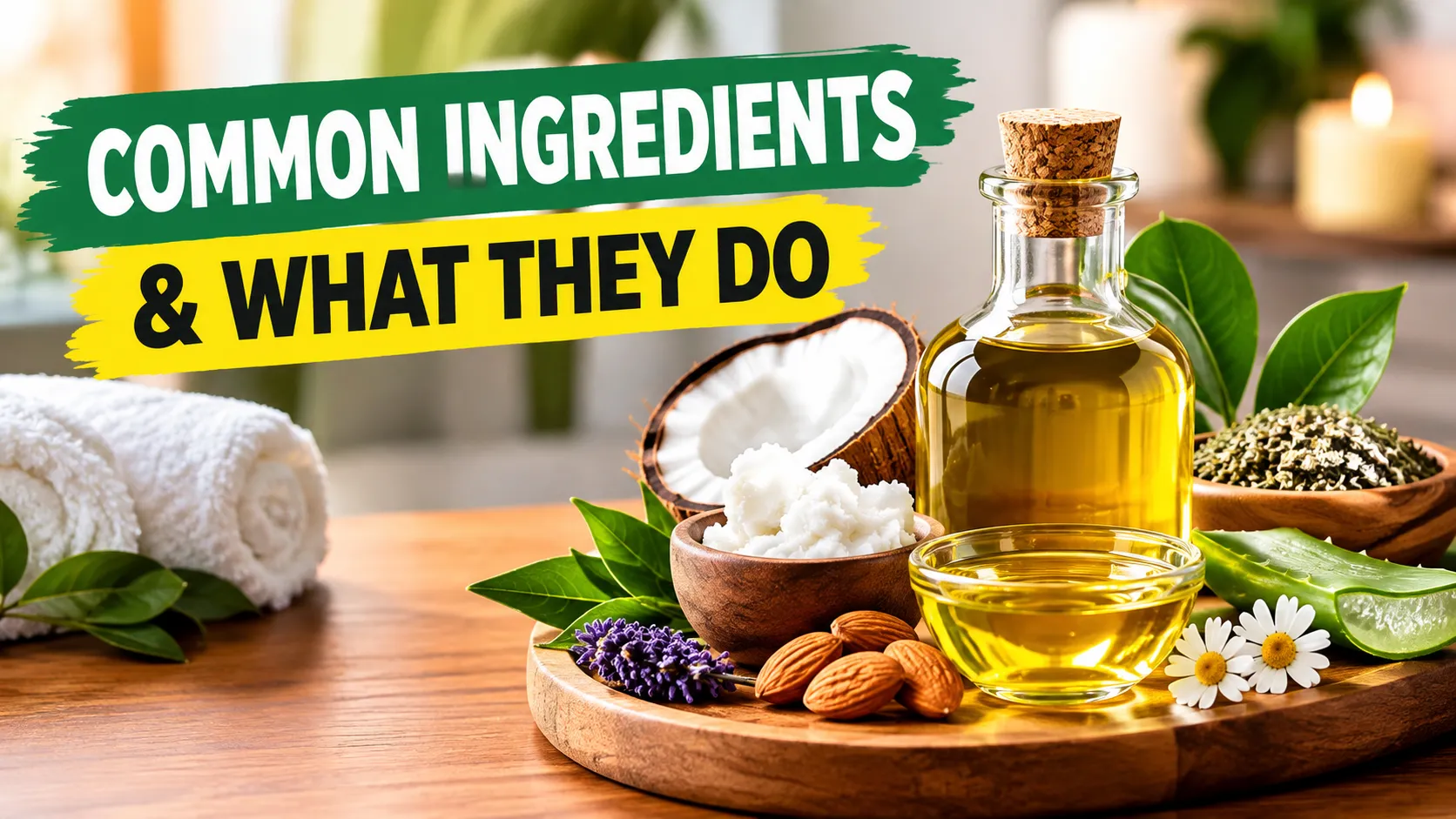
Once you know the ingredient groups, individual names become easier to interpret. The same ingredient can also serve different formulation purposes depending on its concentration and the rest of the recipe.
Moisturizers and emollients
Ingredients such as glycerin can help support skin moisture, while oils, butters, and other emollients can make skin feel softer and help hands move across the surface. Common examples in personal-care formulas include plant oils, mineral oil, shea butter, and fatty ingredients.
These ingredients are mainly about the massage experience. They can improve slip, reduce the need to reapply cream, and help prevent the skin from feeling dry after repeated rubbing.
Menthol and camphor
Some massage and topical pain products contain menthol or camphor. These are not present in every massage cream. When they are listed as active ingredients in an over-the-counter product, the label can identify them as topical analgesic ingredients. :contentReference[oaicite:2]{index=2}
They can also produce a noticeable sensory effect, such as cooling or warming. That sensation should not be confused with proof that an underlying problem has been corrected.
Note: A cream that feels very cool, hot, tingly, or strong is not automatically a better massage cream. Sensory intensity is only one feature, and it may be unsuitable for sensitive or irritated skin.
Botanical extracts
Massage formulas may include ingredients such as arnica, aloe, ginger, willow bark, eucalyptus, or other plant extracts. Their presence does not automatically mean the product has a specific medical benefit. The intended role depends on the product’s labeling and formulation.
For example, one current DailyMed-listed pain cream contains aloe, arnica, ginger, grape seed extract, witch hazel, and several other botanical ingredients alongside its listed active ingredients. :contentReference[oaicite:3]{index=3}
Preservatives, thickeners, and emulsifiers
These less glamorous ingredients are important. Preservatives help protect water-containing formulas from microbial growth, while emulsifiers help keep water and oil components mixed. Thickeners give a cream its body and help determine how it spreads.
Names such as carbomer, phenoxyethanol, propylene glycol, polysorbates, and fatty alcohols may appear on ingredient lists. Seeing a long chemical name does not by itself tell you whether a product is appropriate or inappropriate for your skin.
Ingredient-role comparison
Swipe left/right to see the full table →
| Ingredient | Typical role | Best question to ask |
|---|---|---|
| Glycerin | Humectant | Does the texture suit me? |
| Plant oil | Emollient and glide | Is it too greasy? |
| Menthol | Active or sensory ingredient | What does the Drug Facts label say? |
| Carbomer | Thickener | How does the cream spread? |
How to Read a Massage Cream Label
If you are comparing products, start with the front label only long enough to identify what the product claims to be. Then turn the container over and read the ingredient list and, when present, the Drug Facts panel.
Label-reading flow — practical guide
This sequence helps prevent a common mistake: choosing a product because of a prominent botanical or marketing phrase without checking the actual active ingredients and warnings.
What the label can tell you
Swipe left/right to see the full table →
| Label area | Why it matters | Look for |
|---|---|---|
| Active ingredients | Identifies drug ingredients | Name and strength |
| Inactive ingredients | Shows the rest of formula | Potential sensitivities |
| Warnings | Defines limits | Skin and usage restrictions |
| Directions | Explains application | Amount and frequency |
For an OTC topical pain product, do not assume that every ingredient listed has the same status. Current U.S. labels can distinguish active ingredients such as menthol, camphor, and methyl salicylate from inactive formulation ingredients. :contentReference[oaicite:4]{index=4}
Tip: If you have sensitive skin, compare the full ingredient lists rather than choosing by a product’s scent or the word “natural.” Fragrance, essential oils, botanical extracts, and preservatives can all matter to individual skin tolerance.
Choosing a Formula for Your Massage Routine
The best formula depends on what you want from the session. For a long massage, you may value sustained glide. For quick self-massage, you may prefer a cream that absorbs more readily. If fragrance bothers you, a simpler unscented formula may be easier to evaluate.
Formula-fit dashboard — practical guide
Prioritize comfortable glide and a texture that does not require constant reapplication.
A lighter cream may feel easier when you want less residue afterward.
Keep the ingredient list simple and consider avoiding known personal triggers.
Check whether menthol or another sensory ingredient is included before use.
The dashboard is a practical way to narrow choices without assuming that one ingredient makes a product universally better.
Ingredient choices by routine need
Swipe left/right to see the full table →
| Routine goal | Potentially useful feature | Check first |
|---|---|---|
| More glide | Oils or emollients | Residue level |
| Moisture feel | Humectants | Personal tolerance |
| Cooling feel | Menthol-containing formula | Warnings and sensitivity |
| Simple formula | Shorter ingredient list | Known allergens |
What to Avoid Doing With Massage Cream
Ingredient knowledge is useful only if the product is used according to its label. This is especially important when a massage cream is actually an OTC topical pain product rather than a simple cosmetic massage cream.
Practical priority meter
Read active ingredients
Typical routine priority: 90%
Read warnings
Typical routine priority: 90%
Check personal sensitivities
Typical routine priority: 75%
Choose texture and scent
Typical routine priority: 55%
These values are a practical guide, not scientific measurements. Safety information should come before preferences such as scent, richness, or a strong sensory effect.
Common mistake vs better choice
Swipe left/right to see the full table →
| Common mistake | Better choice | Reason |
|---|---|---|
| Choosing by marketing words | Read the full label | Claims can simplify a complex formula |
| Applying to broken skin | Follow product warnings | Some topical products specifically warn against it |
| Adding heat automatically | Check the label first | Some formulas warn against heating pads |
| Using more for stronger sensation | Use as directed | More is not automatically better |
Warning: Some topical pain creams specifically warn against applying them to damaged skin, using tight bandages, or combining them with heating pads. Follow the individual product label rather than assuming that every massage cream can be used the same way. :contentReference[oaicite:5]{index=5}
When a Massage Cream May Not Be a Good Fit
A simple cosmetic massage cream may be reasonable for ordinary skin massage when the skin is intact and the product is used as directed. A medicated topical product deserves more attention because its active ingredients, warnings, and directions can be different.
Stop using a product and seek appropriate medical advice if you develop significant irritation, worsening symptoms, swelling, blistering, or another unusual reaction. Some current topical pain-product labels specifically instruct users to seek medical advice when irritation develops or symptoms worsen or persist. :contentReference[oaicite:6]{index=6}
Safety decision path — general practical guide
This path is intentionally conservative. It is designed to help with product-use decisions, not to identify the cause of pain or other symptoms.
When to contact a professional
Seek professional help for severe or worsening pain, numbness, weakness, significant injury, fever, chest pain, loss of bladder or bowel control, or symptoms that are unusual or persistent. A skin reaction that is severe, spreading, blistering, infected-looking, or not improving also deserves professional attention.
Massage Cream vs Pain-Relief Cream
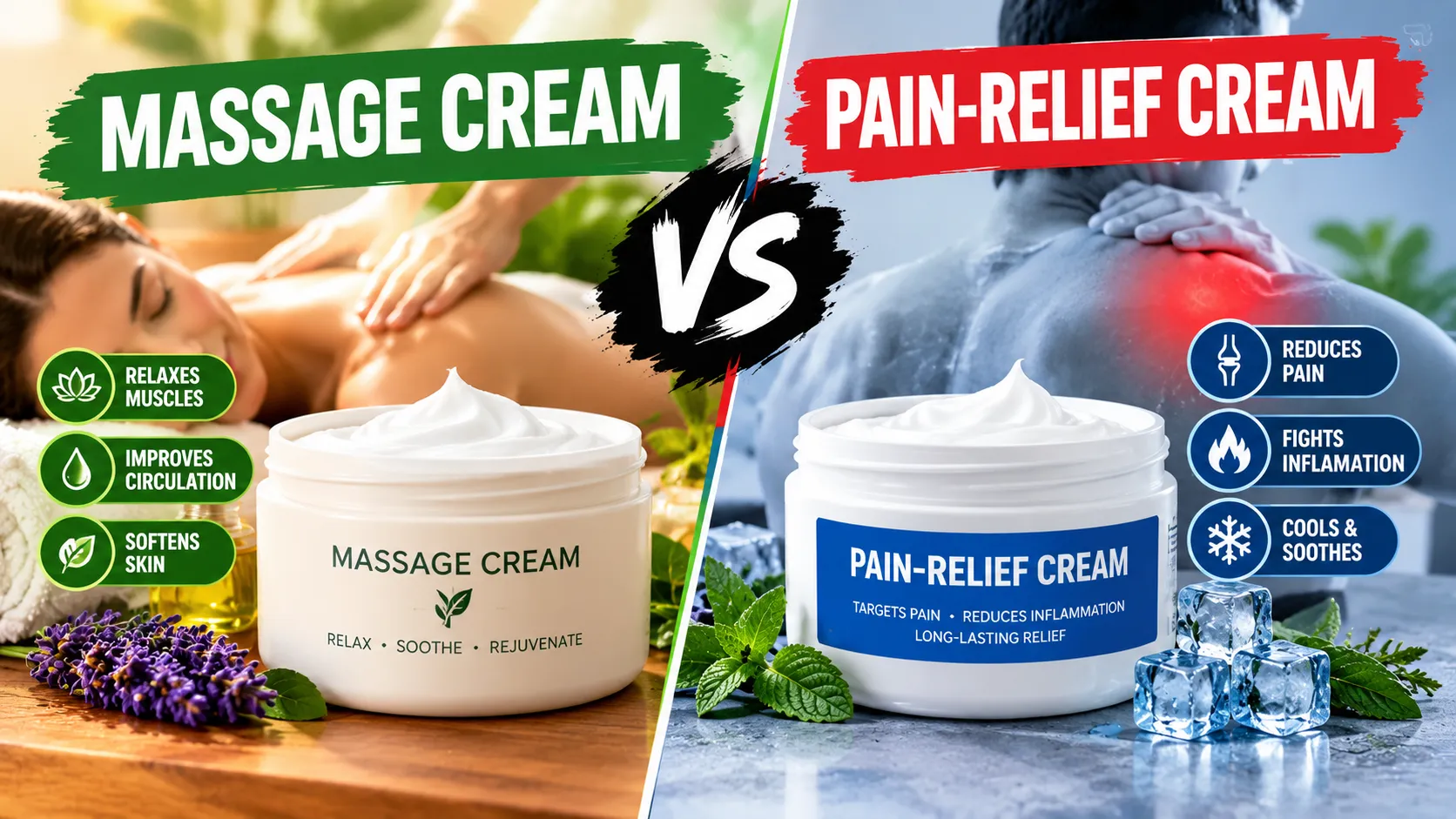
These terms can overlap in everyday shopping, but they are not interchangeable. A massage cream can primarily be a cosmetic or personal-care product designed for glide and skin feel. A topical pain-relief cream may contain an active drug ingredient and have specific Drug Facts directions and warnings.
That distinction is one of the most useful answers to what is in massage cream: the name on the front of the container does not tell you everything about the formula.
For example, current U.S. OTC labels show products containing combinations such as camphor and menthol, or camphor, menthol, and methyl salicylate. These products also include inactive ingredients that build the cream’s texture and stability. :contentReference[oaicite:7]{index=7}
Do not assume that a product containing a botanical extract is automatically a pain medicine, or that a product with a strong cooling sensation is automatically more effective. Read the product category, active ingredients, directions, and warnings together.
The Simple Takeaway
When someone asks what is in massage cream, the short answer is: a mixture of a cream base, moisturizing or emollient ingredients, texture-support ingredients, and sometimes fragrance, botanical extracts, or topical active ingredients.
The ingredient list becomes most useful when you connect each ingredient to its role instead of judging it by how familiar or natural the name sounds. If the product is an OTC topical pain reliever, give the Drug Facts label and warnings extra attention.
A sensible choice is one that fits the intended massage routine, your skin tolerance, and the product’s directions. If you are using a medicated topical product for significant or persistent symptoms, professional guidance can help determine whether self-care is appropriate.
Frequently Asked Questions
What is in massage cream?
Most formulas contain a base such as water plus oils, emollients, humectants, thickeners, emulsifiers, or preservatives. Some also contain botanicals, fragrance, menthol, camphor, or other active ingredients.
Does every massage cream contain menthol?
No. Menthol is used in some formulas, especially products designed to provide a cooling sensation or topical pain-relief effect, but it is not a required massage-cream ingredient.
Why do some massage creams feel warm or cool?
Certain ingredients can create a noticeable sensory effect. Menthol is commonly associated with cooling, while other ingredients may create warming sensations.
Are botanical ingredients always better?
No. Botanical ingredients can be useful parts of a formula, but “natural” does not automatically mean better tolerated or more effective. Individual sensitivity and the complete formula matter.
How can I tell whether a massage cream is medicated?
Look for a Drug Facts panel and a section identifying active ingredients and their purposes. Those details distinguish many OTC topical drug products from ordinary cosmetic massage creams.
Can massage cream be used on irritated or broken skin?
Do not assume it is safe. Some topical products specifically warn against use on damaged or irritated skin, so follow the individual label and seek professional advice when needed.
What should I check before buying massage cream?
Check the intended product type, active ingredients if listed, complete ingredient list, warnings, directions, fragrance, and any ingredients you already know your skin does not tolerate.
Final Thoughts
Knowing what is in massage cream makes it easier to choose a formula based on glide, skin feel, sensory ingredients, and label information rather than marketing alone.
For ordinary massage, focus on a formula that feels comfortable and suits your skin. For medicated topical products or severe, worsening, unusual, or persistent symptoms, follow the label and seek professional guidance.
Author
-

I’m Alex Turner, a massage product reviewer and wellness writer at RemedyTip. I specialize in researching, evaluating, and comparing massage and recovery products to help readers make informed purchasing decisions. My focus is on practical, evidence-informed product guidance covering muscle recovery, relaxation, everyday comfort, and wellness.
I take a research-driven approach to every product I review. I examine product specifications, features, materials, performance claims, user feedback, durability, comfort, ease of use, and overall value. When appropriate, I also consult trusted industry and health-related sources to verify important information and provide readers with a more complete and balanced view.
I cover a wide range of products, including massage guns, handheld massagers, neck and shoulder massagers, foot massagers, massage chairs, foam rollers, and other recovery tools. Rather than focusing only on marketing claims, I look at how products compare in real-world use and who they are actually suitable for. I also consider different budgets, use cases, and user needs when making recommendations.
At RemedyTip, I’m committed to accuracy, transparency, and unbiased product information. I clearly distinguish between manufacturer claims, available evidence, and my own product analysis so readers can understand the basis of each recommendation. I continuously research new products, technologies, and developments in the massage and recovery space to keep my content current and useful.
My goal is simple: to provide trustworthy, easy-to-understand information that helps readers choose massage and recovery products with greater confidence.