Written by Ryan Mitchell · Wellness & Relaxation
Quick Answer: Yoga for stress relief can be a simple way to combine gentle movement, slower breathing, and a short period of quiet attention. A practical starting point is 10 minutes of comfortable movement followed by slow breathing and a brief rest, without forcing difficult poses.
A calmer way to use your next 10 minutes
When stress shows up as a busy mind, tight shoulders, shallow-feeling breathing, or a body that never quite settles, a gentle practice can give you a structured pause. The goal is not to stretch as far as possible or complete an advanced sequence. It is to create a steady rhythm that feels manageable enough to repeat.
For yoga for stress relief, think less about performance and more about pace. Choose comfortable movements, let your breathing stay easy, and use support whenever a pose feels awkward. The National Library of Medicine describes yoga as a practice connecting body, breath, and mind through postures, breathing exercises, and meditation. MedlinePlus explains more about yoga, benefits, and safety.
Trust & Safety: This article is for general educational information only. It does not diagnose, treat, cure, or prevent any condition. It does not replace advice from a licensed healthcare professional. Readers should seek professional help for severe, worsening, unusual, or persistent symptoms.
Why stress can change the way your body feels
Stress is not only a mental experience. It can affect how you breathe, sit, move, sleep, and notice physical tension. That means a useful routine does not have to focus on one “magic” pose. A better approach is to combine several small inputs: gentle movement, comfortable breathing, less rushing, and a few quiet minutes at the end.
Research on yoga and stress is encouraging but should be viewed carefully. A recent systematic review of randomized trials in stressed adults found evidence suggesting yoga may reduce perceived stress, while also describing the overall evidence as limited in quality. That makes yoga reasonable as a supportive practice, not a guaranteed solution for every person.
Think of stress relief as a set of signals rather than a single symptom.
Busy mind
Use slow transitions and a short quiet finish.
Tight shoulders
Choose gentle shoulder and upper-back movement.
Rushed breathing
Let the breath become steady without forcing it.
Restlessness
Start with simple whole-body movement before resting.
This is a practical guide, not a medical scale. Notice what feels relevant today and let that guide how gentle your session should be.
Match the practice to the kind of stress you notice
A short routine works best when it solves the problem you actually have. If your mind is racing, spending the whole session on demanding balance work may add more effort than calm. If you have been sitting for hours, a few easy mobility movements may feel more useful before stillness.
Swipe left/right to see the full table →
| What you notice | Useful focus | Keep it simple |
|---|---|---|
| Racing thoughts | Breath + slow movement | Longer pauses |
| Neck or shoulder tension | Gentle mobility | No forced range |
| Restless energy | Easy standing flow | Finish quietly |
| End-of-day overload | Floor poses + breathing | Lower the pace |
A simple 10-minute yoga for stress relief routine
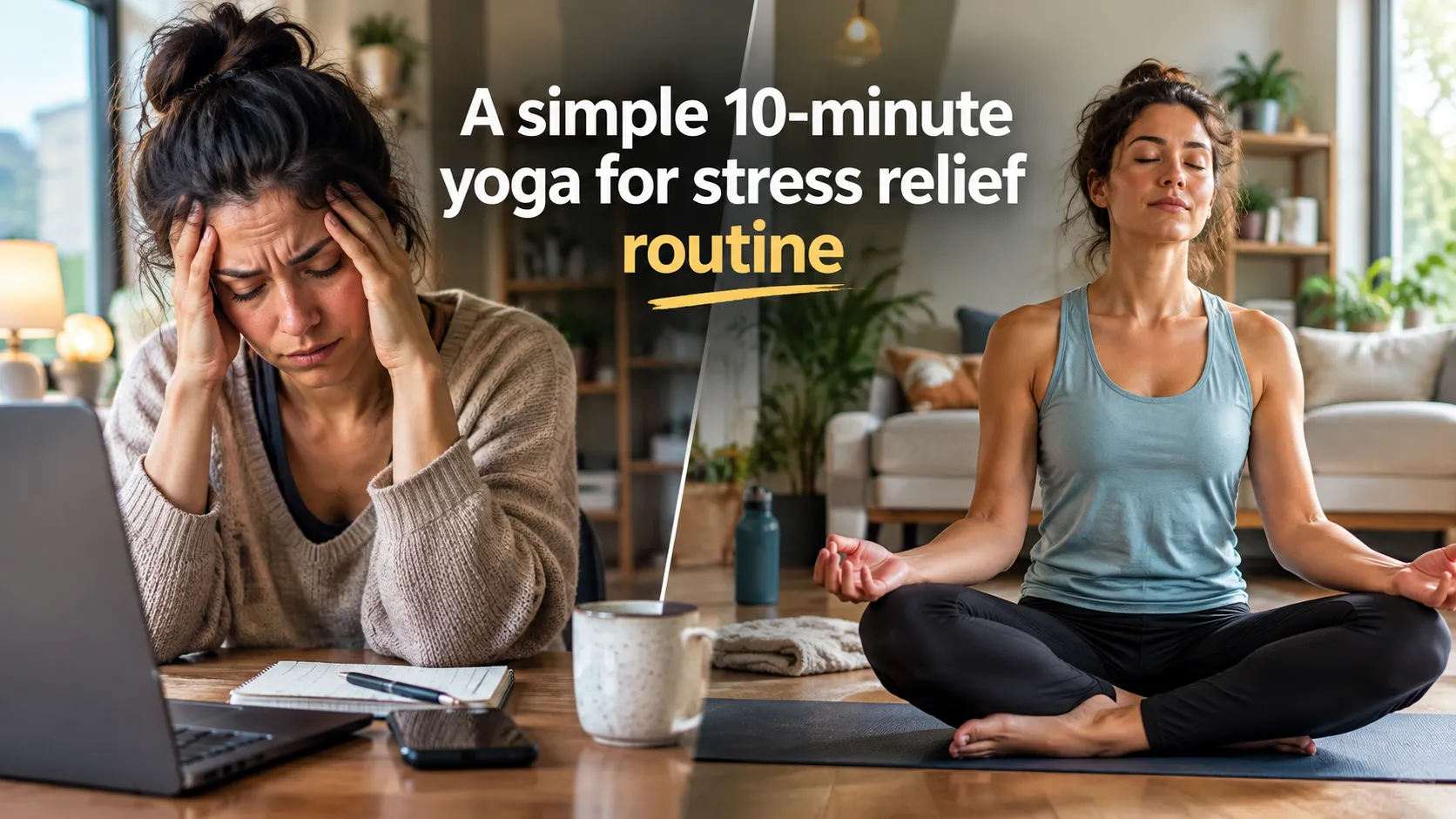
Use a firm, comfortable surface and enough room to move without bumping into furniture. You do not need to complete every movement perfectly. The sequence below is designed around ease: warm up gently, move slowly, settle the breath, then finish with stillness.
Follow the sequence from “arrive” to “rest” rather than treating it like a workout.
1 minute
2 minutes
3 minutes
2 minutes
2 minutes
These time blocks are a practical starting structure, not a scientific prescription. Shorter sessions are fine on busy days, and you can stop earlier when your body feels tired or uncomfortable.
Step 1: Arrive and check in
Sit, stand, or lie down comfortably and notice where your body feels tense without trying to change it immediately.
Step 2: Warm the body gently
Try slow shoulder rolls, an easy cat-cow movement, or gentle side bends for several relaxed repetitions.
Step 3: Move through a small standing flow
Alternate a comfortable standing reach, a gentle forward fold with bent knees, and a slow return to standing.
Step 4: Choose one settling pose
Use a comfortable child’s pose, seated position, or legs-supported rest and stay only as long as it feels easy.
Step 5: Slow the breathing
Breathe comfortably through a natural range, allowing the exhale to feel unhurried without forcing a specific breath count.
Step 6: Finish with stillness
Lie or sit quietly for a couple of minutes and let the session end without immediately jumping back into a busy task.
Which poses fit a stress-focused routine?
There is no single required pose. Choose positions you can enter and leave smoothly. A simple routine may include one warm-up movement, one standing movement, one floor-based position, and a final rest.
Swipe left/right to see the full table →
| Movement | Why it may fit | Easy adjustment |
|---|---|---|
| Cat-cow | Slow spinal movement | Smaller motion |
| Child’s pose | Quiet resting shape | Support forehead or knees |
| Seated breathing | Low-effort reset | Sit against a wall |
| Gentle forward fold | Slows the transition | Bend your knees |
The best choice is the position that lets you breathe normally and move without sharp, worsening, or unfamiliar pain. MedlinePlus also recommends starting slowly, choosing a level that matches your ability, modifying poses when needed, and not pushing beyond your comfort level. See the yoga safety guidance.
Tip: Make your routine easy to start. Keeping a mat or other comfortable surface ready, choosing the same general time of day, and beginning with only 5–10 minutes can reduce the “I need more time” barrier. Consistency matters more than making every session long.
Breathing and pacing may matter as much as the poses
A stress-focused practice can become counterproductive when it turns into another performance task. Instead of trying to breathe as deeply as possible, focus on breathing smoothly. A comfortable inhale followed by an easy, unforced exhale is enough for many beginners.
Harvard Health describes yoga and other mind-body practices as approaches that combine movement, breathing, and mental focus. Mayo Clinic also lists yoga among common stress-relieving practices and notes that slower styles such as Hatha may be suitable for people seeking a gentler pace. Read Mayo Clinic’s stress-relief guidance.
Use this as a practical priority guide rather than a scientific score.
Typical routine priority
The message is simple: the routine does not become more useful just because the poses become harder. For stress-focused practice, comfort and repeatability should lead the session.
How often should you practice?
A useful routine should fit your actual schedule. Some people prefer a brief session most days, while others do better with a few planned sessions each week. There is no need to force a rigid daily target when that makes practice feel like another obligation.
Swipe left/right to see the full table →
| Schedule | Good fit when | Simple target |
|---|---|---|
| Most days | Short routines feel easy | 5–10 minutes |
| 3–4 times weekly | Your week is unpredictable | 10–20 minutes |
| Occasional reset | You need a low-pressure pause | 5–15 minutes |
| Class-based practice | You prefer guidance | Choose beginner level |
Common mistakes that make a calming routine harder
Many beginners make the same basic mistake: they treat a stress-focused routine like a flexibility test. That can lead to rushing, comparing yourself with others, or holding a position longer than feels comfortable.
Replace “push harder” with a choice that makes the routine easier to repeat.
| Common mistake | Better choice | Why it helps |
|---|---|---|
| Stretching too far | Use a smaller range | More comfortable |
| Forcing deep breaths | Breathe naturally | Less effort |
| Copying advanced videos | Choose beginner guidance | Better fit |
| Practicing through pain | Stop or modify | Protects comfort |
Warning: Yoga still involves physical movement, so “gentle” does not mean risk-free. If a movement causes sharp, worsening, unusual, or persistent pain, stop that movement rather than trying to breathe through it or force the position.
When a stress routine is not enough
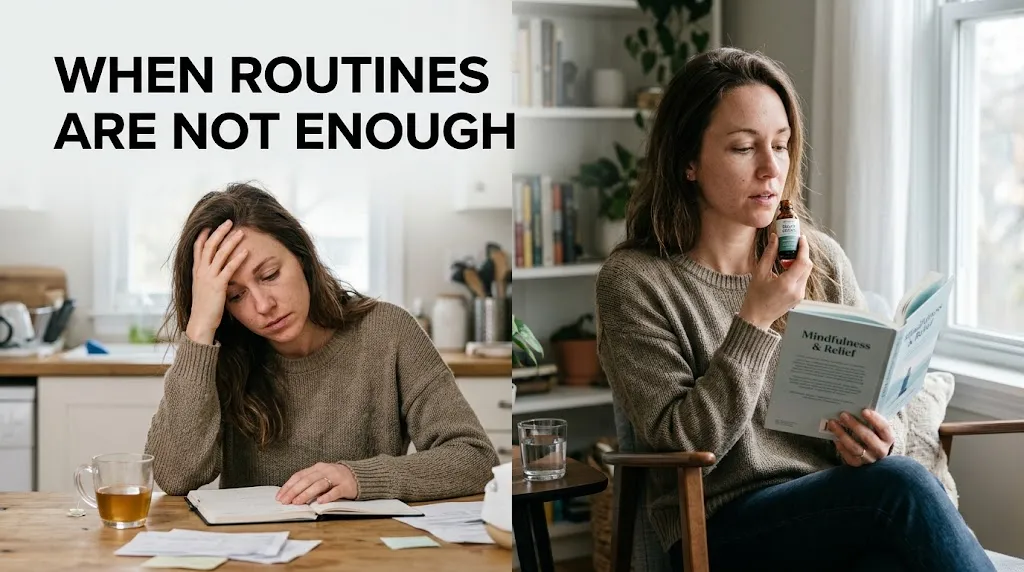
Yoga can fit into a broader wellness routine, but it should not become a substitute for professional evaluation when symptoms are significant. NCCIH notes that studies have found yoga may help with anxiety symptoms, while also emphasizing that the evidence is not strong enough to establish yoga as effective for anxiety disorders. Read NCCIH’s current overview of anxiety and complementary approaches.That distinction matters. A short yoga session may be a reasonable self-care activity for ordinary stress, but persistent or severe symptoms deserve a different level of attention. The right decision is based on the symptom, its severity, and whether it is improving—not on whether you found the “perfect” pose.
Use this decision path as a practical safety guide, not a diagnosis.
Yes → gentle self-care
Try a comfortable routine, keep the pace easy, and stop if something feels wrong.
No or unsure → seek guidance
Persistent, worsening, unusual, or severe symptoms deserve professional attention.
Know the difference between self-care and getting help
Use the table below to keep your expectations realistic. It is better to pause a routine and ask for guidance than to use yoga to explain away symptoms that need another kind of assessment.
Swipe left/right to see the full table →
| Usually reasonable for self-care | Consider professional help | Decision rule |
|---|---|---|
| Mild everyday stress | Symptoms persist or worsen | Look at the trend |
| Comfortable movement | Pain is severe or unusual | Do not push through |
| Short-term tension | Symptoms follow an injury | Get individualized guidance |
| Relaxation-focused practice | Chest pain, weakness, numbness, fever, or loss of bladder/bowel control | Seek urgent medical care |
When to contact a professional: Seek professional advice for severe, worsening, unusual, or persistent symptoms, especially after an injury. Seek urgent medical help for symptoms such as chest pain, significant weakness or numbness, fever with concerning symptoms, or loss of bladder or bowel control.
What progress can realistically look like
Do not judge a routine only by whether you feel completely calm afterward. A more useful measure is whether the practice feels easier to start, easier to complete, and easier to repeat. You may simply notice that you took a short pause, moved your body gently, or created a clearer transition between work and rest.
Because individual responses vary, avoid turning yoga into a promise of instant stress reduction. Keep your goal small: finish the session feeling that you have done something manageable for yourself. Over time, that may make the routine feel more natural.
A general progression guide can help keep expectations realistic.
First sessions
Learn which movements feel comfortable and which need modifying.
Early routine
Make the start time, space, and sequence easier to repeat.
Established habit
Adjust length or intensity based on comfort and schedule.
Long-term fit
Keep the parts that support your routine and drop unnecessary complexity.
This is a general progression guide, not a promise that you will feel a certain result by a certain date.
Frequently asked questions
Can yoga help with everyday stress?
What is a good beginner yoga routine for stress?
Is yoga for stress relief better in the morning or at night?
Which yoga poses are commonly used for stress?
Should I push deeper into a pose to reduce stress faster?
Can yoga replace professional care for anxiety?
When should I stop a yoga routine and ask for help?
Final Thoughts
Yoga for stress relief does not need to be long, difficult, or perfectly performed. A short sequence of gentle movement, comfortable breathing, and quiet rest can be a practical addition to a broader wellness routine. Start small, stay within your comfort level, and seek professional help when symptoms are severe, worsening, unusual, persistent, or not improving.
Author
-

Hi, I’m Ryan Mitchell, a wellness and relaxation writer at RemedyTip.com, where I focus on helping readers better understand stress management, relaxation techniques, mindfulness, sleep improvement, and everyday wellness habits. I have developed a strong knowledge of the Wellness & Relaxation field through sustained learning, in-depth research, and a continued commitment to exploring practical approaches to well-being.
My work focuses on researching wellness topics, examining available evidence, and turning complex information into clear, accessible, and actionable guidance. I’m continually exploring new findings, relaxation practices, and lifestyle strategies to help readers make informed decisions about their daily wellness routines. At RemedyTip.com, my goal is to share trustworthy, research-informed content that encourages healthier habits, greater relaxation, and a more balanced lifestyle.