By Alex Turner
Quick Answer: What is a percussion massager?
A percussion massager is a handheld device that uses rapid, repeated pulses against soft tissue, especially muscles. It is commonly used to support temporary muscle relaxation, ease feelings of tightness, and make recovery routines more convenient.
A simple guide to percussion massagers
If you have seen a massage gun at a gym, physical recovery area, or online store, you may have wondered what it actually does. The basic idea is simple: a motor moves an attachment back and forth rapidly, creating a repeated tapping or percussive sensation on the body.
These devices are mainly intended for soft tissue such as muscle. They are not a replacement for professional evaluation when pain is severe, persistent, unusual, or connected with an injury.
Safety & trust note: This article is for general educational information only. It does not diagnose, treat, cure, or prevent any condition. It does not replace advice from a licensed healthcare professional. Readers should seek professional help for severe, worsening, unusual, or persistent symptoms.
What is a percussion massager?
A percussion massager, often called a massage gun, is a small motorized device designed to deliver repeated pulses of pressure to an area of soft tissue. The attachment moves quickly while you hold or slowly glide the device over a muscle.
The term “percussion” describes the repeated tapping or pressing action. Unlike a conventional vibrating device that mainly creates continuous vibration, a percussion device is designed around more noticeable mechanical pulses. The exact speed, movement depth, pressure, and attachment shape vary between models.
People commonly use these devices around workouts, after long periods of sitting or standing, or as part of a general muscle-care routine. The goal is usually comfort and temporary relaxation rather than treating the underlying cause of a medical problem.
How the device works
Think of the process as controlled mechanical stimulation rather than a treatment that “fixes” a muscle. How it feels depends on the device, pressure, attachment, and the area being used.
Percussion massager vs. ordinary vibration
| Feature | Percussion | Vibration |
|---|---|---|
| Main sensation | Repeated pulses | Continuous vibration |
| Typical focus | Targeted muscle areas | Broader vibration |
| User control | Pressure, speed, attachment | Usually simpler |
| Best described as | Mechanical tapping | Mechanical shaking |
How does a percussion massager work?
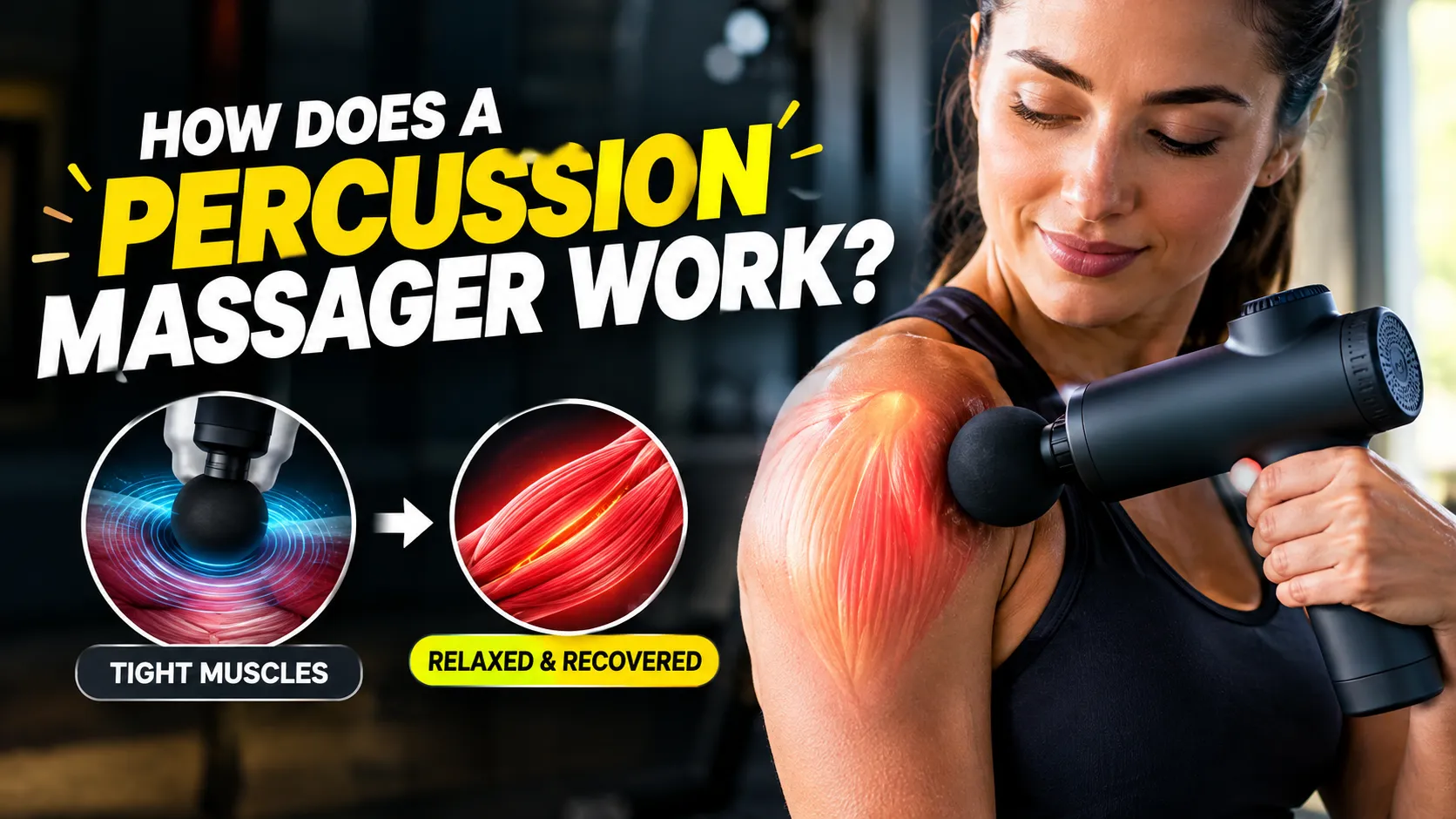
Inside the device, a motor drives an attachment through a repeated movement. When the attachment contacts muscle, it creates a rhythmic mechanical sensation. You control the experience by changing the pressure, speed, direction, and amount of time spent on an area.
That does not mean that stronger is automatically better. A comfortable, controlled sensation is generally more appropriate for a basic self-care routine than aggressive pressure. If an area becomes painful, numb, unusually sensitive, or increasingly irritated, stop using the device there.
The practical appeal is convenience. Instead of manually pressing or rubbing a muscle, the device supplies repeated movement for you. Some models also have multiple heads or speed settings so users can adjust the sensation.
Typical routine priority — practical guide
These percentages are a practical guide, not scientific measurements. The emphasis is on control and comfort rather than trying to create the strongest possible sensation.
What are the potential benefits?
People use percussion massagers for several everyday recovery goals. Research and clinical commentary suggest that properly used massage guns may help with muscle tightness, temporary soreness, relaxation, and range of motion. Results vary by person and by how the device is used.
Benefits vs. limitations
Swipe left/right to see the full table →
| Potential use | What it may support | Important limit |
|---|---|---|
| Muscle tightness | Temporary relaxation | Does not identify the cause |
| Post-workout soreness | Comfort and recovery routine | Not a cure for injury |
| Limited mobility from tight muscles | May make movement feel easier | Effect can be temporary |
| General relaxation | Convenient self-massage | Not suitable for every body area |
Note: A percussion massager can be a comfort tool, but temporary relief should not be treated as proof that an underlying problem has been resolved.
Where does a percussion massager fit best?
For everyday use, the most straightforward areas are large muscle groups such as the thighs, calves, glutes, upper back muscles, and other muscular areas that feel tight after normal activity. The goal is to work the muscle rather than press directly into delicate structures.
It is also useful to think about the reason you are reaching for the device. A short comfort routine after sitting for a long time is different from using a device around a demanding workout. If you have a known injury or a medical condition, ask your healthcare professional whether percussion is appropriate before adding it to your routine.
Choosing the right tool for the routine
Swipe left/right to see the full table →
| Routine goal | Useful feature | What to prioritize |
|---|---|---|
| Occasional use | Simple controls | Comfortable handling |
| Workout recovery | Adjustable speeds | Easy muscle targeting |
| Travel or desk routine | Compact design | Portability |
| Shared household use | Replaceable attachments | Easy cleaning |
A simple way to use one
If you are new to percussion massage, a conservative routine is easier to control than immediately using the highest setting. Follow the instructions for your particular device, and use the manufacturer’s recommended attachment and duration.
1
Choose a comfortable muscle area and check that the skin feels normal before starting.
2
Start on a low or comfortable setting rather than beginning at maximum intensity.
3
Keep the device moving slowly over the muscle instead of holding intense pressure on one point.
4
Use only the duration recommended by the manufacturer and stop if the sensation becomes painful.
5
Afterward, notice how the area feels rather than assuming a stronger session produced a better result.
Routine-fit dashboard
Before activity
A gentle session may fit a warm-up routine when the goal is to make muscles feel less stiff.
After activity
A short, comfortable session may fit a cool-down or recovery routine.
Desk day
It can be one part of a broader routine that also includes movement and position changes.
Persistent pain
Do not rely on the device alone; persistent or worsening symptoms deserve professional attention.
The device works best as one small part of a recovery routine. It should not become a reason to ignore symptoms that keep returning or interfere with normal activities.
Where should you avoid using it?
More sensitive areas require more caution. Avoid treating the front or sides of the neck, the head, directly over the spine, and areas where you can feel bone prominently. Do not use the device directly over an open wound, significant skin irritation, or an area that is acutely swollen or injured.
Do not assume that a painful spot is simply a “knot” that needs harder pressure. Pain can have many causes, and a percussion device cannot determine which cause is responsible.
Safe routine vs. risky routine
Swipe left/right to see the full table →
| Safer approach | Riskier approach | Why it matters |
|---|---|---|
| Low intensity first | Maximum intensity first | Lets you judge comfort |
| Muscle-focused | Directly over bone | Protects sensitive structures |
| Short sessions | Prolonged pressure | Reduces unnecessary irritation |
| Stop when painful | Push through pain | Pain is a reason to reassess |
Safety decision path
1. Normal muscle tightness?
A gentle muscle-focused session may be reasonable if there are no warning signs.
2. Painful or injured area?
Avoid aggressive percussion and consider professional guidance.
3. Symptoms worsening?
Stop using the device and seek appropriate medical advice.
4. Red flags?
Seek urgent medical help rather than relying on self-massage.
This is a practical self-care guide, not a diagnostic tool. When symptoms do not fit ordinary muscle tightness, professional assessment is more appropriate than increasing massage intensity.
Common mistakes beginners make
Many problems with percussion massage come from trying to get too much sensation too quickly. A device that feels powerful can tempt users to press harder or stay on one spot longer, but more intensity does not automatically mean more benefit.
Mistake vs. better choice
Swipe left/right to see the full table →
| Common mistake | Better choice | Practical reason |
|---|---|---|
| Starting at full power | Start gently | Easier to control sensation |
| Holding one spot | Glide slowly | Avoids concentrated pressure |
| Using it on any painful area | Check the area first | Pain may have another cause |
| Ignoring instructions | Follow the manual | Settings differ by device |
Do’s and don’ts
Do
Use controlled pressure, move over muscle gradually, and follow the device instructions.
Don’t
Use aggressive pressure to “break up” pain, treat directly over delicate structures, or ignore worsening symptoms.
Who should be cautious?

People recovering from an injury or managing a medical condition should ask a healthcare professional before using a percussion massager on an affected area. The same applies if you are unsure whether a particular symptom is ordinary muscle soreness or something that needs evaluation.
Extra caution is also appropriate around areas with reduced sensation, unusual swelling, significant bruising, or unexplained pain. If you cannot reliably feel how much pressure you are applying, a strong mechanical device may be difficult to use safely.
When to self-care and when to seek help
Swipe left/right to see the full table →
| Situation | Reasonable next step | Decision rule |
|---|---|---|
| Mild, familiar muscle tightness | Gentle self-care | Stop if symptoms worsen |
| Persistent or worsening pain | Professional evaluation | Do not mask it with repeated massage |
| Recent significant injury | Ask a professional | Use only if advised |
| Numbness or weakness | Medical assessment | Do not self-treat with percussion |
| Chest pain or loss of bladder/bowel control | Urgent medical help | Do not use a massager as a response |
Warning: Severe pain, numbness, weakness, significant injury, fever, chest pain, or loss of bladder or bowel control are not ordinary reasons to increase massage intensity. Seek appropriate medical care.
Red-flag checklist dashboard
If any of these warning signs are present, the practical priority is medical assessment rather than experimenting with stronger percussion.
When to contact a professional: Talk with a licensed healthcare professional if pain is severe, worsening, unusual, persistent, follows a significant injury, or does not improve with ordinary self-care. Seek urgent medical help for serious warning signs such as chest pain, new weakness, major neurological symptoms, or loss of bladder or bowel control.
Does a percussion massager replace massage or professional care?
No. A percussion massager provides a convenient form of self-massage, but it cannot assess your movement, medical history, injury, or symptoms. A professional can consider those factors when deciding what type of care is appropriate.
For uncomplicated muscle tightness, some people may find a device convenient between normal activities. For ongoing or unexplained symptoms, however, convenience should not become a substitute for finding out why the symptoms are happening.
Frequently asked questions
What is a percussion massager used for?
It is commonly used for temporary muscle relaxation, comfort, and recovery routines. It may help some people manage feelings of tightness or post-exercise soreness.
Is a percussion massager the same as a massage gun?
In everyday use, the terms are often used for the same type of handheld device. Both generally describe motorized devices that deliver repeated mechanical pulses to soft tissue.
Can you use a percussion massager every day?
Some devices are designed for regular use, but the appropriate duration varies by model and body area. Follow the manufacturer’s instructions and avoid using it through pain.
Where should you not use a percussion massager?
Avoid delicate areas such as the head, front or sides of the neck, directly over the spine, and prominent bones. Avoid wounds, significantly irritated areas, and acutely injured or swollen areas unless a professional has advised otherwise.
Does a percussion massager help sore muscles?
It may provide temporary comfort for ordinary muscle soreness or tightness. Persistent, severe, worsening, or unusual pain should be evaluated rather than repeatedly masked with massage.
Should a percussion massager hurt?
It should not be necessary to create significant pain to use one. Start gently, keep the device moving, and stop if the area becomes painful, numb, unusually sensitive, or more irritated.
Can a percussion massager replace professional treatment?
No. It can be a self-care tool for some everyday muscle discomfort, but it cannot diagnose the cause of pain or replace professional assessment when symptoms are persistent, severe, unusual, or linked to injury.
Final Thoughts
A percussion massager is a convenient handheld tool that delivers repeated mechanical pulses to muscle and other soft tissue. It may fit a routine for temporary comfort, relaxation, or post-exercise recovery, but gentle use and sensible body-area selection matter more than maximum intensity. If symptoms are severe, worsening, unusual, persistent, or not improving, seek guidance from a licensed healthcare professional rather than relying on percussion alone.
Author
-

I’m Alex Turner, a massage product reviewer and wellness writer at RemedyTip. I specialize in researching, evaluating, and comparing massage and recovery products to help readers make informed purchasing decisions. My focus is on practical, evidence-informed product guidance covering muscle recovery, relaxation, everyday comfort, and wellness.
I take a research-driven approach to every product I review. I examine product specifications, features, materials, performance claims, user feedback, durability, comfort, ease of use, and overall value. When appropriate, I also consult trusted industry and health-related sources to verify important information and provide readers with a more complete and balanced view.
I cover a wide range of products, including massage guns, handheld massagers, neck and shoulder massagers, foot massagers, massage chairs, foam rollers, and other recovery tools. Rather than focusing only on marketing claims, I look at how products compare in real-world use and who they are actually suitable for. I also consider different budgets, use cases, and user needs when making recommendations.
At RemedyTip, I’m committed to accuracy, transparency, and unbiased product information. I clearly distinguish between manufacturer claims, available evidence, and my own product analysis so readers can understand the basis of each recommendation. I continuously research new products, technologies, and developments in the massage and recovery space to keep my content current and useful.
My goal is simple: to provide trustworthy, easy-to-understand information that helps readers choose massage and recovery products with greater confidence.