By Alex Turner | Health & Wellness Writer
Quick Answer:
Most people can safely use an infrared massager for 15–20 minutes per session, 1–2 times daily on the same area, as long as skin doesn’t show redness or irritation. Heavier use or longer sessions require waiting at least 48 hours between treatments on the same spot. Always start lower and monitor your body’s response.
An infrared massager can ease muscle tension, stiffness, and minor discomfort—but using it safely means respecting timing, frequency, and your body’s limits. This guide breaks down how long to use yours, how often, and what signs mean you should stop.
Frequency Guidelines
Warning Signs
When to Stop
Recovery Routines
This article is for general educational information only. It does not diagnose, treat, cure, or prevent any condition. It does not replace advice from a licensed healthcare professional. Readers should seek professional help for severe, worsening, unusual, or persistent symptoms.
Why Duration and Frequency Matter for Infrared Massagers
Infrared massagers use heat and vibration to ease muscle tension, but they’re tools meant for careful, measured use. Too much time on one area can irritate skin, deepen inflammation, or cause mild burns—especially on sensitive regions like the inner forearm, neck, or bony areas. Too little time may not give you the benefit you’re seeking. Finding the right balance means understanding how your body responds and adjusting your routine based on the body part, your condition, and your sensitivity.
The goal isn’t to use the massager as long as possible—it’s to use it long enough to feel relief, then give your muscles and skin time to recover. Overuse doesn’t speed up healing; it often sets you back.
Recommended Duration by Body Area
Different body parts have different heat tolerance and muscle mass. Larger, thicker muscle groups (like the lower back or thighs) tolerate longer sessions than smaller, sensitive areas (neck, face, hands). Start at the lower end of each range and increase only if your skin feels fine and you’re getting relief.
Swipe left/right to see the full table →
| Body Area | Recommended Duration | Frequency Per Week | Key Caution |
|---|---|---|---|
| Lower back | 15–20 min per side | 3–5 times | Avoid direct spine; move slowly |
| Neck & shoulders | 8–12 min per side | 2–4 times | Sensitive skin; skip the throat |
| Thighs & calves | 15–20 min per leg | 3–5 times | Bony knees—use caution; skip shins |
| Forearms & wrists | 5–10 min per arm | 2–4 times | Thin skin & surface nerves; gentle pressure |
| Feet & ankles | 8–12 min per foot | 3–5 times | Bony areas; avoid high heat setting |
These ranges assume typical health and sensitivity. If you have thin, sensitive, or previously injured skin, start at the lower end. If you’re using the device after injury or on fresh soreness, begin with just 5–8 minutes and add time only after several sessions feel safe.
Daily and Weekly Frequency: How Often Is Safe?
Using an infrared massager once daily is generally safe for most people, but more isn’t always better. Your muscles and skin need time between sessions to recover and adapt. The rule of thumb: if you’re treating the same area daily, limit it to 15–20 minutes and give it a full day off every 4–5 days. If you want to use it more than once per day, alternate between different body areas.
Many people find that 3–5 sessions per week, spaced out, delivers steadier relief than daily hammering. This rhythm lets inflammation reduce, soreness ease, and your body respond without fatigue or irritation buildup.
Sample Weekly Routine Pattern
Mon
Back 18 min
Tue
Rest
Wed
Neck 10 min
Thu
Legs 16 min
Fri
Rest
Sat
Back 15 min
Sun
Rest
This pattern spreads use across the week while giving each area recovery time. Adjust based on how your body responds.
Mistake vs. Better-Choice Comparison

Many people accidentally overuse their infrared massager because they assume “more time equals more relief.” Here’s what actually goes wrong—and what to do instead.
Swipe left/right to see the full table →
| Common Mistake | What to Do Instead |
|---|---|
| Using the same area 2–3 times per day, every day | Stick to once daily, and give that area a full rest day every 4–5 days |
| Staying on one spot for 30+ minutes without moving | Move the device slowly every few seconds; stay on one spot no longer than 3–5 minutes |
| Using the highest heat and vibration setting right away | Start on low–medium settings and increase only after 2–3 sessions feel comfortable |
| Ignoring skin redness, warmth, or tenderness | Stop immediately if skin turns red or feels hot; wait 24 hours before using that area again |
| Using it directly on joints, bones, or the spine | Apply pressure to the muscle *next to* the bone, not on it; avoid the direct spine |
The best routine is one you can sustain without discomfort, soreness buildup, or skin irritation. Short, consistent sessions beat occasional marathon sessions every time.
Warning Signs You’re Using It Too Long
Your body tells you when enough is enough. Watch for these signs and pull back immediately if they appear.
Stop Using If You Notice:
Skin redness or heat that doesn’t fade within 30 minutes
Blistering, burning, or pain during or right after use
Swelling that gets worse instead of better
Numbness or tingling in the area or nearby
Persistent soreness that increases after each session
Bruising or dark discoloration
If any of these signs appear, stop using the massager on that area for at least 48 hours. If symptoms persist or worsen, contact a healthcare professional.
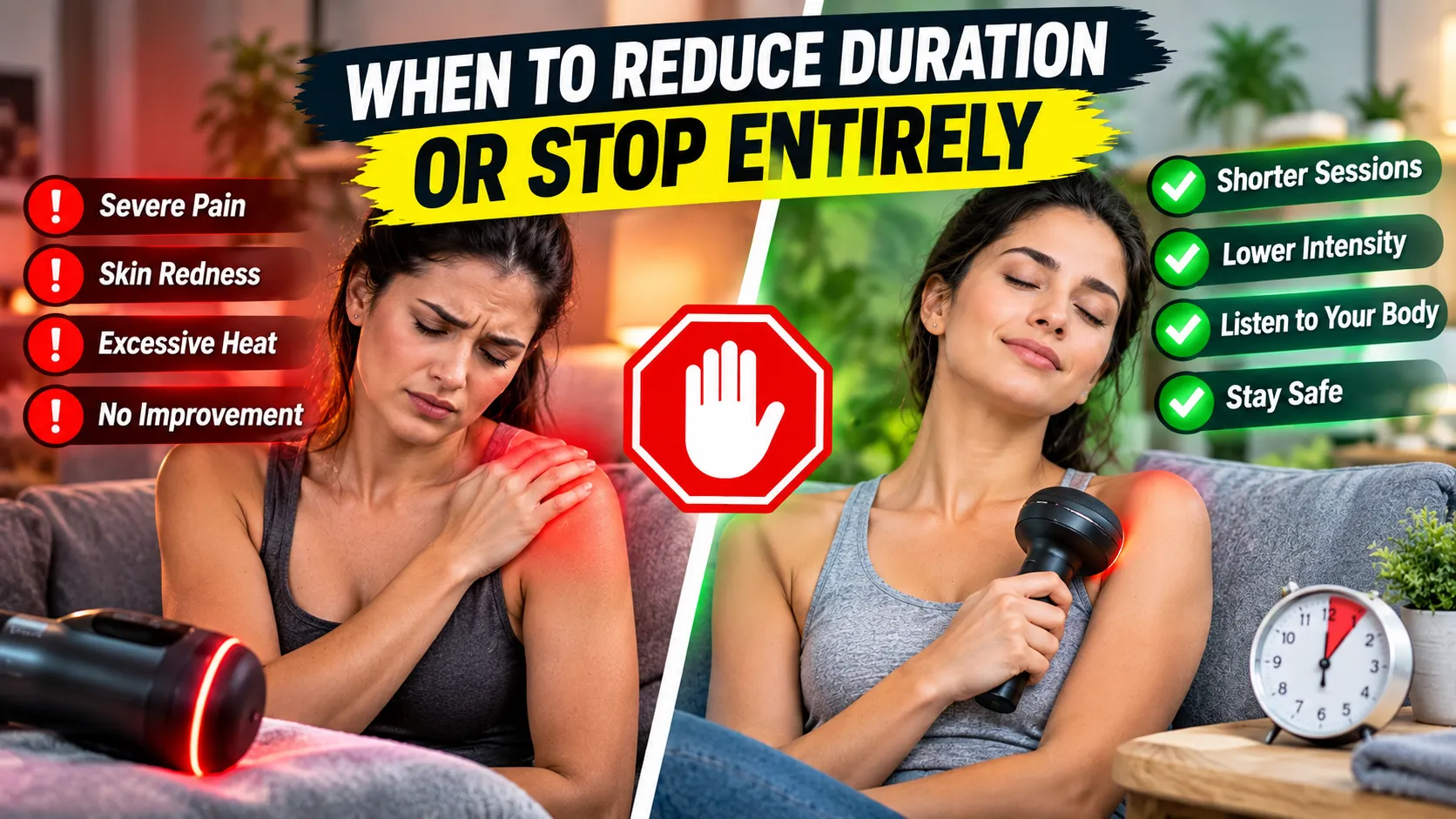
When to Reduce Duration or Stop Entirely
Swipe left/right to see the full table →
| Situation | Recommended Action |
|---|---|
| Active inflammation or acute injury (first 48 hours) | Skip the infrared massager entirely; apply ice instead. Wait at least 2 days before using |
| Fever or infection signs | Do not use. Heat can worsen infection. Seek professional help |
| Nerve issues or neuropathy | Start with 5 minutes maximum, low heat. Talk to your doctor first |
| Pain worsens after 3–4 sessions | Stop and consult a healthcare provider. The massager may not be right for your condition |
| Chronic or severe pain | Reduce to 8–10 minutes, 2 times per week. Get professional guidance |
If symptoms feel unusual, painful, or don’t improve after a week of careful use, talk with a doctor or physical therapist. A healthcare professional can confirm whether the infrared massager is appropriate for your specific condition and suggest safer alternatives if needed.
Pro Tips for Safe and Effective Sessions
Getting the most out of your infrared massager without overdoing it takes a few smart habits:
Use a timer
Set a phone alarm for your target duration (e.g., 15 minutes). It’s easy to lose track and overuse without realizing it.
Start low, go slow
Begin on the lowest heat and vibration setting for your first 2–3 uses. Increase only if you feel comfortable and see no skin irritation.
Move, don’t hold still
Glide the device slowly and steadily over the muscle area. Staying in one spot for more than 3–5 minutes risks irritation or heat buildup.
Watch your skin
Check the skin right after use. Light redness fades fast; if it stays red for hours or feels hot, you overdid it. Skip that area the next day.
Rest days matter
One full day off per week (or every 5 days) gives your muscles and nervous system time to recover and adapt to the stimulus.
Track your response
Keep a simple note of how you feel after each session. If soreness improves, keep that duration; if it increases, scale back.
Note:
If you’re new to infrared massage devices, expect some muscle soreness (similar to mild workout soreness) in the first 1–2 sessions. This usually fades quickly. If soreness intensifies or pain worsens, reduce duration and frequency immediately.
Frequently Asked Questions
Can I use an infrared massager every day?
What if my skin turns red after using the massager?
Is 30 minutes too long for an infrared massager session?
Can I use an infrared massager on injured skin or fresh bruises?
How long does it take to see results from infrared massage?
Should I use an infrared massager before or after exercise?
Affiliate Disclosure: This article may contain affiliate links. If you buy through these links, we may earn a small commission at no extra cost to you. We only mention products that fit the topic and do not replace professional medical advice.
RENPHO Infrared Massage Gun
Adjustable heat settings and multiple massage heads support targeted, controlled sessions—useful for keeping use within safe time limits.
Belmint Infrared Heating Pad
For larger areas like the back, a heating pad offers a gentler, easier-to-time alternative that can help establish consistent, safe routines.
Final Thoughts
Using an infrared massager safely comes down to respecting duration and frequency limits, watching your body’s response, and resisting the temptation to use it more than it needs. Stick to 15–20 minutes per session for large areas, 8–12 minutes for sensitive spots, and give each area regular rest days. If you notice skin irritation, worsening pain, or any unusual symptoms, stop immediately and consult a healthcare professional. Short, consistent sessions paired with rest days deliver better long-term relief than aggressive, daily overuse—so be patient with the process and let your body’s natural recovery do the work.
Author
-

I’m Alex Turner, a massage product reviewer and wellness writer at RemedyTip. I specialize in researching, evaluating, and comparing massage and recovery products to help readers make informed purchasing decisions. My focus is on practical, evidence-informed product guidance covering muscle recovery, relaxation, everyday comfort, and wellness.
I take a research-driven approach to every product I review. I examine product specifications, features, materials, performance claims, user feedback, durability, comfort, ease of use, and overall value. When appropriate, I also consult trusted industry and health-related sources to verify important information and provide readers with a more complete and balanced view.
I cover a wide range of products, including massage guns, handheld massagers, neck and shoulder massagers, foot massagers, massage chairs, foam rollers, and other recovery tools. Rather than focusing only on marketing claims, I look at how products compare in real-world use and who they are actually suitable for. I also consider different budgets, use cases, and user needs when making recommendations.
At RemedyTip, I’m committed to accuracy, transparency, and unbiased product information. I clearly distinguish between manufacturer claims, available evidence, and my own product analysis so readers can understand the basis of each recommendation. I continuously research new products, technologies, and developments in the massage and recovery space to keep my content current and useful.
My goal is simple: to provide trustworthy, easy-to-understand information that helps readers choose massage and recovery products with greater confidence.