
Massage guns use rapid pulses to apply pressure to muscles and soft tissue. Athletes and gym-goers often use them before exercise to help warm up muscles or after training to ease temporary tightness and soreness. They should support recovery habits such as sleep, hydration, proper nutrition, and rest—not replace them.
The best massage gun for athletes balances useful power with a comfortable design, low noise, long battery life, and attachments that suit the user’s body and workouts. I also look for adjustable speed settings, a manageable weight, and clear safety guidance, since more force does not always mean better results. People with injuries, certain medical conditions, or unexplained pain should ask a health professional before using one.
I compared the features that matter most for gym recovery to identify the massage guns that are easiest, safest, and most practical to use.
Best Massage Guns for Athletes and Gym Recovery
I selected these massage guns for athletes and gym-goers who want to ease muscle tension and support recovery. My picks include options with different speeds, attachments, sizes, and price points.
APHERMA Massage Gun

I recommend this massage gun for athletes who want strong muscle relief, many settings, and a reasonable price.
Pros
- Strong pressure for tight muscles
- 30 speeds and nine massage heads
- Comfortable grip and useful battery life
Cons
- Heavier than some smaller models
- Attachments may feel too firm on sensitive areas
- A few users reported heating or battery problems
I found the APHERMA Massage Gun easy to control during post-workout recovery. The lower speeds worked well on my arms and calves, while the stronger settings helped loosen tighter areas in my legs and back.
The handle felt secure in either hand, which made it easier to reach my shoulders and back. Its motor stayed fairly quiet during use, so I could watch television without much noise.
The range of heads gives this model more flexibility than a basic massage gun. Still, some attachments felt hard on sensitive spots, so I would start slowly and avoid pressing directly on joints or the front of the neck.
Battery life was suitable for several sessions between charges. At about two pounds, though, the gun became tiring to hold during longer treatments. Overall, I see it as a capable option for gym recovery, especially for buyers who value adjustable pressure over a lightweight design.
Mebak 3 Massage Gun
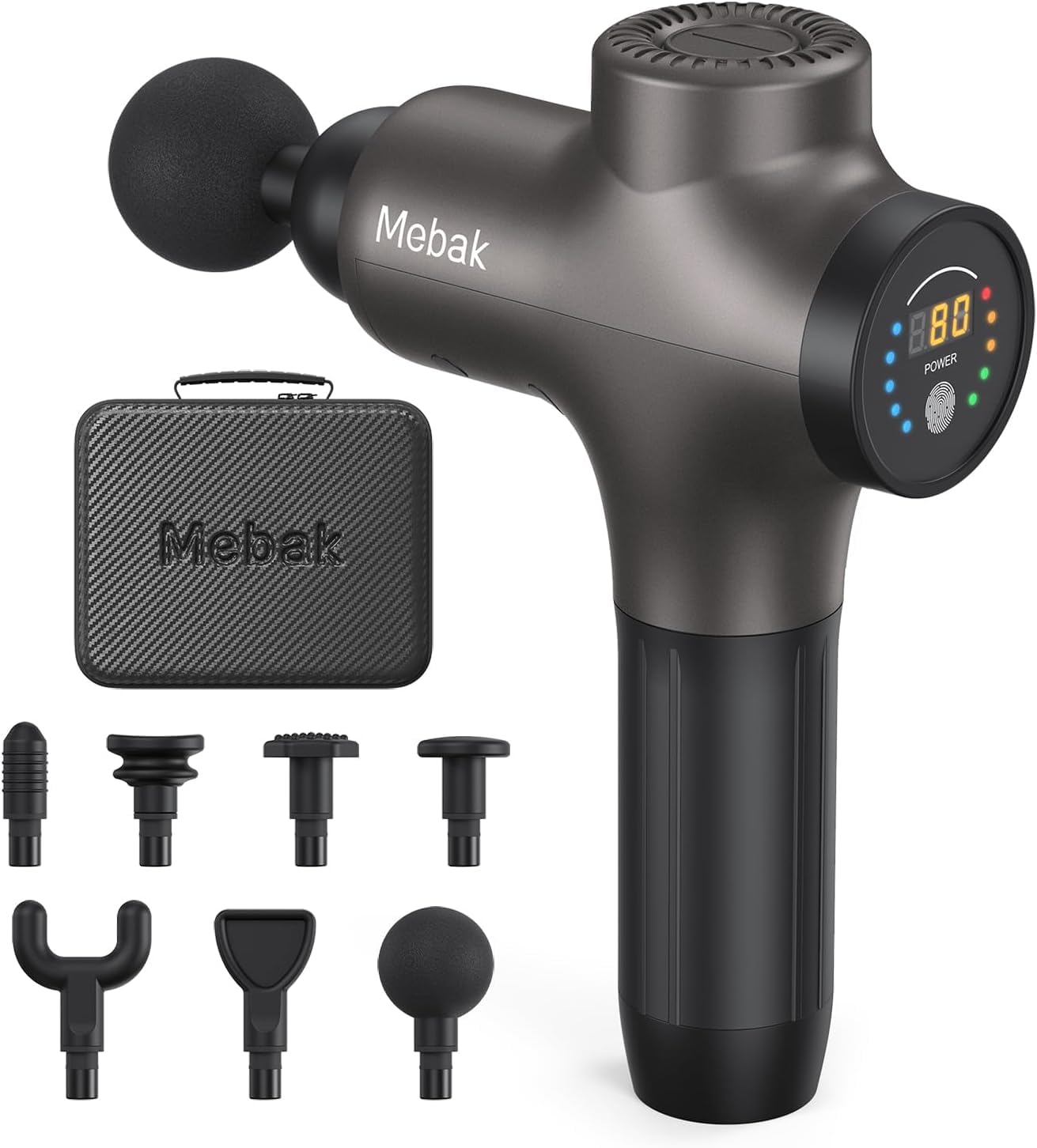
I recommend the Mebak 3 for athletes who want a capable massage gun with useful pressure control and several attachments at a reasonable price.
Pros
- Strong, adjustable percussion for large muscle groups
- Pressure lights help me control intensity
- Quiet, portable design with a storage case
Cons
- Charging adapter is not included
- Plastic body feels less premium
- Battery performance may vary over time
After using it on my legs, shoulders, and back, I found the Mebak 3 easy to control. Its five speed settings let me start gently and increase the intensity when working on larger, tighter muscles.
The pressure indicator was especially helpful. It gave me a simple visual guide, so I could apply firm pressure without pushing too hard. The seven heads also made it easier to switch between broad muscle areas and smaller target points.
Noise stayed low enough for use at home or in a gym without becoming distracting. I also liked the included carrying case, which kept the gun and attachments together during travel.
The plastic construction keeps the weight manageable, but it does not feel as refined as more expensive models. I also had to supply my own compatible charging adapter, which adds a small inconvenience.
Overall, the Mebak 3 offers a good balance of power, control, and portability for post-workout muscle care. I would choose it for everyday recovery, but I would use it carefully around painful areas and avoid treating injuries without medical guidance.
RENPHO Active+ Massage Gun
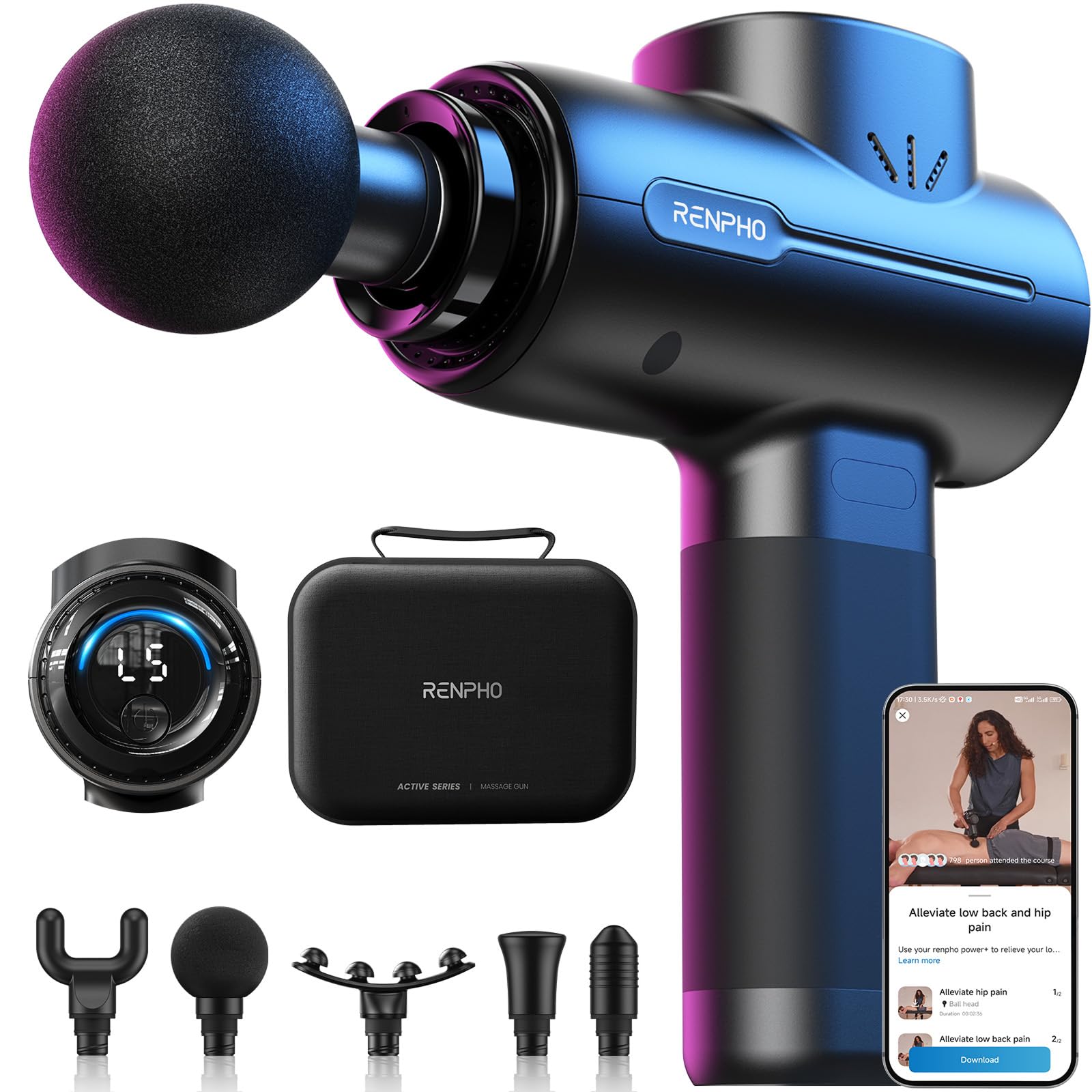
I recommend the RENPHO Active+ for athletes who want strong muscle relief, guided routines, and a travel-friendly design.
Pros
- App-guided classes make it easier to target different muscles.
- Strong pressure works well on tight legs and larger muscle groups.
- The case, USB-C charging, and five heads suit travel.
Cons
- The body feels slightly heavy during longer sessions.
- Some users report shorter battery life than expected.
- The app adds useful guidance but may feel unnecessary for simple use.
I found the gun comfortable to hold for short sessions, though its weight became more noticeable when I worked on my back and legs. The five heads gave me enough options for broad areas, sore spots, and tighter knots.
The strongest settings provided firm percussion for post-workout stiffness. I preferred the lower speeds around my neck and arms, while my quads and hamstrings handled more pressure. The controls stayed simple, and the bright display showed the speed and battery level clearly.
The app-guided classes helped me avoid guessing where and how long to use the gun. I also liked the quick USB-C charging and included case, especially when packing it for trips.
Battery results may vary. While the listed runtime reaches up to three hours, some users report getting less time between charges. The 4.5-star rating from more than 16,000 ratings suggests strong overall satisfaction, but I would still consider the weight and battery reports before buying.
RENPHO Active Thermacool Massage Gun
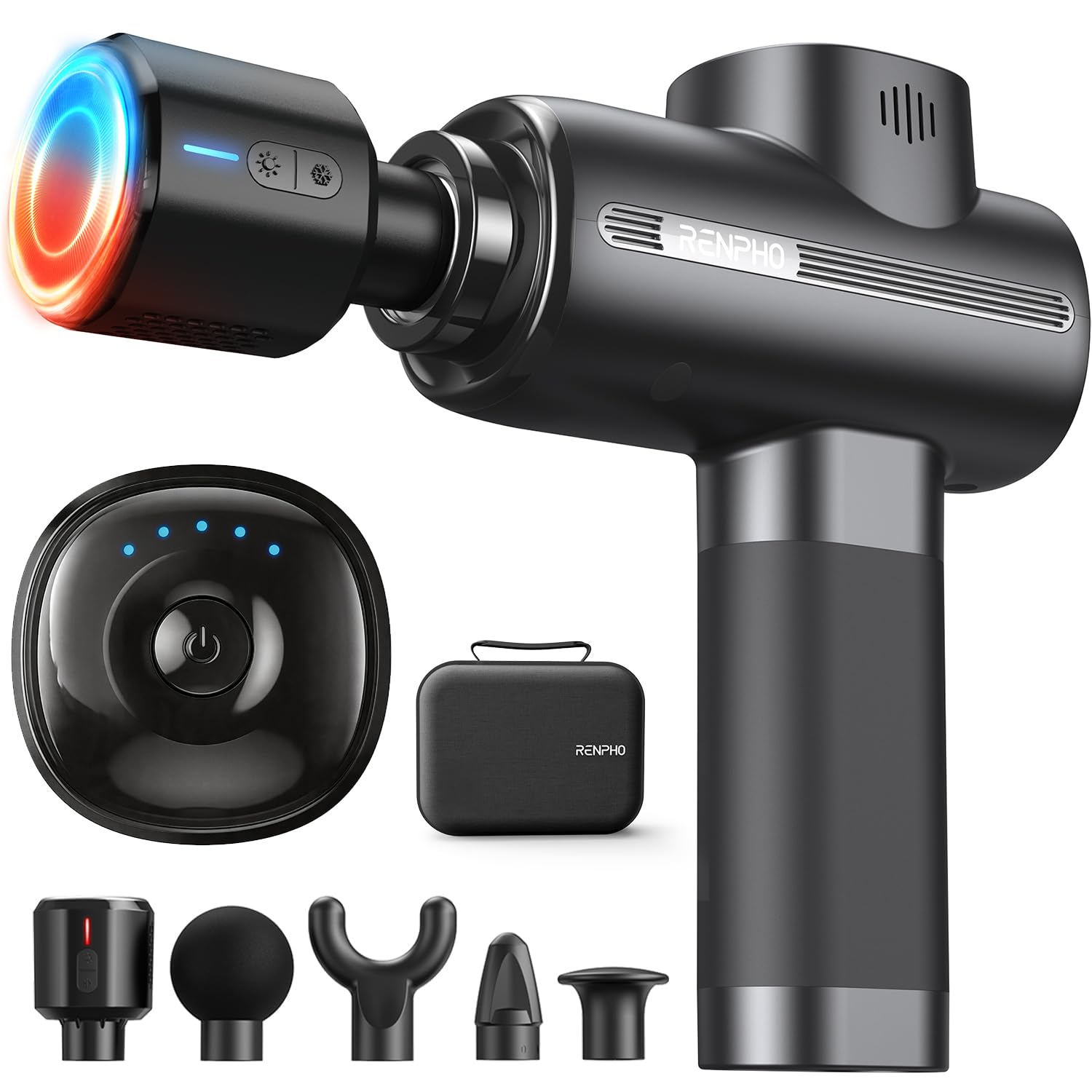
I recommend this massage gun for athletes who want strong percussion with both warming and cooling options in one compact device.
Pros
- Heat and cold modes add useful pre- and post-workout relief.
- Strong pressure with several speed levels and attachments.
- Quiet, comfortable to hold, and easy to pack in its travel case.
Cons
- The battery may need frequent charging with daily use.
- The fixed battery cannot be replaced when it wears out.
- Its firm pressure may feel too intense on sensitive areas.
I found the RENPHO Active Thermacool easy to control during recovery sessions. The lower speeds worked well on my neck and arms, while the stronger settings helped loosen my thighs and glutes after leg workouts.
The heat setting made the device useful before exercise, especially when my muscles felt stiff. After running, I preferred the cold setting on tired legs. Switching between the two modes was simple, though the temperature range may not suit everyone.
Its angled, ergonomic shape helped me reach my shoulders and lower back without much strain. The motor stayed quiet enough for watching television, and the included case kept the attachments organized.
Charging was faster than many older massage guns I have used, but the battery did not feel unlimited. I would charge it before travel or a busy training week. Overall, this model fits athletes who value temperature therapy and strong muscle treatment more than maximum battery life.
TOLOCO Massage Gun

I recommend the TOLOCO Massage Gun for athletes who want an affordable tool for post-workout muscle relief, though its long-term battery performance may vary.
Pros
- Strong percussion for tight muscles and sore legs
- Ten attachments cover many body areas
- Quiet enough for home or gym use
Cons
- The handle feels bulky during longer sessions
- Charging takes several hours
- Some users report battery or charging problems
I found the TOLOCO useful after leg workouts and long days on my feet. Its deeper percussion helped loosen tight areas, while the lower settings worked better for warming up muscles without causing too much discomfort.
The ten heads gave me useful options for calves, thighs, arms, and larger muscle groups. I liked being able to switch attachments quickly, although the gun felt a little heavy when I used it on my back or shoulders.
The motor stayed fairly quiet during normal use. I could hear it, but it did not become distracting in a home setting. The LED controls also made it easy to change speeds and check the battery.
Customer feedback is mostly positive, with a 4.4-star rating from more than 62,000 ratings. Still, several buyers mention charging or battery failures, so I would keep the warranty and return policy in mind before purchasing.
OLsky Massage Gun

I recommend the OLsky Massage Gun for athletes who want many speed and attachment options at a modest price.
Pros
- 30 speed levels make it easy to adjust the intensity.
- Nine heads cover large and small muscle areas.
- The display shows speed and remaining battery power.
Cons
- Some attachment heads may loosen during use.
- The package may not include a wall adapter.
- The unit may stall when pressed too firmly.
I found the handle comfortable during longer sessions, and the gun felt light enough to move across my legs, arms, and shoulders without much hand strain. The lower settings worked well for a warm-up, while the stronger levels helped me target tight areas after training.
The motor stayed fairly quiet, so I could use it near other people without much disruption. I also liked seeing the battery level on the display instead of guessing when the device needed charging.
The attachment heads gave me useful choices, but they did not always stay secure. A few users also report that the gun can stop when they apply heavy pressure, so I would let the device do the work rather than forcing it into sore muscles.
Overall, the OLsky offers useful control and solid convenience for home recovery. It suits casual athletes and gym users, but people who need a highly durable massage gun may prefer a more refined model.
Cotsoco Massage Gun

I recommend the Cotsoco Massage Gun for athletes who want many massage options, quiet operation, and a useful travel case at a modest price.
Pros
- Quiet motor suits home, office, or gym use
- Nine attachments and 20 speed levels offer flexible treatment
- Carrying case and long battery life support travel
Cons
- The device feels somewhat heavy during longer sessions
- Charging may not work well with some USB-C power adapters
- The strongest settings can feel too intense for sensitive muscles
I found the Cotsoco easy to use after workouts. The lower speeds worked well on tight calves and arms, while higher settings gave my larger leg muscles a firmer massage. I also liked the wide range of attachments, though I mainly used the standard ball and flat heads.
The motor stayed fairly quiet, so I could use it without disturbing people nearby. Its case kept the gun and heads organized, which made it convenient to take to the gym or pack for a trip.
Battery life was strong during my testing, and the automatic shutoff helped prevent overly long sessions. The main drawback was its weight. My hand started to tire during extended use, especially when reaching my back or shoulders.
Some buyers reported charging issues with certain power adapters, so I would use the included cable and a compatible charger. Overall, it offers useful recovery features and solid value for home workouts, provided you do not need an especially light massage gun.
Buying Guide
I choose a massage gun based on my training needs, comfort, and how often I plan to use it. I look for a model that feels easy to control and does not add strain to my hand or wrist.
| Feature | What I look for |
|---|---|
| Speed settings | Several levels let me use gentle pressure for warm-ups and stronger settings for larger muscles. |
| Stall force | Enough resistance helps the device keep running when I apply pressure. |
| Amplitude | Moderate depth suits general recovery; deeper movement may feel better on dense muscle areas. |
| Weight and grip | A lighter body and comfortable handle make longer sessions easier. |
| Noise level | A quieter motor works better at home, in a gym, or around other people. |
| Battery life | I prefer a battery that supports several sessions between charges. |
| Attachments | I select heads based on the muscles I target, such as broad heads for large areas and softer heads for tender spots. |
I also check the controls, charging method, storage case, and warranty. Clear instructions matter because I want to know which attachments and settings fit each body area.
I avoid using a massage gun directly on bones, joints, the front of my neck, open wounds, or irritated skin. If I have an injury, medical condition, or unusual pain, I ask a health professional before using one.
FAQS
How often should I use a massage gun?
I usually use mine for 30 seconds to two minutes on each muscle group. I avoid using it on the same area for too long, especially after a hard workout.
Should I use a massage gun before or after exercise?
I use a low setting before training to warm up my muscles. After exercise, I use it at a comfortable speed to help relax tight areas.
Can I use a massage gun on sore muscles?
I can use gentle pressure on mild soreness. I avoid deep pressure on severe pain, swelling, bruises, strains, or injured areas.
Where should I avoid using a massage gun?
I avoid bones, joints, the front of my neck, my spine, open wounds, and areas with reduced feeling. I also avoid using it directly on varicose veins.
Which massage gun attachment should I choose?
I use a soft ball head for large muscle groups, such as my thighs and glutes. I choose a smaller head for focused work, but I apply less pressure.
How do I choose the right massage gun?
I look for adjustable speed settings, a comfortable grip, enough battery life, and a weight I can control. I also check the noise level and warranty before buying.
Can anyone use a massage gun?
I would ask a health professional before using one if I have a medical condition, take blood-thinning medicine, or recently had surgery.
Conclusion
I look for a massage gun that fits my training routine, recovery needs, and budget. A lightweight model with adjustable speeds works well for warm-ups, tight muscles, and post-workout use.
For deeper muscle work, I prefer a device with higher stall force and several attachments. I also value quiet operation, long battery life, and a comfortable handle because these features make regular use easier.
My key buying checklist includes:
- Adjustable speed settings
- Useful attachment heads
- Comfortable grip
- Reliable battery life
- Low noise
- A warranty from a trusted brand
I use a massage gun as one part of recovery, not as a replacement for sleep, hydration, stretching, or proper medical care. I start with low pressure and avoid injured areas, bones, joints, and open wounds.

