By Ryan Mitchell
Quick Answer:
Healthy stress relief supports your well-being without creating new problems, while unhealthy coping may provide short-term comfort but cause difficulties when it becomes a repeated pattern. The key difference is what the strategy does over time, not simply whether it feels relaxing in the moment.
Stress is a normal response to demands, change, uncertainty, and challenges. Stress relief can be helpful, but not every way of escaping stress supports long-term well-being. Some choices restore energy, improve coping, or create space to deal with the source of stress. Others can become avoidance habits that feel useful briefly while making everyday life harder later.
Understanding the difference can make stress management more practical. Instead of asking whether a coping method feels good right now, consider whether it leaves you better prepared for the next day.
Healthy coping Unhealthy patterns Stress awareness Safer choices
Safety & Trust Note: This article is for general educational information only. It does not diagnose, treat, cure, or prevent any condition. It does not replace advice from a licensed healthcare professional. Readers should seek professional help for severe, worsening, unusual, or persistent symptoms.
What Healthy Stress Relief Looks Like
Healthy stress relief does not mean eliminating every stressful feeling. A better goal is to respond to stress in ways that protect your ability to function, recover, and handle future challenges.
Examples can include taking a walk, practicing slow breathing, spending time with supportive people, getting adequate sleep, taking a reasonable break, journaling, relaxing with music, organizing priorities, or setting limits when demands become excessive. The best choice depends on the situation and the person.
A useful feature of healthy coping is that it does not require you to create another problem to solve. A short break can help you return to an important task. Talking with someone can provide perspective. Physical activity can create a change of pace. Rest can help when fatigue is contributing to stress.
Healthy vs. Unhealthy Stress Relief at a Glance
Swipe left/right to see the full table →
| Healthy pattern | Unhealthy pattern | Longer-term question |
|---|---|---|
| Restores capacity | Creates new problems | Does this help tomorrow? |
| Supports daily life | Interferes with routines | Is functioning improving? |
| Can be adjusted | Feels increasingly necessary | Is flexibility decreasing? |
| Addresses needs | Mostly avoids problems | Am I still dealing with the cause? |
The distinction is about patterns rather than perfection. A person can use an unhelpful coping choice occasionally without that single event defining their overall approach to stress. The bigger concern is a repeated pattern that becomes difficult to change or starts affecting everyday life.
What Unhealthy Stress Relief Can Look Like
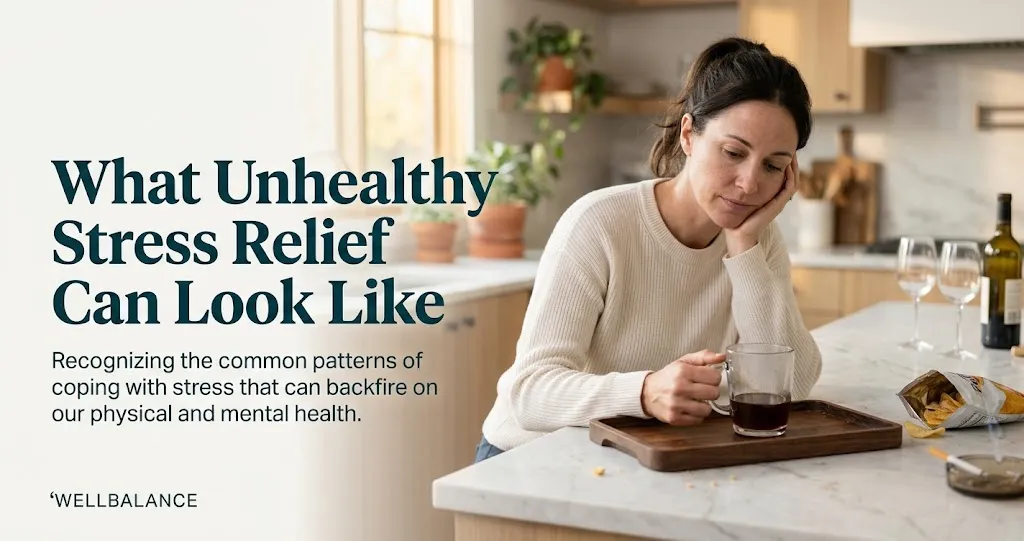
Unhealthy coping often has an immediate payoff: distraction, numbness, escape, or temporary comfort. The problem is what follows. If the strategy repeatedly interferes with sleep, responsibilities, relationships, health, or problem-solving, it may no longer be serving you well.
Examples can include repeatedly avoiding important responsibilities, withdrawing from supportive people, using excessive screen time to escape every stressful feeling, overeating as the main response to stress, or relying on other behaviors that leave you feeling worse afterward.
The same activity can also have different meanings in different situations. Watching a show for a while may be a perfectly reasonable break. Watching for hours every time an important problem appears, while repeatedly postponing necessary tasks, can become an avoidance pattern. Context and frequency matter.
Shared vs. Distinct Patterns
Both can feel relieving
Healthy and unhealthy choices may reduce uncomfortable feelings temporarily. The difference becomes clearer when you look at what happens afterward.
Healthy coping preserves options
A helpful strategy generally leaves room to return to responsibilities, connect with others, rest, or address the stressor.
Unhealthy coping narrows options
A repeated pattern may make avoidance easier in the short term while making the original problem or daily routine harder to manage.
Patterns matter most
Look at frequency, consequences, flexibility, and whether the behavior supports or disrupts your normal responsibilities.
This overlap is why judging a coping strategy by its label alone can be misleading. A more useful question is whether the choice helps you recover while keeping your life moving in a healthy direction.
Signs a Stress-Relief Habit May Be Unhelpful
Consider the pattern rather than one isolated day. Several signs can suggest that a stress-relief habit deserves a closer look.
Common Warning Signs
Swipe left/right to see the full table →
| Pattern | What to notice | Better question |
|---|---|---|
| Avoidance | Important tasks keep being delayed | Can I return to the task afterward? |
| Isolation | Supportive contact keeps shrinking | Would connection help right now? |
| Loss of control | The habit feels increasingly necessary | Can I choose another response? |
| Worsening routine | Sleep, school, work, or relationships suffer | Is my daily functioning changing? |
Note: A stress-relief habit does not need to be perfectly productive to be healthy. Rest, entertainment, quiet time, and simple distractions can all have a place in a balanced routine. The concern is when one coping method consistently replaces sleep, responsibilities, relationships, or other forms of care.
How to Tell Which Direction Your Coping Is Taking
A simple way to compare your options is to look at four areas: immediate effect, later effect, flexibility, and consequences. You do not need to score yourself perfectly. The purpose is simply to notice patterns.
Practical Priority Meter
Supports recovery
Typical routine priority: high
Protects daily functioning
Typical routine priority: high
Provides temporary escape only
Practical guide: examine the pattern
Creates additional problems
Practical guide: important warning sign
The bars are a practical guide, not scientific measurements. If a coping choice repeatedly creates consequences that are harder than the original stressor, it may be worth replacing or balancing it with another strategy.
Healthy Choices and Riskier Patterns
Swipe left/right to see the full table →
| Situation | Healthier response | Riskier pattern |
|---|---|---|
| Overloaded schedule | Prioritize and set limits | Avoid every task indefinitely |
| Mental fatigue | Take a genuine recovery break | Stay distracted until obligations pile up |
| Worry | Talk, write, breathe, or organize next steps | Repeatedly avoid the trigger |
| Need for downtime | Schedule restorative leisure | Let leisure displace basic needs |
Common Mistakes When Judging Stress Relief
One common mistake is assuming that anything enjoyable must be healthy. Enjoyment matters, but a coping strategy also needs to fit your wider life. Another mistake is assuming that something uncomfortable must be unhealthy. Exercise, having a difficult conversation, setting a boundary, or tackling a stressful task may not feel relaxing immediately, yet they can be constructive responses.
Mistake vs. Better Choice
Swipe left/right to see the full table →
| Mistake | Why it misses the point | Better approach |
|---|---|---|
| Chasing instant relief | It ignores later consequences | Check the next-day effect |
| Using one strategy for everything | Different stressors need different responses | Build several coping options |
| Avoiding every uncomfortable feeling | Avoidance can delay useful action | Use relief plus practical action |
| Ignoring persistent problems | Self-care may not address every situation | Consider professional support |
Tip: Try pairing relief with one constructive action. For example, take a short break and then identify the next small task, relax before a difficult conversation and then schedule it, or take time to decompress before returning to your normal routine.
A Simple Decision Path
Pause and identify what you are feeling or what is demanding your attention.
Choose rest, movement, breathing, connection, or another constructive activity when appropriate.
If it repeatedly harms sleep, responsibilities, relationships, or health, reconsider the pattern.
If yes, consider talking with a qualified healthcare or mental health professional.
This path is not a diagnostic test. It is simply a practical way to slow down before automatically repeating a coping habit.
Healthy Stress Relief Works Best as a Flexible Toolkit
There is rarely one perfect stress-relief method. A useful toolkit may include several options that serve different purposes: a brief calming activity for an intense moment, movement during a long day, quiet time when overstimulation is high, social support when you feel isolated, and practical planning when the stressor can be changed.
It can also help to separate what you can control from what you cannot. If the stress comes from a manageable task, breaking it into smaller steps may be more useful than trying to relax indefinitely. If the situation cannot be changed immediately, a restorative break or supportive conversation may help you handle it without adding unnecessary strain.
Do’s and Don’ts for a Balanced Coping Routine
Do: notice triggers
Understanding what repeatedly creates stress can make it easier to choose an appropriate response.
Do: vary your options
Different situations may call for rest, movement, connection, planning, or professional support.
Don’t: demand instant calm
A useful coping strategy may help you function better without making every stressful feeling disappear immediately.
Don’t: ignore the pattern
If stress keeps interfering with ordinary life, increasing support can be more useful than adding another self-help technique.
When Self-Care May Not Be Enough
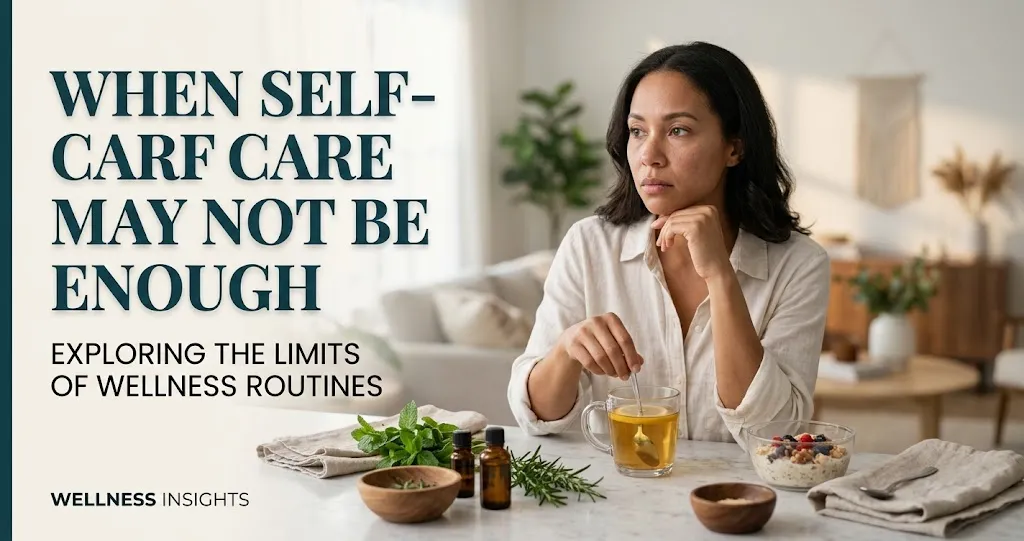
Self-care can be useful for everyday stress, but it should not become a reason to ignore persistent or worsening difficulties. Consider professional support when stress is making normal responsibilities difficult, disrupting sleep or daily functioning, causing significant distress, or continuing despite reasonable attempts to manage it.
Self-Care or Professional Support?
Swipe left/right to see the full table →
| Situation | Reasonable next step | Consider more support when |
|---|---|---|
| Occasional everyday stress | Use healthy coping tools | It becomes frequent or difficult to manage |
| Stress affects routine | Review triggers and coping patterns | Daily activities become difficult |
| Symptoms persist | Track patterns and seek guidance | Symptoms are severe, unusual, or worsening |
| You feel unable to cope | Reach out for support | Seek urgent professional help for an immediate safety concern |
When to Escalate Support
Persistent
Stress or related difficulties continue rather than settling with ordinary coping.
Worsening
The pattern is becoming more disruptive or harder to manage.
Functioning affected
School, work, relationships, sleep, or ordinary responsibilities are significantly affected.
Safety concern
An immediate safety concern warrants urgent help from a qualified professional or local emergency service.
When to contact a professional: Seek help from a licensed healthcare or mental health professional if stress or related symptoms are severe, worsening, unusual, persistent, or interfering with everyday functioning. If there is an immediate safety concern, seek urgent help from local emergency services or an appropriate crisis service.
Healthy vs Unhealthy Stress Relief: The Bottom Line
The most useful distinction is not whether a coping strategy feels relaxing in the moment. Look at the pattern over time: Does it help you recover, preserve daily functioning, maintain healthy connections, and leave you able to address the source of stress?
Healthy coping does not need to be complicated. A flexible mix of rest, movement, calming activities, supportive relationships, practical problem-solving, and appropriate professional support can provide a more balanced approach than relying on one escape habit.
If stress remains severe, unusual, persistent, or increasingly disruptive despite reasonable self-care, professional guidance can help you decide what additional support is appropriate.
Frequently Asked Questions
What is the main difference between healthy and unhealthy stress relief?
Healthy coping generally supports recovery and daily functioning without creating additional problems. Unhealthy coping may provide short-term relief but become disruptive when repeated or relied on heavily.
Can something relaxing still be unhealthy?
Yes. Relaxation itself is not the only measure. If a relaxing activity repeatedly replaces sleep, responsibilities, relationships, or necessary problem-solving, the overall pattern may be unhelpful.
Is avoiding stress always unhealthy?
No. Taking a break from a stressful situation can be useful. The concern is repeated avoidance that prevents you from handling important responsibilities or addressing an ongoing problem.
What are examples of healthy ways to relieve everyday stress?
Examples include taking a reasonable break, walking or moving, practicing slow breathing, spending time with supportive people, journaling, relaxing with music, getting adequate sleep, and organizing manageable next steps.
How can I tell if my stress-relief habit is becoming unhealthy?
Look for repeated consequences such as disrupted sleep, neglected responsibilities, reduced social connection, worsening distress, or feeling unable to choose another coping method.
When should I seek professional help for stress?
Consider professional help when stress or related symptoms are severe, worsening, unusual, persistent, or interfering with everyday functioning. An immediate safety concern should receive urgent professional attention.
Do I need to eliminate stress completely?
No. Stress is a normal part of life. The goal is to develop flexible ways to respond to stressful situations and recognize when stress is becoming difficult to manage.
Final Thoughts
Healthy stress relief is less about finding one perfect technique and more about choosing coping strategies that support your life over time. If stress becomes severe, worsening, unusual, persistent, or difficult to manage, consider speaking with a qualified healthcare or mental health professional.
Author
-

Hi, I’m Ryan Mitchell, a wellness and relaxation writer at RemedyTip.com, where I focus on helping readers better understand stress management, relaxation techniques, mindfulness, sleep improvement, and everyday wellness habits. I have developed a strong knowledge of the Wellness & Relaxation field through sustained learning, in-depth research, and a continued commitment to exploring practical approaches to well-being.
My work focuses on researching wellness topics, examining available evidence, and turning complex information into clear, accessible, and actionable guidance. I’m continually exploring new findings, relaxation practices, and lifestyle strategies to help readers make informed decisions about their daily wellness routines. At RemedyTip.com, my goal is to share trustworthy, research-informed content that encourages healthier habits, greater relaxation, and a more balanced lifestyle.