Written by Alex Turner · General educational information
Quick Answer: A percussion massager can be used around some neck and shoulder muscles, but direct use on the front, sides, throat, spine, or bony areas of the neck is not a good DIY approach. Safer use focuses on nearby muscle tissue with low intensity, light pressure, and short sessions.
Using Percussion Massage Around the Neck
Neck tightness can make a percussion massager seem like an easy solution, especially after long hours at a desk, driving, exercising, or holding your head in one position. The important distinction is between working on a broad muscle area near the neck and placing a vibrating percussion device directly over vulnerable structures.
For most people considering home use, the safer strategy is conservative: work on suitable muscle tissue around the upper shoulders and upper back rather than chasing painful spots on the neck itself. If symptoms are unusual, severe, persistent, or linked with an injury or neurological symptoms, professional assessment is more appropriate than self-massage.
Safety & trust note: This article is for general educational information only. It does not diagnose, treat, cure, or prevent any condition. It does not replace advice from a licensed healthcare professional. Readers should seek professional help for severe, worsening, unusual, or persistent symptoms.
Why Neck Percussion Needs Extra Caution
The neck is not simply a smaller version of a shoulder or thigh. It contains the cervical spine, nerves, blood vessels, airway-related structures, and several areas that are not appropriate targets for forceful percussion. A percussion device is designed to deliver repeated mechanical pulses, so putting it over the wrong structure can create unnecessary pressure.
That does not mean every muscle near the neck should be treated as off-limits. Cleveland Clinic notes that properly used percussion devices may be used on areas where people carry muscular tension, including the neck and shoulders, while also advising users to stay on muscle rather than bone and to avoid areas such as the bony nape. :contentReference[oaicite:1]{index=1}
The practical lesson is simple: location matters more than the name of the body part. A broad upper-trapezius muscle area is different from the front or side of the neck. If you cannot clearly identify a safe muscular target, do not improvise with a high-powered device.
Practical safety decision path
If yes, continue cautiously. If not, stop.
If yes, choose a different area.
Skip self-percussion and seek professional guidance.
Use the lowest comfortable setting with light pressure and a short session.
This decision path is a practical safety guide, not a diagnosis. It is especially important when symptoms do not behave like ordinary muscle tightness.
Safer Areas vs Areas to Avoid
The safest home approach is to keep percussion away from delicate structures and focus on broad muscle tissue. Product manufacturers also commonly list direct application to the face, throat, head, and neck among situations requiring avoidance or professional guidance. :contentReference[oaicite:2]{index=2}
Swipe left/right to see the full table →
| Area | Practical approach | Why |
|---|---|---|
| Upper shoulders | More suitable muscle target | Broad muscular tissue |
| Upper back | Keep pressure gentle | Avoid spine and bones |
| Front of neck | Avoid direct percussion | Contains vulnerable structures |
| Bony spine | Avoid direct contact | Not a muscle target |
How to Use a Percussion Massager More Conservatively
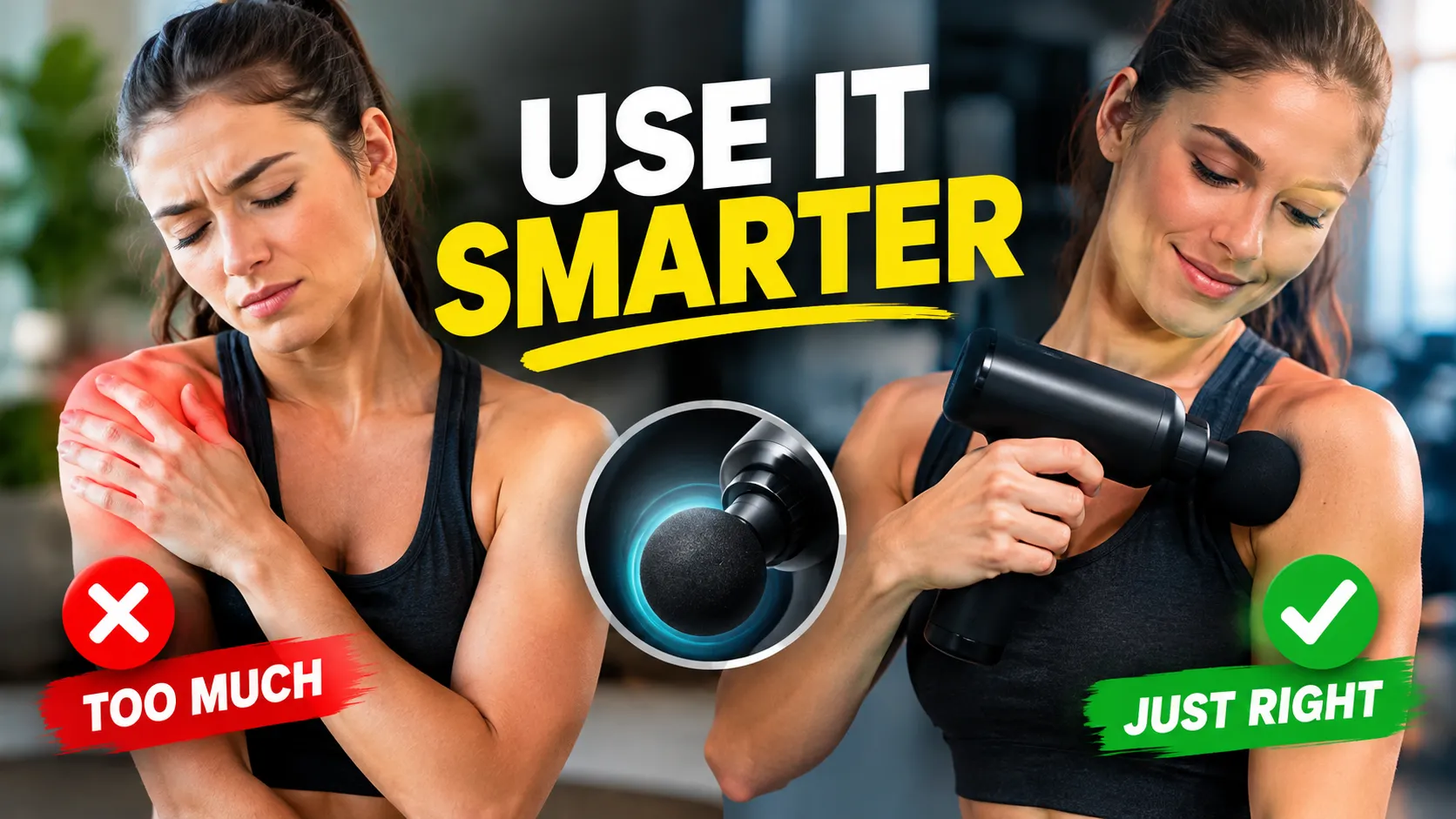
If your goal is simply to loosen muscular tension around the neck and shoulders, you do not need to make the neck itself the main target. A conservative routine can work outward from the uncomfortable area toward larger, easier-to-identify muscle groups.
1
Choose a broad muscle area. Start with the upper shoulder or upper-back muscle rather than the front or side of the neck.
2
Begin at the lowest comfortable setting. More speed or force is not automatically better for tight muscles.
3
Keep the device moving. Avoid holding percussion over one small point for an extended period.
4
Use short passes. A brief exposure lets you reassess how the tissue feels before doing more.
5
Stop if symptoms change. Pain, numbness, tingling, dizziness, weakness, or other unusual symptoms are reasons to stop rather than increase intensity.
Tip: Cleveland Clinic guidance on percussion therapy emphasizes starting gently, using short sessions, and reducing intensity or moving to another location if an area becomes painful. :contentReference[oaicite:3]{index=3}
Typical routine priority — practical guide
These percentages are visual labels for practical routine priority, not scientific measurements.
The main idea is to reduce unnecessary force. If a technique requires you to press hard to feel an effect, switch to a gentler method or ask a professional for guidance.
Safe Routine vs Risky Routine
Swipe left/right to see the full table →
| Safer choice | Riskier choice | Reason |
|---|---|---|
| Low setting | Maximum power | Limits unnecessary force |
| Broad muscle | Spine or throat | Targets tissue more appropriately |
| Brief passes | Long pressure | Makes reassessment easier |
| Stop with unusual symptoms | Push through symptoms | Avoids ignoring warning signs |
Who Should Be More Careful?
Extra caution is appropriate if you have a recent injury or surgery, altered sensation, significant bone or spine problems, circulation concerns, bleeding problems, or another condition that could change how you respond to pressure or vibration. Therabody’s safety guidance lists several of these circumstances as precautions or contraindications and advises professional guidance when they apply. :contentReference[oaicite:4]{index=4}
Medication can matter too. For example, people taking medicines that affect bleeding or sensation may need individualized advice before using percussion equipment. A device manual should also be treated as part of the safety instructions rather than as an optional suggestion.
Situations That Change the Decision
Swipe left/right to see the full table →
| Situation | Practical choice | Next step |
|---|---|---|
| Recent neck injury | Avoid self-percussion | Ask a professional |
| Numbness or altered sensation | Do not rely on sensation | Seek guidance |
| Blood-thinning medicine | Use only with advice | Discuss with healthcare team |
| Normal muscle tightness | Conservative routine | Reassess after brief use |
Warning: Do not use a percussion massager simply because a painful spot feels like a “knot.” Pain can have causes other than ordinary muscle tightness, and stronger percussion is not a reliable way to determine what is causing it.
Warning Signs That Should Change Your Plan
Neck symptoms deserve more attention when they occur with neurological symptoms, significant injury, fever, or other unusual changes. Mayo Clinic advises urgent medical evaluation for severe neck pain associated with traumatic injury, weakness, trouble walking, or high fever. :contentReference[oaicite:5]{index=5}
Red-flag checklist dashboard
Severe neck symptoms after a fall, crash, blow, or other trauma need professional evaluation.
New weakness in an arm or leg is not a reason to increase massage intensity.
Numbness, tingling, unusual sensation, or trouble walking deserves attention.
These symptoms can require medical assessment rather than home percussion.
If any of these warning signs are present, the useful next step is evaluation, not experimenting with a stronger attachment or higher setting.
Self-Care or Professional Help?
Swipe left/right to see the full table →
| Situation | General direction | Why |
|---|---|---|
| Mild, familiar tightness | Conservative self-care | May fit a simple muscle-care routine |
| Persistent or worsening symptoms | Professional guidance | Cause may need assessment |
| Neurological symptoms | Stop and seek help | Not appropriate for trial-and-error massage |
| Severe pain after trauma | Urgent medical assessment | Injury needs evaluation |
Common Mistakes With Neck Percussion
Do this / not that
Choose broad, clearly identifiable muscle tissue around the shoulders and upper back.
Use the device directly over the throat, front of the neck, spine, or bony areas.
Start gently and reassess how the area responds.
Increase force because a spot feels tight, sore, or difficult to reach.
Another common mistake is assuming that discomfort means the device is “working.” Cleveland Clinic specifically notes that more intensity is not always better with percussive therapy and recommends reducing speed or intensity if an area becomes painful. :contentReference[oaicite:6]{index=6}
A Simple Risk Gauge
General practical guide — not a medical risk score
Clearly identified muscle area, low setting, brief use, no unusual symptoms.
Recent injury, altered sensation, significant medical conditions, or uncertainty about the target area.
Severe pain, new weakness, neurological symptoms, fever, or significant trauma.
The gauge is meant to simplify the decision, not label your medical condition. When the situation is uncertain, choosing less force and getting professional advice is more appropriate than testing the limits of the device.
Safer Alternatives for Neck Tension

If the goal is general comfort rather than percussion itself, there are gentler options. Cleveland Clinic and Mayo Clinic both describe approaches such as gentle massage, stretching, and heat or cold as possible self-care measures for some forms of neck muscle discomfort. :contentReference[oaicite:7]{index=7}
For example, you might try a warm shower, gentle shoulder movement, slow neck mobility within a comfortable range, or hands-only massage of accessible muscle tissue. These options make it easier to control pressure and stop immediately if something feels wrong.
Do not use an alternative simply to avoid getting medical care. If symptoms persist, worsen, follow an injury, or include neurological changes, the more useful next step is professional assessment.
When to Contact a Professional
When to contact a professional:
- Neck pain is severe, worsening, unusual, or persistent.
- Symptoms started after a significant fall, collision, or other trauma.
- You develop weakness, numbness, tingling, trouble walking, or other neurological changes.
- Severe neck pain occurs with fever or other concerning symptoms.
- You have a medical condition, recent surgery, altered sensation, or medication issue that may affect safe percussion use.
Mayo Clinic recommends urgent evaluation for severe neck pain associated with trauma, weakness, difficulty walking, or high fever. :contentReference[oaicite:8]{index=8}
Frequently Asked Questions
Can you use a percussion massager on your neck?
Some percussion therapy guidance allows carefully targeted muscle use around the neck and shoulders, but direct application to the throat, front or side of the neck, spine, and bony areas should be avoided. :contentReference[oaicite:9]{index=9}
Can a massage gun be used on the back of the neck?
The back of the neck contains muscle and bony structures, so direct percussion should not be treated as automatically safe. A safer approach is to target suitable shoulder or upper-back muscle areas instead.
Can you use a percussion massager on the front of your neck?
No DIY percussion approach should target the front of the neck. The area contains important structures, and manufacturer safety guidance specifically lists direct application to the throat and neck among areas to avoid or discuss with a professional. :contentReference[oaicite:10]{index=10}
What setting should I use on a massage gun for neck tension?
If using a device on an appropriate nearby muscle area, begin with the lowest comfortable setting and light pressure. More intensity is not necessarily better.
Can a percussion massager make neck pain worse?
It can be uncomfortable or aggravating if used too forcefully, on an unsuitable area, or when the underlying problem needs assessment. Stop if pain or unusual symptoms develop.
Who should avoid using a percussion massager on the neck?
People with recent injury or surgery, altered sensation, certain circulation or bleeding problems, significant medical conditions, or uncertainty about safe use should seek individualized professional guidance. :contentReference[oaicite:11]{index=11}
When should neck pain be checked by a doctor?
Seek professional help for severe, worsening, unusual, or persistent symptoms, especially after trauma or when weakness, numbness, trouble walking, or fever occurs. :contentReference[oaicite:12]{index=12}
Final Thoughts
A percussion massager may have a place in a careful muscle-care routine, but the neck is an area where target selection matters. Keep direct percussion away from the throat, front and side of the neck, spine, and bony structures, and favor gentle work on suitable shoulder or upper-back muscles instead.
If symptoms are severe, worsening, unusual, persistent, or connected with injury or neurological changes, skip the device and seek professional guidance.
Author
-

I’m Alex Turner, a massage product reviewer and wellness writer at RemedyTip. I specialize in researching, evaluating, and comparing massage and recovery products to help readers make informed purchasing decisions. My focus is on practical, evidence-informed product guidance covering muscle recovery, relaxation, everyday comfort, and wellness.
I take a research-driven approach to every product I review. I examine product specifications, features, materials, performance claims, user feedback, durability, comfort, ease of use, and overall value. When appropriate, I also consult trusted industry and health-related sources to verify important information and provide readers with a more complete and balanced view.
I cover a wide range of products, including massage guns, handheld massagers, neck and shoulder massagers, foot massagers, massage chairs, foam rollers, and other recovery tools. Rather than focusing only on marketing claims, I look at how products compare in real-world use and who they are actually suitable for. I also consider different budgets, use cases, and user needs when making recommendations.
At RemedyTip, I’m committed to accuracy, transparency, and unbiased product information. I clearly distinguish between manufacturer claims, available evidence, and my own product analysis so readers can understand the basis of each recommendation. I continuously research new products, technologies, and developments in the massage and recovery space to keep my content current and useful.
My goal is simple: to provide trustworthy, easy-to-understand information that helps readers choose massage and recovery products with greater confidence.