
Written by Alex Turner
Quick Answer:
Massage cream mainly works by making the skin easier to massage while adding moisture and, in some products, creating sensations such as cooling or warming. Its effects depend on the formula and how the cream is used.
What Massage Cream Actually Does
If you are wondering how does massage cream work, the simplest answer is that the cream changes the way your hands move across the skin. A suitable formula can reduce drag, make repeated strokes more comfortable, and help prevent the skin from feeling overly dry during a massage.
Some formulas also contain ingredients intended to moisturize the skin or create a cooling, warming, or soothing sensation. Those effects should not be confused with proof that a cream is reaching deep muscle tissue or treating an underlying medical condition.
Important: This article is for general educational information only. It does not diagnose, treat, cure, or prevent any condition. It does not replace advice from a licensed healthcare professional. Readers should seek professional help for severe, worsening, unusual, or persistent symptoms.
How Massage Cream Works on the Skin
Massage cream is usually designed to create a more controlled surface between your hands and the skin. Without enough lubrication, repeated rubbing can create more friction and make a massage feel rough or uncomfortable. A cream can provide slip, allowing the hands to move with less resistance.
That surface effect is one of the main reasons people use a cream during massage. The product does not need to penetrate deeply to make the massage itself easier. In fact, the physical properties of creams and other lubricating products can substantially change friction at the skin surface.
Good to know: The massage action and the cream are two different parts of the experience. Massage involves physical pressure and movement, while the cream mainly changes skin contact, glide, moisture, and—depending on its ingredients—sensory effects.
Why Glide Matters
Better glide can make it easier to perform smooth strokes without repeatedly pulling at the skin. This can be particularly useful when a massage involves many passes over the same general area. The right amount of product is important: too little may create unnecessary drag, while too much can make the surface difficult to control.
Massage cream can therefore be useful even when it contains no special active ingredient. A basic moisturizing formula may simply provide a comfortable surface for massage.
Practical ingredient-to-function map
Help condition the skin and improve comfort during repeated contact.
Can contribute to a smoother, more lubricated surface.
May create a noticeable cooling sensation in formulas designed for that purpose.
Some formulas create a feeling of warmth or stimulation at the skin surface.
The important distinction is that an ingredient’s sensory effect is not automatically evidence that it reaches the underlying muscle or fixes the source of discomfort.
What Ingredients Are Commonly Used?
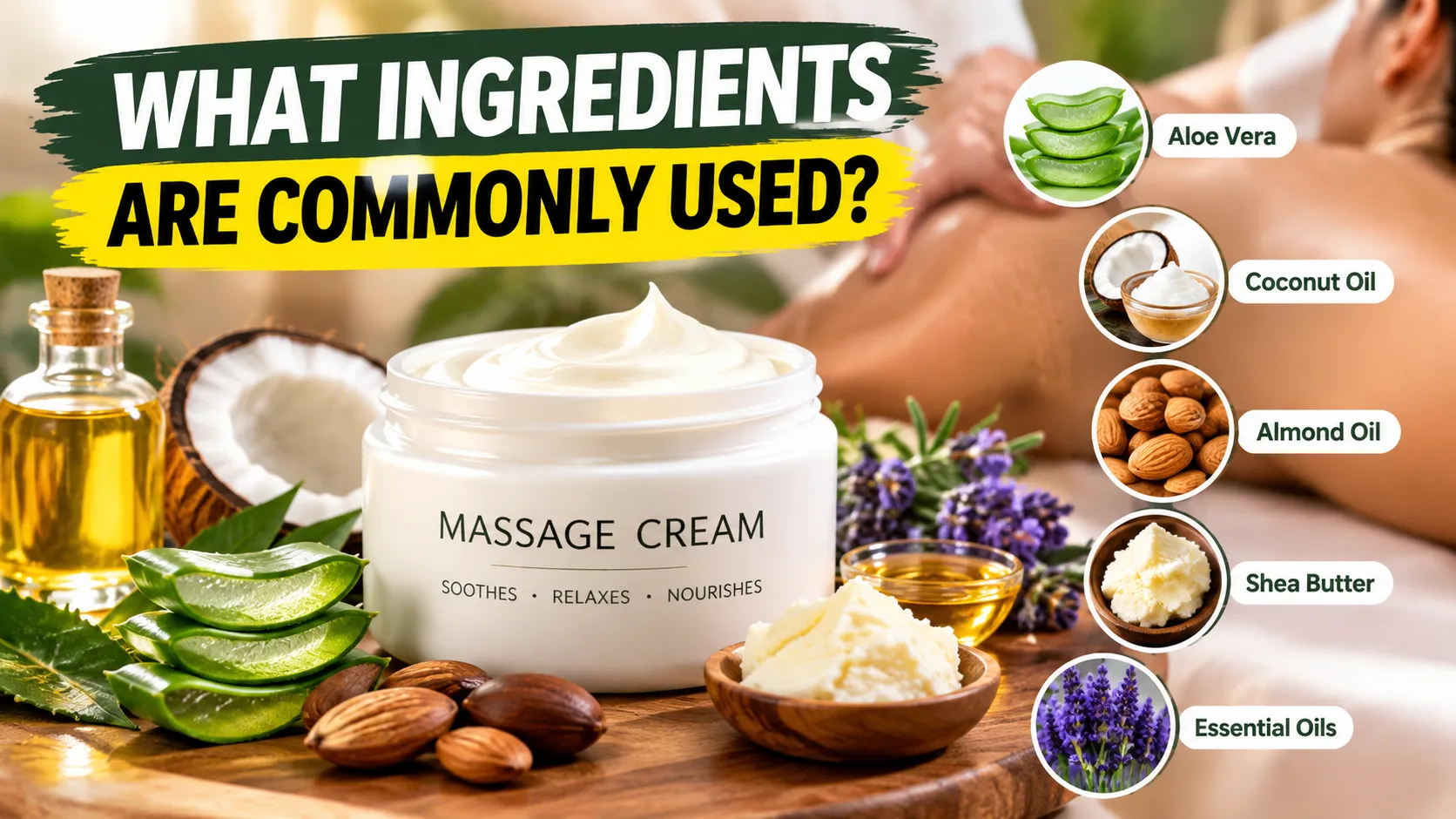
There is no single standard massage-cream formula. Products can be simple moisturizing creams, richer body creams, or topical products formulated around a particular sensation or intended use. Reading the label is therefore more useful than judging a product by the word “massage” alone.
Ingredient Roles at a Glance
The table below separates ingredients by their practical role rather than assuming every product provides the same effect.
Swipe left/right to see the full table →
| Ingredient type | Main role | What to expect |
|---|---|---|
| Glycerin | Moisture support | Helps the skin feel conditioned |
| Dimethicone | Skin conditioning | Can create a smoother surface |
| Menthol | Cooling sensation | May feel cool on application |
| Botanical oils | Emollience and glide | Formula-dependent feel and fragrance |
Ingredients vary considerably between products. For example, official U.S. drug labeling databases contain massage products with ingredients such as glycerin and dimethicone, while other topical products use ingredients such as menthol for a cooling sensation. Always check the specific product label rather than assuming that all massage creams behave alike.
Massage Cream Benefits vs. Limitations
Understanding how does massage cream work becomes easier when you separate practical benefits from claims that go beyond what the product can reasonably do. A cream can improve the massage experience, but the presence of a topical ingredient does not automatically mean the product addresses a deeper cause of pain or stiffness.
Practical benefit dashboard
Improving hand glide and making massage more comfortable.
Adding moisture or reducing the dry feeling caused by repeated rubbing.
Cooling, warming, fragrance, and other sensory experiences.
A pleasant sensation does not prove deep tissue action or treatment of an underlying condition.
This distinction matters because massage itself can produce physical responses through pressure and movement, while a topical product can mainly change the surface experience. Research on massage therapy has examined several types of pain, but the evidence varies by condition and does not mean every massage cream has the same effects.
Benefits and Limits Side by Side
Swipe left/right to see the full table →
| Possible benefit | Why it may help | Limitation |
|---|---|---|
| Better glide | Less surface drag | Does not identify a pain cause |
| Skin moisture | Conditioning ingredients | Formula determines the effect |
| Cooling or warmth | Specific topical ingredients | Sensation is not proof of deep action |
| Massage comfort | Combines glide and skin feel | Not a substitute for evaluation |
How to Use Massage Cream in a Simple Routine
A good routine does not require a large amount of cream. Start with the product directions and use enough to create comfortable movement without leaving the skin excessively slippery.
Simple routine flow
Check directions and warnings.
Use a modest amount on intact skin.
Use comfortable, controlled movements.
Stop if irritation or unusual symptoms develop.
A Few Practical Choices
Use clean hands and follow the label. Avoid applying products to broken or irritated skin unless the product specifically says otherwise. Keep topical products away from the eyes and mouth. If a formula contains a strong cooling or warming ingredient, do not assume that applying more will produce a better result.
If the goal is simply massage glide, a straightforward moisturizing cream may be enough. If a product is marketed as a topical pain reliever, treat it as a different category and follow its Drug Facts directions carefully.
Safe Routine vs. Risky Routine
Swipe left/right to see the full table →
| Safer choice | Riskier choice | Why |
|---|---|---|
| Follow label directions | Use more than directed | More product is not automatically better |
| Use on intact skin | Apply over damaged skin | May increase irritation |
| Wash hands afterward | Touch eyes after application | Helps avoid accidental eye exposure |
| Stop if rash develops | Keep applying despite irritation | Irritation deserves attention |
Choosing the Right Type for Your Goal
Not everyone needs the same type of cream. The best fit depends on whether your main goal is simple massage glide, skin conditioning, or a specific topical sensation.
Swipe left/right to see the full table →
| Your goal | Look for | Consider avoiding |
|---|---|---|
| Basic massage glide | Simple cream or emollient base | Ingredients you know irritate your skin |
| Dry-feeling skin | Moisturizing ingredients | Unnecessary fragrance if sensitive |
| Cooling sensation | A clearly labeled cooling formula | Using extra product to intensify sensation |
| Topical pain product | Official Drug Facts information | Treating it like ordinary moisturizer |
Tip: If your only goal is comfortable massage, start with the simplest formula that meets that goal. Fewer unnecessary features can also make it easier to identify which ingredient may be responsible if your skin reacts.
Common Mistakes When Using Massage Cream
Many problems come from treating every massage cream as though it were interchangeable. The label, active ingredients, intended use, and warnings can differ substantially between products.
Do’s and don’ts
Read the directions before applying a topical product.
Use enough cream for comfortable movement rather than maximum coverage.
Assume a strong cooling or warming sensation means the product is working deeper.
Continue using a product after significant irritation, rash, or other unusual reaction.
Mistake vs. Better Choice
Swipe left/right to see the full table →
| Common mistake | Better choice | Reason |
|---|---|---|
| Choosing by marketing claims | Check the ingredient and use information | Labels give more useful product details |
| Applying too much | Start with a modest amount | Improves control and reduces waste |
| Ignoring irritation | Stop and reassess the product | Persistent reactions need attention |
| Expecting a cure | Use it for the role stated on the label | Topicals have specific intended uses |
When a Massage Cream May Not Be the Right Answer
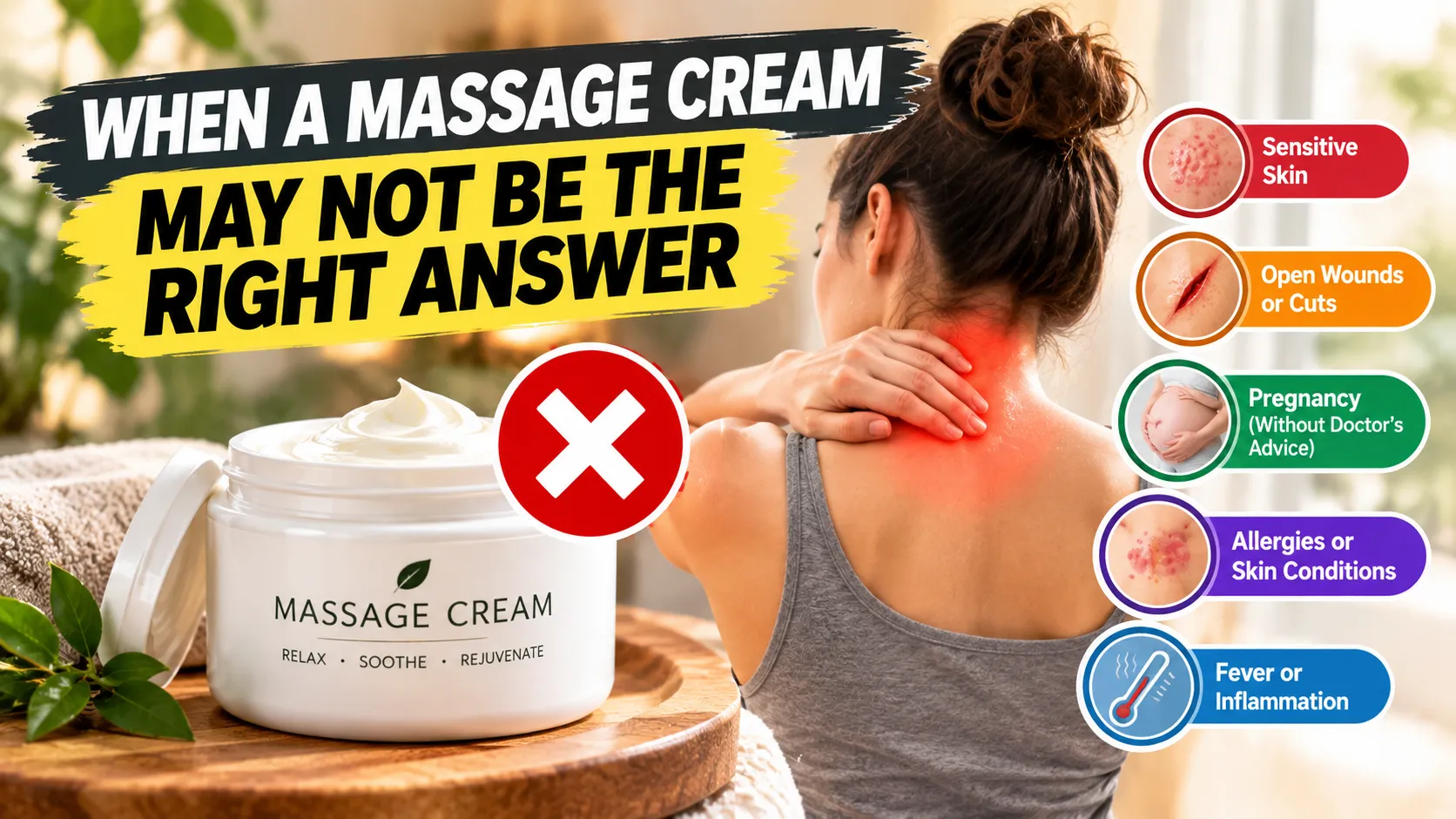
A topical cream can improve the massage experience, but persistent or unexplained symptoms should not simply be covered up with a product. If discomfort is severe, worsening, unusual, or continues despite reasonable self-care, professional evaluation may be more appropriate.
Safety decision path
Skin is intact, symptoms are mild, and the product label fits the intended use.
Burning, rash, significant irritation, or another unusual reaction develops.
Symptoms are persistent, severe, worsening, or difficult to explain.
Serious warning symptoms such as significant weakness, numbness, chest pain, major injury, fever with concerning symptoms, or loss of bladder or bowel control require prompt medical attention.
When to contact a professional: Seek medical advice for severe, worsening, unusual, or persistent pain; numbness or weakness; symptoms after a significant injury; fever with concerning symptoms; chest pain; or loss of bladder or bowel control. A new or persistent symptom should not be assumed to be a simple muscle problem because a massage cream feels soothing.
A Practical Decision Rule
If the goal is simply to make massage smoother and more comfortable, a basic cream that suits your skin may be sufficient. If you are using a topical product because of ongoing pain or another persistent symptom, read the product label carefully and consider whether professional guidance is appropriate instead of relying only on the sensation produced by the cream.
Frequently Asked Questions
How does massage cream work?
It can reduce surface friction, improve hand glide, condition the skin, and sometimes create cooling or warming sensations depending on its ingredients.
Does massage cream penetrate into muscle?
A cream’s surface feel does not prove that it penetrates deeply into muscle. What happens depends on the specific formulation and active ingredients.
What is the main purpose of massage cream?
For many products, the main practical purpose is to improve glide and comfort during massage while helping condition the skin.
Can massage cream make skin feel warmer or cooler?
Yes. Some topical formulas contain ingredients designed to create cooling or warming sensations. The sensation varies by product and person.
Is massage cream the same as a pain-relief cream?
Not necessarily. A basic massage cream may mainly provide glide and moisture, while an OTC pain-relief cream has specific active ingredients, uses, and label directions.
Can massage cream irritate the skin?
Yes. Any topical product can be unsuitable for some people. Stop using it if a rash or significant irritation develops and seek professional advice if the reaction is persistent or concerning.
Final Thoughts
Understanding how does massage cream work starts with separating the cream’s surface effects from the physical effects of massage. A suitable formula can improve glide, support skin comfort, and sometimes provide a cooling or warming sensation, but those effects do not automatically mean the product is treating an underlying problem.
Choose products according to their actual label and your intended use. If symptoms are severe, worsening, unusual, persistent, or not improving, seek advice from a qualified healthcare professional rather than relying on topical massage products alone.
Author
-

I’m Alex Turner, a massage product reviewer and wellness writer at RemedyTip. I specialize in researching, evaluating, and comparing massage and recovery products to help readers make informed purchasing decisions. My focus is on practical, evidence-informed product guidance covering muscle recovery, relaxation, everyday comfort, and wellness.
I take a research-driven approach to every product I review. I examine product specifications, features, materials, performance claims, user feedback, durability, comfort, ease of use, and overall value. When appropriate, I also consult trusted industry and health-related sources to verify important information and provide readers with a more complete and balanced view.
I cover a wide range of products, including massage guns, handheld massagers, neck and shoulder massagers, foot massagers, massage chairs, foam rollers, and other recovery tools. Rather than focusing only on marketing claims, I look at how products compare in real-world use and who they are actually suitable for. I also consider different budgets, use cases, and user needs when making recommendations.
At RemedyTip, I’m committed to accuracy, transparency, and unbiased product information. I clearly distinguish between manufacturer claims, available evidence, and my own product analysis so readers can understand the basis of each recommendation. I continuously research new products, technologies, and developments in the massage and recovery space to keep my content current and useful.
My goal is simple: to provide trustworthy, easy-to-understand information that helps readers choose massage and recovery products with greater confidence.

