By Alex Turner
Making your own massage oil is a simple, low-cost way to build a relaxing self-care routine that fits your skin and preferred scent. With just a carrier oil and a few careful choices, you can create a blend that feels custom-made without guessing at ingredients.
Carrier Oils Safe Dilution DIY Steps Patch Testing Storage Tips
Why People Choose to Make Their Own Massage Oil
Store-bought massage oils often include fragrance blends or fillers that some people would rather avoid. Learning how to make your own massage oil lets you control exactly what touches your skin, adjust the scent, and match the oil to your skin type. It also tends to be more affordable over time, since a single bottle of carrier oil can make several batches.
A homemade blend can support a calmer bedtime routine, a post-workout cooldown, or simple everyday relaxation. The key is choosing a suitable carrier oil, diluting any essential oil correctly, and testing the blend before full use.
Step-by-Step: How to Make Your Own Massage Oil
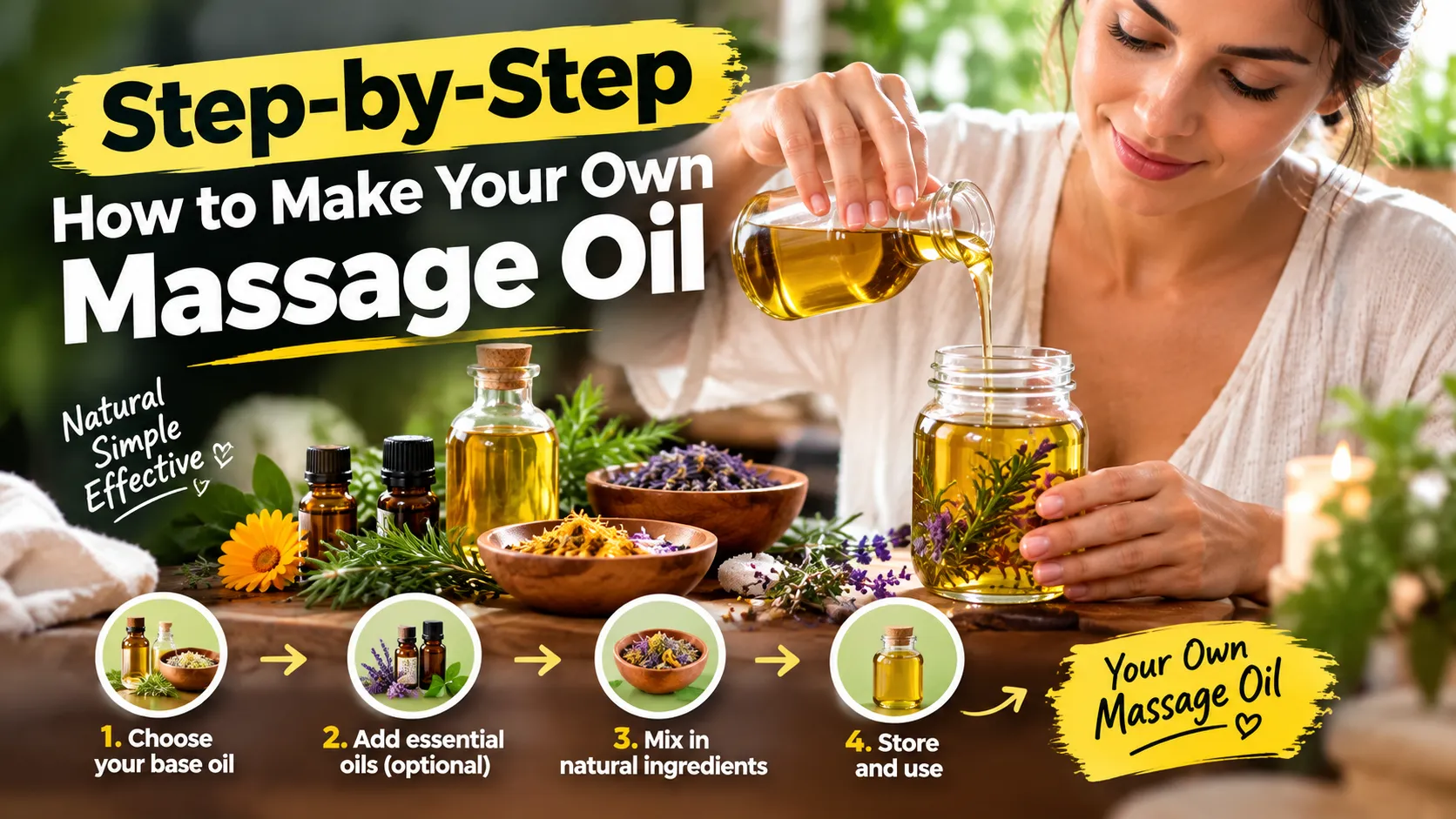
Here is a simple routine for how to make your own massage oil at home using basic kitchen tools.
1
Choose one carrier oil (about 100ml) such as sweet almond, jojoba, or grapeseed oil, based on your skin type.
2
Pour the carrier oil into a clean, dark glass bottle to protect it from light.
3
If using essential oil, add drops slowly, keeping total dilution around 1-3% for body use.
4
Cap the bottle and gently swirl, rather than shake, to blend evenly.
5
Patch test a small amount on your inner forearm and wait 24 hours before full use.
6
Label the bottle with the date and ingredients, and store it in a cool, dark spot.
Here’s the mixing routine as a simple flow, so you can see how each part connects.
Following this order each time helps your homemade massage oil stay consistent, safe, and easy to repeat.
Tools and Ingredients You’ll Need
Swipe left/right to see the full table →
| Item | Purpose |
|---|---|
| Dark glass bottle | Protects oil from light and slows spoilage |
| Carrier oil | Base for the blend and main moisturizing layer |
| Measuring spoon | Keeps carrier-to-essential-oil ratio accurate |
| Essential oil (optional) | Adds scent; always used in small, diluted amounts |
| Label and marker | Tracks date made and ingredients used |
Choosing a Carrier Oil That Fits Your Skin
Swipe left/right to see the full table →
| Carrier Oil | Best Fit |
|---|---|
| Sweet almond oil | Normal to dry skin; light, absorbs well |
| Jojoba oil | Oily or acne-prone skin; closely mimics natural oils |
| Grapeseed oil | Combination skin; thin texture, low scent |
| Coconut oil (fractionated) | Very dry skin; stays liquid, rich feel |
A quick practical guide to how much essential oil to add relative to carrier oil for common uses.
Face-area blends
General body massage
Larger muscle areas
These are typical routine priorities, not fixed rules — always start lower and increase only if your skin tolerates it well.
Common Mistakes When Making Massage Oil
Swipe left/right to see the full table →
| Mistake | Better Choice |
|---|---|
| Skipping the patch test | Always test on your inner arm first and wait 24 hours |
| Using too much essential oil | Keep dilution around 1-3% of total blend |
| Storing in clear plastic | Use dark glass bottles away from heat and sun |
| Applying near eyes or broken skin | Avoid sensitive areas and any irritated skin |
A simple do’s and don’ts view for anyone learning how to make your own massage oil safely.
Do
Patch test, dilute lightly, and store in a labeled dark bottle.
Don’t
Use undiluted essential oil directly on skin or near eyes.
Troubleshooting Your Blend
If the oil feels too greasy, use less per application or switch to a lighter carrier oil like grapeseed. If the scent fades quickly, essential oils may have oxidized — store bottles tightly capped and away from warmth. If your skin feels irritated, stop use and rinse with mild soap and water.
Pro Tips for a Better DIY Massage Oil
Warm the bottle briefly in your hands before use rather than microwaving it. Keep a simple log of ratios that worked well for your skin. If you enjoy layered scents, add oils one at a time and test between additions rather than combining several at once.
Watch for these signs that a blend isn’t right for your skin.
Redness or rash
Appears within minutes to hours after applying the blend.
Burning or stinging
Discomfort that doesn’t fade after rinsing the area.
Swelling
Puffiness around the area where oil was applied.
Breathing changes
Any tightness or difficulty breathing after scent exposure.
When Results Don’t Improve
If your homemade massage oil isn’t helping with relaxation or your skin still reacts after adjusting the recipe, the issue may not be the blend itself. Persistent skin irritation, ongoing muscle discomfort, or unexplained symptoms deserve a closer look from a professional rather than more trial and error at home.
For more on essential oil safety, see NCCIH’s aromatherapy overview and AAD’s skin care guidance.
Pure Sweet Almond Carrier Oil
A light, easily absorbed base that may support a comfortable, everyday DIY massage oil routine.
Amber Glass Bottles with Dropper
Dark glass storage that can help make daily care easier by keeping your homemade blend protected from light.
Frequently Asked Questions
How to make your own massage oil without essential oils?
Simply use a carrier oil like sweet almond or jojoba on its own. It still provides slip and moisture without any added scent.
What’s the best carrier oil for making your own massage oil?
Sweet almond oil suits most skin types, while jojoba works well for oily or acne-prone skin.
How much essential oil should I add?
Keep total dilution around 1-3% for body use, which is roughly 5-9 drops per 30ml of carrier oil.
How long does homemade massage oil last?
Most blends stay fresh for 3-6 months when stored in a cool, dark place in a sealed bottle.
Is it safe to make your own massage oil during pregnancy?
Some essential oils aren’t recommended during pregnancy, so check with a healthcare professional before adding any scented oil.
Can I use coconut oil to make my own massage oil?
Yes, fractionated coconut oil works well since it stays liquid and has minimal scent of its own.
Why did my homemade massage oil cause a reaction?
This usually means the essential oil concentration was too high or the patch test step was skipped before full use.
Now that you know how to make your own massage oil, the process really comes down to a good carrier oil, careful dilution, and a proper patch test. Start with a simple blend, take notes on what works for your skin, and adjust gradually. If irritation, pain, or discomfort is severe, worsening, or doesn’t improve, check in with a healthcare professional rather than continuing to self-treat.
Author
-

I’m Alex Turner, a massage product reviewer and wellness writer at RemedyTip. I specialize in researching, evaluating, and comparing massage and recovery products to help readers make informed purchasing decisions. My focus is on practical, evidence-informed product guidance covering muscle recovery, relaxation, everyday comfort, and wellness.
I take a research-driven approach to every product I review. I examine product specifications, features, materials, performance claims, user feedback, durability, comfort, ease of use, and overall value. When appropriate, I also consult trusted industry and health-related sources to verify important information and provide readers with a more complete and balanced view.
I cover a wide range of products, including massage guns, handheld massagers, neck and shoulder massagers, foot massagers, massage chairs, foam rollers, and other recovery tools. Rather than focusing only on marketing claims, I look at how products compare in real-world use and who they are actually suitable for. I also consider different budgets, use cases, and user needs when making recommendations.
At RemedyTip, I’m committed to accuracy, transparency, and unbiased product information. I clearly distinguish between manufacturer claims, available evidence, and my own product analysis so readers can understand the basis of each recommendation. I continuously research new products, technologies, and developments in the massage and recovery space to keep my content current and useful.
My goal is simple: to provide trustworthy, easy-to-understand information that helps readers choose massage and recovery products with greater confidence.