
Written by Alex Turner
Quick Answer: Warming massage oil slightly is usually fine and feels more comfortable than cold oil. It should only be barely warm to the touch — never hot. Skip direct heat sources like microwaves and stovetops, always test a drop on your inner wrist first, and avoid heat entirely on numb, broken, or irritated skin.
Cold oil hitting warm skin is a small shock. Muscles tense, the person flinches, and the first minute of a massage gets spent recovering instead of relaxing. So it makes sense that people ask whether they should heat massage oil before using it — and the honest answer is that a little warmth helps a lot, while too much warmth is one of the easiest ways to cause a minor burn at home.
This guide walks through what warming actually does, which heating methods are reasonably safe, which ones are not worth the risk, how to test temperature properly, and the situations where warm oil should be skipped altogether.
This article is for general educational information only. It does not diagnose, treat, cure, or prevent any condition. It does not replace advice from a licensed healthcare professional. Readers should seek professional help for severe, worsening, unusual, or persistent symptoms.
What warming the oil actually changes
Warm oil does two simple things. It spreads more easily, because most carrier oils thin slightly as their temperature rises, and it feels less startling on the skin. That second part matters more than people expect. When oil lands cold, the natural reaction is a quick muscle contraction — exactly the opposite of what a massage is meant to encourage. Oil at roughly body temperature skips that reaction entirely.
What warming does not do is change the oil into something medicinal. A warm oil is not stronger, deeper, or more effective at reaching muscle tissue. Skin is a barrier, and gentle surface warmth stays mostly at the surface. Any added comfort comes from the sensation and from more relaxed handling, not from the oil penetrating further. Treating warmth as a performance upgrade is where people start overheating it.
There is also a practical benefit for thicker oils. Products that are semi-solid at room temperature — unrefined coconut oil, shea-based blends, heavy balms — become much easier to apply once they soften. In a cold room, warming may be the only way to use them at all without dragging on the skin.
Note: “Warm” here means close to skin temperature — the way bathwater feels neutral rather than hot. If you can clearly feel heat when you touch it, it has already gone past the comfortable range for an area you plan to rub for several minutes.
Should you heat massage oil, or just warm it in your hands?
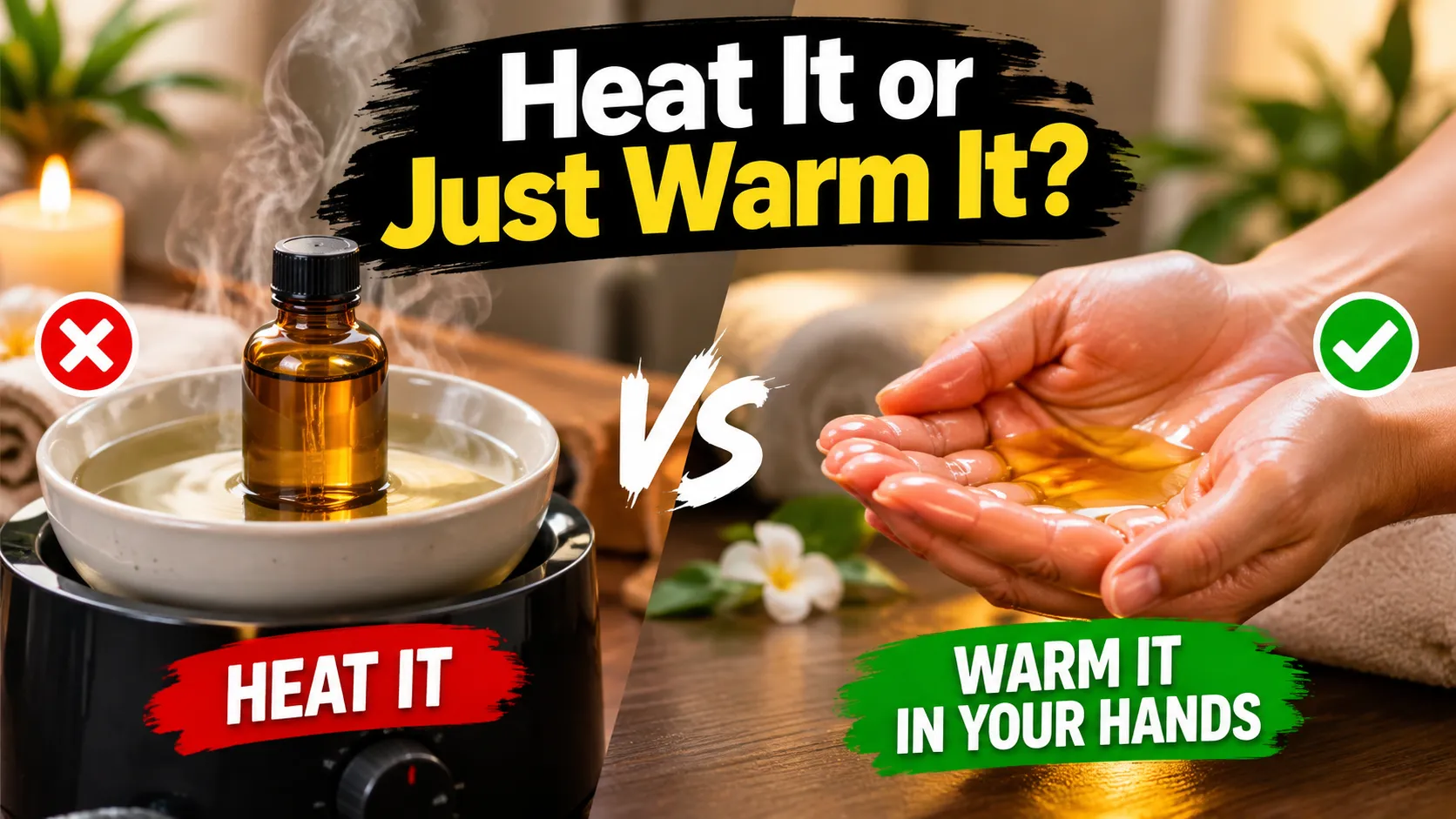
For most people, hands are enough. Pour a small amount into your palms, rub them together for ten to fifteen seconds, and the oil arrives warm without any equipment or risk. This is what most professionals do, and it is the default answer to the question of whether you should heat massage oil for an ordinary home session.
Separate heating becomes worth considering in three situations: the room is cold, the oil is thick or semi-solid, or you are working over a large area like a back and full legs where hand-warming each pour slows everything down. In those cases a gentle, indirect warming method makes sense — with the emphasis firmly on gentle and indirect.
The following block shows a practical sequence for warming oil safely. It is a general routine guide, not a clinical protocol.
Safe warming routine — typical order
The two steps people skip most often are the wrist test and the small-area start. Both take seconds and both catch a temperature problem before it covers a large patch of skin.
Warming methods: safer options vs risky ones
Swipe left/right to see the full table →
| Method | Safer choice? | Main concern |
|---|---|---|
| Rub between palms | Yes — best default | Slow for large areas |
| Warm water bath | Yes, with testing | Water too hot; wet bottle |
| Purpose-made oil warmer | Usually, per label | Left on too long |
| Microwave | Not recommended | Hidden hot spots |
| Stovetop or open flame | No | Very fast overheating |
Microwaves deserve a specific caution. Oil heats unevenly in them, so a bottle can feel mild on the outside while holding a much hotter pocket inside. That pocket only reveals itself once it lands on skin.
Warning: Never warm oil in a sealed or fully capped container, and never leave oil warming unattended. Oils can reach an uncomfortable temperature faster than water does, and there is no visual cue — no steam, no bubbling — to tell you it has happened.
Who should be extra cautious with warm oil
The main safety issue with warm oil is not the oil — it is reduced ability to feel heat. Anyone whose skin sensation is altered may not register that something is too hot until after skin has been affected. That is why this question is less about the product and more about the person receiving the massage.
Situations that call for more care
Swipe left/right to see the full table →
| Situation | Why it matters | Practical approach |
|---|---|---|
| Numbness or tingling | Heat may not be felt | Use room-temperature oil; ask a clinician |
| Very young children | Thinner, more sensitive skin | Hand-warm only; pediatric guidance first |
| Older adults | Sensation can be reduced | Lower warmth; check in often |
| Broken or irritated skin | Barrier is already stressed | Avoid the area entirely |
| Fresh swelling or bruising | Warmth may add discomfort | Hold off and ask a professional |
None of these mean warm oil is forbidden. They mean the decision should involve a professional who knows the specific situation, rather than a general rule from an article.
Decision path: should you heat massage oil today?
Yes →
Warm gently, test on your wrist, start on a small area. Stop if it stings.
No or unsure →
Use room-temperature oil, avoid the affected area, and ask a healthcare professional first.
Used this way, the decision takes about ten seconds and removes almost all of the guesswork.
Red flags to watch for during and after
Most temperature problems announce themselves right away, but a few show up in the minutes afterward. Knowing what to look for means you react early instead of finishing the session and noticing later.
Red-flag checklist — stop and reassess
Immediate stinging or burning
Wipe the oil off gently and cool the area with cool running water.
Bright redness that stays
Normal massage flush fades quickly; redness that persists is worth attention.
Blistering or peeling
Do not apply more oil. Seek medical advice promptly.
Itching, bumps, or rash
This points to the product itself rather than the temperature.
Warmth and reaction can be told apart fairly reliably: heat problems appear within seconds and are sharply localized, while product reactions tend to build over several minutes and often itch. General guidance on minor burn care is available from MedlinePlus and Mayo Clinic.
Mistakes that turn a good idea into a burn
The question of whether you should heat massage oil usually goes wrong at the execution stage, not the concept stage. These are the errors that come up most often.
Common mistake vs better choice
Swipe left/right to see the full table →
| Mistake | Better choice |
|---|---|
| Testing on fingertips only | Test on inner wrist — thinner, more sensitive skin |
| Heating the whole bottle | Warm only one session’s worth |
| Reheating leftovers repeatedly | Discard leftovers; pour fresh next time |
| Pouring straight onto the back | Pour into your hands first, every time |
| Assuming “warmer works better” | Aim for neutral-warm comfort, nothing more |
Reheating leftovers is worth calling out separately. Oil that has been on skin and back into a container picks up residue, and repeated warming cycles are not good for the product’s shelf life.
Tip: Warm the room instead of overheating the oil. A space that is comfortably warm keeps the oil from cooling on the skin, which is the real reason cold oil feels unpleasant during a longer session.
Not every oil handles warmth the same way
Oil type affects how warming behaves. Thicker oils benefit most; thin, delicate oils often need no help at all. Scented blends are a separate consideration, because warmth increases how strongly aroma releases and can make a fragrance feel overpowering in a small room.
Oil type and warming fit
Swipe left/right to see the full table →
| Oil type | Warming fit | Keep in mind |
|---|---|---|
| Fractionated coconut | Good | Already thin; barely needs it |
| Unrefined coconut | Very helpful | Solid when cool; softens fast |
| Sweet almond / jojoba | Optional | Nut allergy check for almond |
| Scented or essential-oil blends | Use less heat | Aroma intensifies; patch test |
| Warming or tingling formulas | Do not add heat | Follow the label exactly |
That last row matters. Products already marketed as “warming” create a heat sensation through their ingredients, and adding real heat on top stacks two effects that were never meant to combine.
Relative risk by method — general practical guide
Hands only
Warm water bath
Dedicated oil warmer
Microwave
Stovetop or flame
Bar widths are a practical comparison guide, not measured data.
The pattern is straightforward: the less control you have over the final temperature, the higher the everyday risk.
Do’s and don’ts at a glance
Do
Warm small amounts and test every batch.
Patch test any new oil on a small area.
Ask the person how the temperature feels.
Don’t
Use a microwave, stovetop, or open flame.
Apply warm oil to numb or broken skin.
Assume hotter oil gives a deeper effect.
Kept to these basics, warming stays a comfort improvement rather than a hazard.
Handling it at home vs getting advice

Swipe left/right to see the full table →
| What you notice | Reasonable next step |
|---|---|
| Oil felt slightly too warm, no marks | Lower the temperature next time |
| Brief pink flush that fades | Usually fine; keep an eye on it |
| Redness or soreness lasting hours | Contact a healthcare professional |
| Blisters, open skin, or spreading rash | Seek medical care promptly |
| Swelling, breathing changes, faintness | Get urgent medical help |
When to contact a professional: Get medical advice if skin blisters, breaks, stays painful or red for hours, shows signs of infection, or if a rash spreads. Seek urgent help for widespread burns, severe pain, or any swelling of the face, lips, or throat, or difficulty breathing after using a product. Talk with a clinician before using warm oil at all if there is numbness, reduced sensation, a circulation condition, a recent injury, or a skin condition on the area you plan to massage.
This article may contain affiliate links. If you buy through these links, we may earn a small commission at no extra cost to you. We only mention products that fit the topic and do not replace professional medical advice.
Massage Oil Bottle Warmer
A dedicated warmer can help keep oil at a steady, comfortable temperature so you are not reheating between rounds. Follow the manufacturer’s instructions and still test on your wrist.
Unscented Fractionated Coconut Massage Oil
A light, fragrance-free carrier oil that stays liquid at room temperature — which may make daily care easier and reduce the need to heat it at all.
Frequently asked questions
How warm should massage oil actually be?
It should feel neutral or barely warm on your inner wrist, similar to skin temperature. If you clearly register heat, let it cool before using it.
Can you microwave massage oil?
It is not recommended, because oil heats unevenly and can hold hot pockets that the outside of the bottle does not reveal. A warm water bath gives far more control.
Should you heat massage oil for sore muscles?
Gentle warmth may feel more comfortable, but it does not treat muscle problems. For pain that is severe, persistent, or follows an injury, speak with a healthcare professional.
Is warm oil safe for babies or young children?
Children’s skin is thinner and more heat-sensitive, so warming should be very conservative. Check with a pediatric healthcare professional before using any oil on an infant.
Does heating change or spoil the oil?
Brief gentle warming is generally fine, but repeated heating cycles are not good for shelf life. Warm only what you need and discard leftovers rather than returning them to the bottle.
What should I do if the oil was too hot?
Stop, gently remove the oil, and cool the area with cool running water. If blistering, lasting pain, or broken skin appears, contact a healthcare professional.
Should you heat massage oil that already says “warming” on the label?
No — those products create a warm sensation through their ingredients, so adding real heat stacks two effects. Follow the label instructions exactly.
Final thoughts
So, should you heat massage oil? For most people, a small amount of gentle warmth makes a session more comfortable and is easy to do safely — hands first, a warm water bath second, and a wrist test every single time. The goal is neutral comfort, not heat.
Skip warming entirely on numb, broken, or irritated skin, and follow product labels rather than improvising. If skin blisters, stays red or painful, shows signs of infection, or if symptoms are severe, worsening, unusual, persistent, or simply not improving, stop and speak with a licensed healthcare professional.
Author
-

I’m Alex Turner, a massage product reviewer and wellness writer at RemedyTip. I specialize in researching, evaluating, and comparing massage and recovery products to help readers make informed purchasing decisions. My focus is on practical, evidence-informed product guidance covering muscle recovery, relaxation, everyday comfort, and wellness.
I take a research-driven approach to every product I review. I examine product specifications, features, materials, performance claims, user feedback, durability, comfort, ease of use, and overall value. When appropriate, I also consult trusted industry and health-related sources to verify important information and provide readers with a more complete and balanced view.
I cover a wide range of products, including massage guns, handheld massagers, neck and shoulder massagers, foot massagers, massage chairs, foam rollers, and other recovery tools. Rather than focusing only on marketing claims, I look at how products compare in real-world use and who they are actually suitable for. I also consider different budgets, use cases, and user needs when making recommendations.
At RemedyTip, I’m committed to accuracy, transparency, and unbiased product information. I clearly distinguish between manufacturer claims, available evidence, and my own product analysis so readers can understand the basis of each recommendation. I continuously research new products, technologies, and developments in the massage and recovery space to keep my content current and useful.
My goal is simple: to provide trustworthy, easy-to-understand information that helps readers choose massage and recovery products with greater confidence.

