This guide provides practical and actionable sciatica self care tips to help you manage and alleviate nerve pain from the comfort of your home. You’ll learn about gentle stretches, effective pain relief strategies, crucial posture adjustments, and important lifestyle changes that can significantly improve your comfort. Empower yourself with simple, daily practices to find relief and better manage your sciatica symptoms.
Suffering from sciatica can be incredibly debilitating. That shooting pain, numbness, or tingling sensation radiating down your leg can turn simple daily tasks into agonizing challenges. The good news is that for many people, effective sciatica self care tips can make a significant difference in managing symptoms and finding relief right from the comfort of their home. You don’t always need complex treatments to start feeling better.
This comprehensive guide is designed to empower you with practical, easy-to-follow strategies. We’ll walk you through gentle stretches, pain relief techniques, lifestyle adjustments, and postural improvements that can help calm your angry sciatic nerve. By the end of this guide, you’ll have a clear roadmap to implement sciatica self care tips into your daily routine and work towards a more comfortable, pain-free life. Remember, consistency is your best friend when it comes to sciatica relief.
Key Takeaways
- Gentle Movement is Key: Incorporate regular, low-impact stretches like pelvic tilts, knee-to-chest, and piriformis stretches to decompress the sciatic nerve and improve flexibility.
- Utilize Heat and Cold Therapy: Alternate between applying heat to relax muscles and cold to reduce inflammation, which can effectively soothe acute sciatica pain.
- Prioritize Proper Posture: Make conscious efforts to improve your sitting, standing, and sleeping posture, and adjust your workspace ergonomics to minimize pressure on the sciatic nerve.
- Stay Active and Maintain a Healthy Weight: Regular, gentle exercise and managing your weight can reduce stress on your spine and lower back, significantly contributing to long-term sciatica relief.
- Over-the-Counter Relief Can Help: Use NSAIDs or topical pain relief creams as directed to manage acute pain episodes, but always follow dosage instructions.
- Listen to Your Body: Never push through pain during stretches or activities. If symptoms worsen or new symptoms appear, it’s crucial to seek professional medical advice.
Understanding Sciatica: A Quick Overview
Before diving into the self-care strategies, let’s briefly understand what sciatica is. Sciatica isn’t a condition itself; rather, it’s a symptom of an underlying problem affecting the sciatic nerve. This nerve is the longest and thickest nerve in your body, running from your lower back, through your hips and buttocks, and down each leg. When this nerve gets compressed, irritated, or inflamed, you experience the characteristic pain, numbness, or weakness often associated with sciatica. Common causes include a herniated disc, spinal stenosis, piriformis syndrome, or even muscle spasms. While self-care can provide relief, understanding the cause can sometimes help guide your approach, so consider a doctor’s visit for a proper diagnosis if you haven’t had one.
Step 1: Embrace Gentle Movement and Targeted Stretches
One of the most effective sciatica self care tips is to keep moving, but gently. Restricting all movement can sometimes make sciatica worse. Gentle stretches can help decompress the nerve, improve flexibility, and reduce muscle tension. Always listen to your body and stop if you feel any sharp pain.
Pelvic Tilts
This is a gentle exercise to engage your core and gently mobilize your lower back.
- How to do it: Lie on your back with your knees bent and feet flat on the floor, hip-width apart. Flatten your lower back against the floor by tightening your abdominal muscles and rotating your pelvis upwards. Hold for 5-10 seconds, then release.
- Repetitions: Repeat 8-12 times.
- Tip: Breathe deeply throughout the exercise.
Knee-to-Chest Stretch
This stretch helps to gently lengthen the muscles in your lower back and glutes.
- How to do it: Lie on your back with your knees bent and feet flat. Gently bring one knee towards your chest, holding it with your hands. Hold for 20-30 seconds. Release and repeat with the other leg.
- Repetitions: Do 2-3 repetitions for each leg.
- Tip: If both legs feel comfortable, you can gently bring both knees to your chest.
Piriformis Stretch (Figure-4 Stretch)
The piriformis muscle, located deep in your buttock, can sometimes irritate the sciatic nerve. This stretch targets it directly.
- How to do it: Lie on your back with your knees bent and feet flat. Cross one ankle over the opposite knee, forming a “figure-4” shape. Gently pull the non-crossed knee towards your chest until you feel a stretch in your buttock. Hold for 20-30 seconds.
- Repetitions: Do 2-3 repetitions for each side.
- Tip: You should feel the stretch in your glute, not sharp pain in your knee or back.
Cat-Cow Pose
A great yoga pose for spinal mobility and gentle stretching.
- How to do it: Start on your hands and knees. As you inhale, drop your belly towards the floor and look up (Cow pose). As you exhale, round your spine towards the ceiling, tucking your chin to your chest (Cat pose).
- Repetitions: Flow between Cat and Cow 10-15 times, coordinating with your breath.
- Tip: Move slowly and deliberately, focusing on spinal articulation.
Step 2: Alternate Between Heat and Cold Therapy
This is one of the classic sciatica self care tips for immediate relief. Both heat and cold can be effective, but they serve different purposes.
Applying Cold
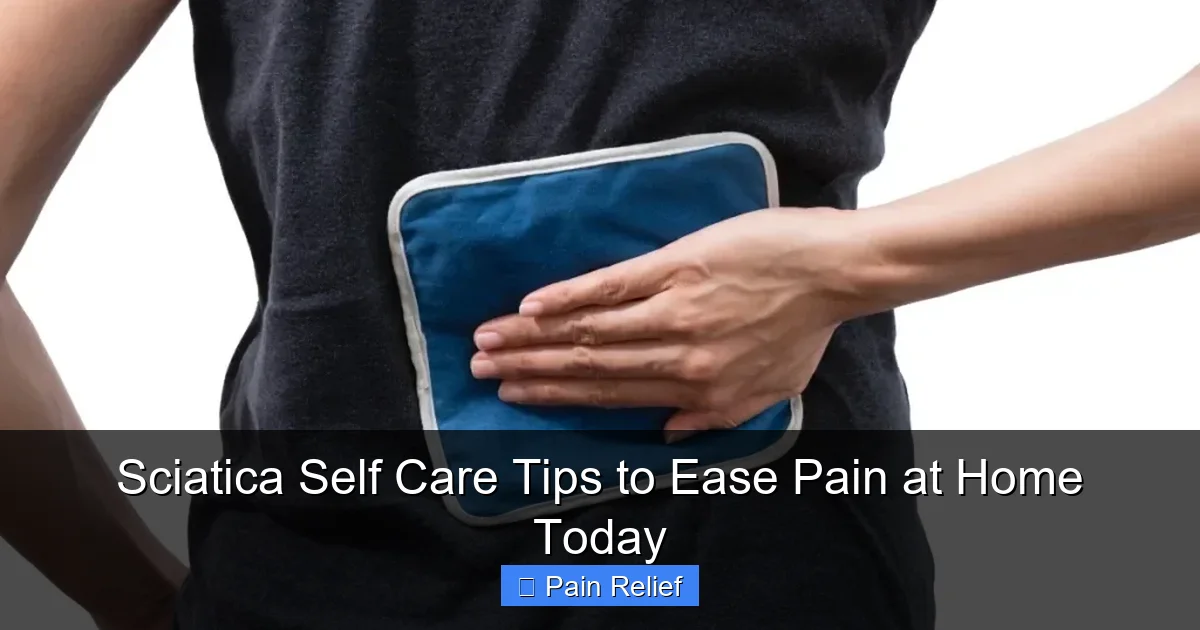
Cold therapy (like an ice pack) can help reduce inflammation and numb the area, providing immediate pain relief, especially during acute flare-ups.
- How to do it: Apply an ice pack (wrapped in a thin towel) to the affected area (lower back or buttock) for 15-20 minutes.
- Frequency: Repeat every 2-3 hours as needed, especially in the first 48-72 hours of a flare-up.
Applying Heat
Heat therapy (like a heating pad or hot bath) can relax tight muscles that might be contributing to nerve compression and improve blood flow.
- How to do it: Use a heating pad, hot water bottle, or take a warm bath for 15-20 minutes.
- Frequency: Apply after the acute inflammation has subsided, or to soothe chronic muscle tension.
Tip: Many people find alternating between hot and cold therapy to be most effective. Start with cold for inflammation, then switch to heat to relax muscles. Always ensure a barrier between your skin and the heat/cold source to prevent burns or frostbite.

Visual guide about Sciatica Self Care Tips to Ease Pain at Home Today
Image source: i.pinimg.com
Visual guide about Sciatica Self Care Tips to Ease Pain at Home Today
Image source: i.pinimg.com
Step 3: Consider Over-the-Counter Pain Relief
Visual guide about Sciatica Self Care Tips to Ease Pain at Home Today
Image source: womansworld.com
For temporary relief, over-the-counter (OTC) medications can be a helpful part of your sciatica self care tips arsenal.
NSAIDs (Non-Steroidal Anti-Inflammatory Drugs)
Medications like ibuprofen (Advil, Motrin) or naproxen (Aleve) can help reduce inflammation and pain.
- How to use: Follow the dosage instructions on the package carefully.
- Caution: These medications are not suitable for everyone and can have side effects, especially with prolonged use. Consult your doctor if you have underlying health conditions or are taking other medications.
Topical Creams and Gels
Topical pain relievers containing ingredients like menthol, capsaicin, or salicylates can be applied directly to the skin over the painful area.
- How to use: Apply as directed on the product label.
- Benefit: They offer localized relief with fewer systemic side effects compared to oral medications.
Step 4: Improve Posture and Ergonomics
Your daily posture significantly impacts your spine and can either alleviate or exacerbate sciatica. This is one of the most crucial sciatica self care tips for long-term relief.
Sitting Posture
- Tips: Sit with your feet flat on the floor, knees at a 90-degree angle, and your back straight against the chair. Use a rolled-up towel or lumbar pillow to support the natural curve of your lower back. Avoid sitting for prolonged periods; get up and move every 30-60 minutes.
Standing Posture
- Tips: Distribute your weight evenly on both feet. Avoid locking your knees. If standing for a long time, use a footrest to elevate one foot slightly, alternating periodically.
Sleeping Posture
- Tips: If you sleep on your side, place a pillow between your knees to keep your hips, pelvis, and spine aligned. If you sleep on your back, place a pillow under your knees to reduce pressure on your lower back. Avoid sleeping on your stomach if possible, as it can strain your neck and back.
Ergonomic Adjustments
- Workspace: Ensure your computer monitor is at eye level. Your keyboard and mouse should be close enough that your elbows are at a 90-degree angle.
- Driving: Adjust your car seat to support your lower back. Use a lumbar cushion if necessary. Take breaks on long drives to stretch.
Step 5: Make Lifestyle Adjustments
Beyond immediate pain relief, certain lifestyle changes can significantly support your body in healing and preventing future sciatica flare-ups. These are vital sciatica self care tips for overall well-being.
Stay Active (but don’t overdo it)
- Recommendation: While rest is important during acute pain, prolonged inactivity can weaken muscles and worsen symptoms. Engage in low-impact activities like walking, swimming, or cycling.
- Benefit: Regular movement strengthens core muscles that support your spine and improves blood flow.
Maintain a Healthy Weight
- Impact: Excess weight, especially around the abdomen, puts additional strain on your lower back and spine, potentially aggravating sciatica.
- Action: Focus on a balanced diet and regular exercise to achieve and maintain a healthy weight.
Quit Smoking (if applicable)
- Connection: Smoking can impair blood flow, which may slow healing and contribute to disc degeneration, worsening spinal health over time.
- Benefit: Quitting smoking can improve overall health and potentially reduce sciatica symptoms.
Manage Stress
- Link: Stress can lead to muscle tension, especially in the shoulders, neck, and lower back, which can exacerbate nerve pain.
- Techniques: Incorporate stress-reduction techniques such as deep breathing, meditation, yoga, or spending time in nature.
Step 6: Utilize Supportive Aids
Sometimes, a little extra support can go a long way in managing sciatica discomfort.
Lumbar Support Pillows
- Use: These pillows help maintain the natural curve of your lower back when sitting, reducing pressure on the sciatic nerve.
- Application: Great for office chairs, car seats, or even your couch.
Ergonomic Chairs
- Benefit: Investing in a good ergonomic chair designed to support proper spinal alignment can make a big difference if you spend many hours sitting.
Proper Footwear
- Impact: High heels or unsupportive shoes can alter your gait and spinal alignment, potentially contributing to sciatica.
- Recommendation: Wear comfortable, supportive shoes with good arch support.
Consider a Firm Mattress
- Benefit: A mattress that provides adequate support without being too soft can help maintain proper spinal alignment throughout the night.
- Tip: If your mattress is old or saggy, it might be time for an upgrade.
Troubleshooting: When to Seek Professional Help
While these sciatica self care tips are highly effective for many, it’s crucial to know when to consult a doctor. Self-care is a powerful tool, but it’s not a substitute for professional medical advice, especially for severe or worsening symptoms.
Seek immediate medical attention if you experience:
- Sudden, severe pain in your lower back or leg.
- Sciatica following a violent injury, such as a car accident.
- Difficulty controlling your bowels or bladder.
- Progressive weakness in your leg.
- Loss of sensation in your leg, foot, or groin area (saddle anesthesia).
Also, consult your doctor if:
- Your pain doesn’t improve with self-care after a few weeks.
- Your pain worsens or becomes more frequent.
- You develop new symptoms.
A medical professional can provide an accurate diagnosis, rule out more serious conditions, and recommend appropriate treatments, which might include physical therapy, medication, or in rare cases, surgery.
Conclusion
Living with sciatica can be challenging, but with consistent effort and the right approach, you can significantly ease your pain and improve your quality of life. The sciatica self care tips outlined in this guide—from gentle stretches and proper posture to heat/cold therapy and lifestyle adjustments—are powerful tools to manage your symptoms at home. Remember that patience is key, and finding what works best for your body may take some experimentation. By proactively incorporating these strategies into your daily routine, you are taking an active role in your healing journey. Always prioritize listening to your body, and don’t hesitate to seek professional medical advice if your symptoms persist or worsen. Take control of your sciatica today, one self-care step at a time!
🎥 Related Video: STOP Stretching Sciatica!
📺 RehabFix
Want to know how we help thousands across the world resolve their sciatica and back pain with our “Centralization Process”, and …