
By Ryan Mitchell | Wellness & Relaxation
Quick Answer: Mindfulness at work means paying attention to the task, thoughts, emotions, and surroundings you are experiencing right now without immediately judging them. Start with a minute of comfortable breathing, take short intentional breaks, focus on one task at a time, and listen carefully during conversations. Small, repeatable practices may support focus and everyday stress management.
A calmer way to approach your workday
Deadlines, emails, meetings, and constant notifications can pull your attention in several directions. You might finish a busy day feeling exhausted without remembering where much of your time went. Mindfulness offers a practical way to notice what is happening and choose your next response more deliberately.
You do not need a silent office, a meditation room, or a long break to begin. You can practice while opening your laptop, preparing for a meeting, eating lunch, or listening to a colleague.
Single-task focus
Mindful breaks
Better listening
Important health information
This article is for general educational information only. It does not diagnose, treat, cure, or prevent any condition. It does not replace advice from a licensed healthcare professional. Readers should seek professional help for severe, worsening, unusual, or persistent symptoms.
What Does Mindfulness at Work Mean?
Mindfulness is the practice of paying attention to the present moment with openness rather than automatically judging what you notice. At work, this can mean recognizing that your shoulders feel tense, noticing that you are rushing through an email, or realizing that your thoughts have wandered during a meeting.
The goal is not to empty your mind or feel relaxed every minute. Thoughts will appear, distractions will happen, and difficult emotions may arise. Mindfulness involves noticing these experiences and gently bringing your attention back to what matters now.
For example, imagine receiving an unexpected request just before a deadline. An automatic response might be to panic, agree immediately, or send a frustrated reply. A mindful response creates a small pause: notice the frustration, take a comfortable breath, check your existing workload, and decide what you can reasonably do.
This approach can fit office-based, remote, hybrid, and customer-facing jobs. The exact practice may change, but the basic skill remains the same: notice what is happening before deciding how to respond.
Why Practice Mindfulness During the Workday?
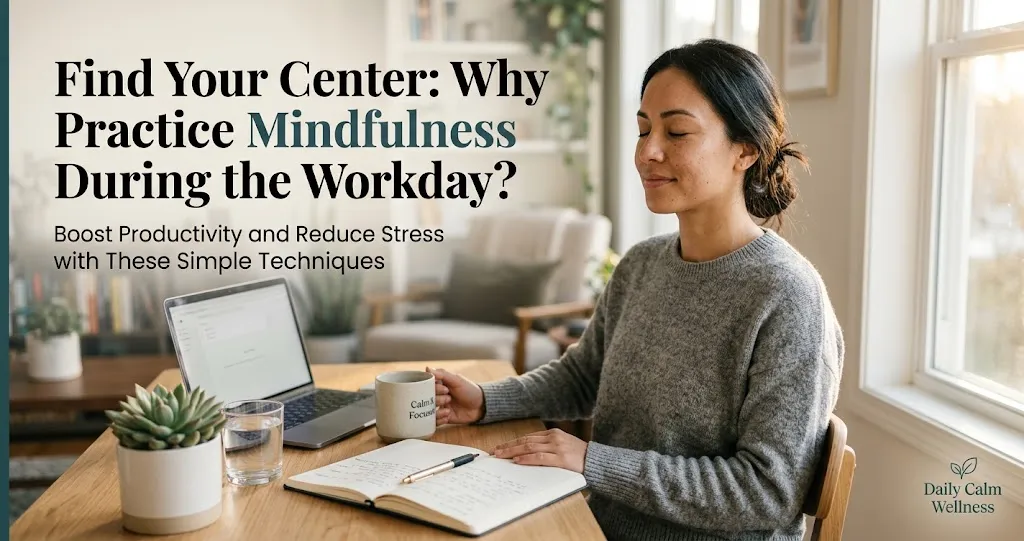
Workplace mindfulness programs have been studied for their possible effects on stress and well-being. Findings are encouraging overall, but results vary, and mindfulness should not be treated as a guaranteed way to improve performance or prevent burnout. The World Health Organization discusses mindfulness-based approaches as one possible option for building stress-management skills at work, with limitations in the certainty of evidence.
More intentional focus
Noticing distractions can help you return to the task in front of you. This may be useful when writing, reviewing documents, or completing work that requires sustained attention.
A pause before reacting
Recognizing frustration early may help you choose your words more carefully. It does not mean ignoring genuine problems or accepting disrespectful behavior.
Better awareness
You may become more aware of fatigue, hunger, tension, or overload. These signals can remind you to take a break or discuss an unrealistic workload.
More attentive conversations
Listening without preparing your next reply may help you understand colleagues more clearly. This can support respectful communication, even when you disagree.
Mindfulness is one tool, not a solution to every workplace difficulty. If deadlines are consistently impossible, staffing is inadequate, or a workplace is unsafe, personal breathing exercises cannot replace organizational changes. The WHO guidance on mental health at work emphasizes the importance of addressing workplace risks as well as supporting individual workers.
How to Practice Mindfulness at Work: Six Simple Steps
Start with a short routine that fits your real schedule. You can practice at your desk, in a quiet corner, or during a break. You do not have to complete every step perfectly; consistency and practicality matter more than making the routine complicated.
1
Pause before starting.
Before opening your first email, take a moment to notice how you feel and what you need to accomplish. Choose one realistic priority rather than trying to solve the entire day at once.
2
Notice your breathing.
Sit comfortably and notice the natural movement of your breath for about one minute. You do not need to take unusually deep breaths or hold them. If focusing on breathing feels uncomfortable, use sounds or the feeling of your feet on the floor instead.
3
Choose one task.
Decide what you will work on for the next reasonable block of time. Close unrelated tabs or silence nonessential notifications when your role permits, and keep your attention on the selected task.
4
Notice when your mind wanders.
You may begin thinking about lunch, another deadline, or an awkward conversation. Instead of criticizing yourself, acknowledge the distraction and return to the next useful action.
5
Take a mindful transition break.
Between tasks, stand if comfortable, stretch gently, drink water, or look away from your screen. Pay attention to the activity rather than scrolling through another stream of notifications.
6
Review the day without judgment.
At the end of your shift, notice one thing that went well and one thing you may handle differently tomorrow. Identify any unfinished work that needs a realistic plan rather than replaying every mistake.
A simple mindfulness routine flow chart
Use this visual as a reminder when your day feels scattered.
Notice your current state
Breath, thoughts, and surroundings
One useful next action
Continue with awareness
The sequence is a practical reminder, not a test. If you become distracted halfway through, simply begin again at the step you notice. You can repeat this cycle before a meeting, after an interruption, or whenever you need to reset your attention.
When Should You Practice During the Day?
You do not need to set aside a large part of your schedule. Pairing a short practice with an activity you already do can make it easier to remember. The following timings are practical suggestions, not scientifically established minimums or requirements.
Choose a routine that fits your workday
Use this timing guide to connect mindfulness with common work transitions.
Swipe left/right to see the full table →
| Work moment | Practice | Practical aim |
|---|---|---|
| Start of shift | One-minute pause | Set one priority |
| Before a meeting | Notice breath and posture | Arrive attentively |
| After focused work | Stand or stretch comfortably | Mark a transition |
| During lunch | Notice taste and texture | Take a genuine break |
| End of shift | Reflect and plan | Create a clear stopping point |
Choose one or two moments at first rather than trying to follow the whole table. A routine that fits your schedule is generally more realistic than one that creates another source of pressure.
Mindfulness Techniques for Common Workplace Challenges
Different situations call for different approaches. The following practices are options to try, not rules you must follow.
When emails and notifications feel overwhelming
Notice the urge to check every alert immediately. If your responsibilities allow it, set a manageable time to review messages and return to your priority between checks. When an urgent message arrives, assess it rather than automatically treating every notification as equally important.
When you feel tense before a meeting
Give yourself a brief transition before joining. Notice the chair supporting you, the sounds around you, and the natural pace of your breathing. You might also write down the main point you need to communicate. If focusing inward feels uncomfortable, orient yourself to the room instead.
When a conversation becomes difficult
Listen to the other person without interrupting when possible. Notice your reaction and separate what you heard from what you assumed it meant. You can ask a clarifying question, request time to think, or set a respectful boundary. Mindfulness does not require tolerating harassment or inappropriate behavior.
When your attention feels scattered
Write down unrelated thoughts that need attention later, then return to one manageable task. If you have been working for a long stretch, consider whether a break, food, water, or a change in task would be more useful than trying harder to concentrate.
Match the practice to the situation
Use this table to choose an appropriate response to everyday distractions.
Swipe left/right to see the full table →
| Challenge | Try this | Avoid assuming |
|---|---|---|
| Constant alerts | Review messages in planned blocks | Every alert is urgent |
| Meeting nerves | Orient to the room and agenda | You must feel perfectly calm |
| Wandering thoughts | Return to the next action | A wandering mind means failure |
| Heavy workload | Prioritize and discuss capacity | Breathing fixes excess work |
Build a Mindful Work Environment
Individual habits become easier to maintain when your surroundings support them. You do not need a special office or expensive equipment. Small changes to notifications, transitions, and communication may be enough to help you remember your routine.
Useful tools and simple alternatives
Consider these options before purchasing anything or adding another app to your workflow.
Swipe left/right to see the full table →
| Tool or support | How it may help | Keep in mind |
|---|---|---|
| Calendar reminder | Prompts a brief pause | Avoid excessive alerts |
| Paper task list | Keeps one priority visible | Keep the list realistic |
| Meditation audio | Provides guided structure | Use only when practical |
| Quiet workspace | May reduce interruptions | Not possible in every role |
Choose tools based on your actual needs. A simple reminder or written list may be enough, and no app is required to practice mindfulness. If you try a guided recording, select one that suits your preferences and does not interfere with safety-sensitive work.
Note:
Mindfulness is not a substitute for breaks, adequate staffing, fair deadlines, or a safe work environment. If your workload is consistently unmanageable, raise the practical barriers with an appropriate manager, human resources contact, union representative, or other trusted workplace resource.
Common Mindfulness Mistakes and Better Choices
Some people give up because they expect to feel calm immediately or believe they must meditate for a long time. A more useful approach is to start small and adapt the practice to your needs.
What to change in your routine
This comparison can help you avoid turning a supportive habit into another demand on your time.
Swipe left/right to see the full table →
| Common mistake | Better choice | Why it matters |
|---|---|---|
| Trying to stop every thought | Notice and redirect attention | Thoughts naturally come and go |
| Expecting instant calm | Observe what is actually present | The experience varies |
| Skipping lunch to finish work | Take a feasible genuine break | Mindfulness is not overwork |
| Forcing uncomfortable breathing | Notice sounds or touch instead | Choose a comfortable anchor |
Tip:
Attach your practice to an existing habit. For example, take one attentive breath before opening your inbox or notice your surroundings before entering a meeting. Linking mindfulness to a familiar activity can make it easier to remember without adding another complicated task.
Make a Realistic Plan You Can Maintain

A useful plan should fit your job, energy, and available time. You can begin with one minute each morning and a short pause later in the day. After a week, consider whether the practice is practical and whether you want to continue, change the timing, or try another technique.
A practical priority guide
The following visual ranks possible starting points by how easy they may be to fit into an ordinary workday. These are practical suggestions, not scientific measurements or rankings of effectiveness.
Typical routine priority — practical guide
Bar lengths illustrate suggested ease of adoption only; they do not represent measured outcomes.
Start with the simplest option that feels useful. If you already have a busy schedule, a brief pause may be more realistic than a structured meditation session. If you enjoy guided practice and have private time available, you may prefer a longer session outside demanding work periods.
A short weekly check-in
At the end of each week, ask yourself three questions: Did I remember to pause? Which situations made it hard to pay attention? What one change would make the routine easier next week? Focus on useful observations rather than judging your performance.
If you notice that the same workplace pressures repeatedly interrupt your routine, look at the cause. Unclear expectations, conflicting priorities, frequent interruptions, and excessive workloads may require practical changes or a conversation with your manager. Individual mindfulness practice should not be used to blame yourself for circumstances beyond your control.
Warning:
Do not use a mindfulness exercise when it would distract you from operating machinery, driving, monitoring hazards, or performing another safety-sensitive task. Do not force yourself to focus on your breath if doing so increases discomfort. Choose an appropriate, safe alternative or stop the exercise.
When Mindfulness Is Not Enough
Workplace stress is not always something you can manage through a change in attention. If you regularly feel overwhelmed, cannot recover outside work hours, struggle to sleep, or find that stress is interfering with daily life, consider talking with a qualified healthcare professional or mental health provider.
Seek urgent medical help if you experience an immediate mental health crisis or symptoms that could indicate a medical emergency. You do not need to wait until a problem becomes severe to ask for support.
When to contact a professional
Consider professional support when distress is persistent, worsening, or affecting sleep, relationships, concentration, or your ability to manage everyday activities. If work conditions are contributing to the problem, seek appropriate workplace support as well. Mindfulness can be a complementary practice, but it should not delay needed care.
For further guidance, the NHS mindfulness guide explains how to notice thoughts, feelings, and sensations during everyday activities. The National Center for Complementary and Integrative Health also provides information about meditation and mindfulness, including their potential benefits and safety considerations.
Frequently Asked Questions
What is mindfulness at work?
It is the practice of paying attention to the present moment during work tasks, conversations, and breaks. You notice thoughts and feelings without automatically reacting to them.
How can I practice mindfulness at my desk?
Sit comfortably, notice your natural breathing or the feeling of your feet on the floor, and choose one task to focus on. Even a short pause can help you practice returning attention to the present.
Can mindfulness help with work stress?
Mindfulness-based practices may help some people manage everyday stress and emotional reactions. Results vary, and they do not replace changes to unsafe or unreasonable working conditions.
How long should I practice mindfulness at work?
Start with about one minute and extend the practice if it suits you. There is no single duration that everyone must follow, so choose an approach that fits your schedule and comfort.
What if I cannot stop my thoughts during mindfulness?
You do not need to stop your thoughts. Notice when your attention wanders, acknowledge the distraction without judging yourself, and gently return to your chosen focus.
Can I practice mindfulness during meetings?
Yes. Listen carefully, notice when your attention drifts, and return to the speaker or discussion. A brief pause before responding can also help you choose your words more deliberately.
Does mindfulness replace workplace mental health support?
No. It is one possible self-management tool, not a replacement for professional care, reasonable workloads, safe working conditions, or organizational support.
Final Thoughts
Mindfulness at work does not require a perfect routine or a completely quiet mind. Begin with one short pause, return to a single task when distractions appear, and use transitions as reminders to notice the present moment. Adjust the practice to your needs, address workplace pressures where possible, and seek professional support if distress is persistent, worsening, or interfering with daily life.
Author
-

Hi, I’m Ryan Mitchell, a wellness and relaxation writer at RemedyTip.com, where I focus on helping readers better understand stress management, relaxation techniques, mindfulness, sleep improvement, and everyday wellness habits. I have developed a strong knowledge of the Wellness & Relaxation field through sustained learning, in-depth research, and a continued commitment to exploring practical approaches to well-being.
My work focuses on researching wellness topics, examining available evidence, and turning complex information into clear, accessible, and actionable guidance. I’m continually exploring new findings, relaxation practices, and lifestyle strategies to help readers make informed decisions about their daily wellness routines. At RemedyTip.com, my goal is to share trustworthy, research-informed content that encourages healthier habits, greater relaxation, and a more balanced lifestyle.

