
By Ryan Mitchell | Wellness & Relaxation
Quick Answer: Yoga for sleep may help you unwind by combining gentle movement, slower breathing, and mindful attention. Try a 10–15-minute bedtime routine with Child’s Pose, Cat-Cow, a gentle forward fold, and Corpse Pose. Keep movements comfortable and consistent, and remember that yoga can support healthy sleep habits but is not a guaranteed solution for persistent insomnia.
Build a Gentler Transition From Day to Night
Busy days can leave your mind racing long after you get into bed. Work messages, family responsibilities, screen time, and everyday worries may make it difficult to switch into a restful evening rhythm.
A gentle yoga routine gives you a quiet activity to focus on before bedtime. Rather than trying to force yourself to fall asleep, you can slow down, notice your breathing, and release some of the tension you may be carrying.
This guide covers simple poses, a step-by-step nighttime routine, common mistakes, and practical ways to make your bedroom more sleep-friendly.
Gentle movement
Breathing awareness
Bedtime habits
Relaxation
Health and safety note: This article is for general educational information only. It does not diagnose, treat, cure, or prevent any condition. It does not replace advice from a licensed healthcare professional. Readers should seek professional help for severe, worsening, unusual, or persistent symptoms.
Why Gentle Yoga May Support Better Sleep
Yoga combines physical postures, breathing techniques, and mindful attention. When practiced at a comfortable pace, it can offer a way to step away from daily demands and prepare for rest.
Research suggests that yoga may improve sleep quality for some people. However, results vary by population and practice, and the evidence does not establish yoga as a reliable stand-alone treatment for insomnia. The National Center for Complementary and Integrative Health discusses both the potential benefits and limitations in its overview of sleep disorders and complementary health approaches.
How a Wind-Down Practice Fits Into Your Evening
Pause
Step away from work and stimulating activities.
Move gently
Choose easy stretches without forcing your range.
Slow down
Pay attention to relaxed, natural breathing.
Prepare for bed
Move into a quiet, comfortable sleep environment.
Practical guide: this sequence is a suggested routine, not a scientific measure of sleep improvement.
The purpose is not to become more flexible or complete a challenging workout. It is to create a repeatable transition between daytime activity and nighttime rest.
7 Gentle Yoga Poses to Try Before Bed
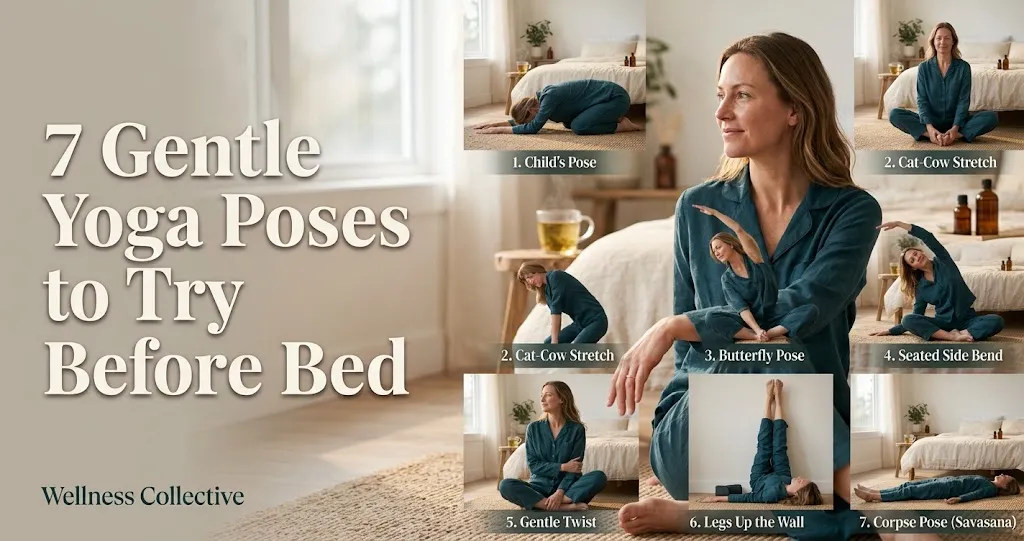
Choose a quiet, uncluttered space and use a yoga mat, folded blanket, or pillow for comfort. Start with the easiest movements, and skip any pose that causes pain, dizziness, numbness, or unusual discomfort.
1. Child’s Pose (Balasana)
Kneel on a mat, bring your hips gently toward your heels, and fold your torso forward. Rest your forehead on a cushion or stacked hands if reaching the floor feels uncomfortable. Keep your arms forward or relaxed alongside your body.
Stay for three to five comfortable breaths, or less if your knees or hips feel strained. A pillow between your thighs and torso may make the position easier. If kneeling is uncomfortable, choose a seated breathing exercise instead.
2. Cat-Cow (Marjaryasana-Bitilasana)
Begin on your hands and knees, with your hands beneath your shoulders and knees beneath your hips. As you breathe in, gently lift your chest and let your back curve naturally. As you breathe out, round your back without forcing your chin toward your chest.
Repeat slowly four to six times. Keep the movement small and smooth rather than pushing to the end of your range. If being on your hands and knees is difficult, leave this pose out.
3. Seated Forward Fold
Sit with your legs extended or slightly bent, then hinge forward from your hips only as far as feels easy. Your hands can rest on your thighs or shins; there is no need to reach your toes. A folded blanket beneath your hips may improve comfort.
Hold for three to five slow breaths without bouncing or pulling yourself deeper. People with back pain or conditions that limit forward bending should skip this movement or ask a qualified professional about modifications.
4. Reclined Butterfly (Supta Baddha Konasana)
Lie on your back, bring the soles of your feet together, and allow your knees to open gently to the sides. Place pillows or yoga blocks under your thighs so your legs are supported instead of hanging under their own weight.
Rest your hands at your sides and breathe naturally for about one minute. If your hips, knees, or groin feel strained, bring your knees closer together or choose a different resting position.
5. Legs Up the Wall (Viparita Karani)
Sit sideways beside a wall, lower your torso to the floor, and gently bring your legs up the wall. Move your hips as close to the wall as comfortable, not as close as possible. A folded blanket beneath your head can provide extra support.
Stay for 30 seconds to a few minutes if the position feels good. Come out slowly by bending your knees and rolling onto your side before sitting up. Skip it if it causes pressure, tingling, dizziness, or discomfort, and seek individual advice if you have a condition that makes this position unsuitable.
6. Supine Knees-to-Chest Stretch
Lie on your back and bring one knee toward your chest, holding behind the thigh rather than pressing directly on the kneecap. Keep the other leg bent or extended according to what feels comfortable. Switch sides after several gentle breaths.
You can also bring both knees toward your chest if that feels comfortable for your back and hips. Avoid pulling forcefully or rocking aggressively. If the movement increases back pain or causes symptoms to travel down a leg, stop.
7. Corpse Pose (Savasana)
Lie on your back with your legs comfortably apart and your arms resting beside you, palms facing upward if comfortable. Place a pillow under your knees if that eases tension in your lower back. Close your eyes or soften your gaze.
Remain still for two to five minutes and allow your breathing to settle naturally. If lying flat is uncomfortable, rest on your side with a pillow between your knees. This final pose is about resting, not trying to empty your mind completely.
A Simple 10–15-Minute Bedtime Routine
You do not need to perform all seven poses every night. Pick three or four comfortable movements and finish with quiet rest. The following sequence is a practical starting point, not a required prescription.
Your Wind-Down Flow
1
Minutes 0–2: Settle in
Dim the lights, silence notifications, and sit comfortably.
2
Minutes 2–5: Move gently
Try Cat-Cow or a comfortable seated stretch.
3
Minutes 5–10: Release tension
Choose Child’s Pose, reclined butterfly, or knees-to-chest.
4
Minutes 10–15: Rest quietly
Finish in Corpse Pose or another supported resting position.
Move through the routine without watching the clock constantly. If you have only five minutes, shorten the sequence rather than rushing. A short, comfortable routine you can repeat is often more practical than a complicated one you rarely finish.
How Long Should You Hold Each Pose?
There is no universal holding time that guarantees better sleep. Use these ranges as flexible starting points and adjust them to your comfort.
Swipe left/right to see the full table →
| Pose | Starting range | Adjustment |
|---|---|---|
| Child’s Pose | 3–5 breaths | Support the torso |
| Cat-Cow | 4–6 cycles | Keep movements small |
| Reclined Butterfly | 30–60 seconds | Support both thighs |
| Legs Up the Wall | 30 seconds–3 minutes | Stop if uncomfortable |
| Corpse Pose | 2–5 minutes | Use a pillow for support |
These times are practical suggestions rather than research-established sleep doses. Shorten or omit any movement that creates strain.
Breathing Techniques for a Quieter Evening
Breathing awareness can make a bedtime routine feel calmer without adding complicated steps. Sit or lie in a comfortable position and notice the movement of your abdomen or ribs.
Try breathing in gently through your nose and allowing the exhale to remain slow and unforced. You might count quietly during each breath if that feels helpful, but do not force a specific rhythm or hold your breath to meet a target.
If counting makes you anxious or leaves you feeling short of breath, return to your natural breathing pattern. Stop any technique that causes dizziness, tingling, chest discomfort, or distress.
Note: Relaxation is not a performance test. Thoughts may continue to appear while you breathe, and that is normal. Gently bring your attention back to the next comfortable breath rather than judging whether you are relaxed enough.
Choose a Routine That Fits Your Needs
The most useful bedtime practice is one you can do safely and comfortably. You do not need expensive equipment, advanced flexibility, or a long video to get started.
Tools That May Make Practice Easier
Swipe left/right to see the full table →
| Item | How it may help | What to consider |
|---|---|---|
| Yoga mat | Provides a defined practice area | Choose stable, nonslip material |
| Pillow or bolster | Supports knees, hips, or head | Avoid unstable stacking |
| Folded blanket | Adds cushioning or warmth | Keep it flat and secure |
| Quiet audio guide | Offers simple verbal prompts | Choose calm audio without bright screens |
These are optional aids, not requirements. Start with household items you already own and add equipment only if it genuinely improves comfort.
Match Your Practice to Your Evening
Practical Routine-Fit Dashboard
Mind feels busy
Practical guide: prioritize comfortable breathing and a short, familiar sequence.
Body feels stiff after sitting
Practical guide: try gentle Cat-Cow or an easy seated stretch if movement is comfortable.
Very little time available
Practical guide: choose one gentle pose followed by a few minutes of quiet rest.
Movement feels uncomfortable
Practical guide: prioritize supported rest or ask a qualified professional for adaptations.
These bars represent suggested routine priorities, not measured effectiveness or clinical outcomes.
Mistakes That Can Make Bedtime Yoga Less Helpful
More movement does not necessarily mean more relaxation. A routine can become counterproductive if it feels like another task to complete or leaves you physically uncomfortable.
Common Mistakes and Better Choices
Swipe left/right to see the full table →
| Mistake | Better choice | Why it matters |
|---|---|---|
| Forcing a deep stretch | Use a smaller range | Reduces unnecessary strain |
| Doing vigorous flows immediately before bed | Choose slow, restorative movement | High intensity may feel stimulating |
| Holding your breath | Breathe naturally | Avoids unnecessary discomfort |
| Expecting instant results | Observe comfort over time | Sleep varies from night to night |
Tip: Set up your mat and pillow before you begin. Keeping the routine simple removes extra decisions and may make it easier to repeat on busy evenings.
Pair Yoga With Healthy Sleep Habits
Bedtime movement is only one part of a sleep-friendly routine. The environment and habits surrounding your practice may matter just as much as the poses you choose.
A Sleep-Friendly Evening Checklist
Keep a steady schedule
Aim for a consistent bedtime and wake-up time that allows enough sleep.
Dim bright lights
Reduce bright screens and stimulating content as bedtime approaches.
Make the room comfortable
Keep the sleep area quiet, dark, and comfortably cool when possible.
Watch evening stimulants
Avoid caffeine too close to bedtime and notice how late meals affect your rest.
For additional guidance, see the National Heart, Lung, and Blood Institute’s sleep disorder treatment and healthy sleep guidance. It includes practical habits that can complement a relaxing evening routine.
When Should You Practice?
You can experiment with gentle yoga during the final 10–30 minutes before bedtime, provided it leaves you feeling calm rather than energized. There is no single best time for everyone, so adjust the timing to your own response.
Swipe left/right to see the full table →
| Timing | Possible approach | Best adjustment |
|---|---|---|
| Early evening | Gentle mobility and breathing | Leave time for other wind-down habits |
| Shortly before bed | Supported poses and quiet rest | Avoid vigorous movements |
| After a late workout | Try a brief cool-down | Allow time to settle |
| When already sleepy | Skip the full sequence | Prioritize getting to bed |
What If You Still Cannot Fall Asleep?

One difficult night does not mean your routine has failed. Sleep can be affected by stress, changes in schedule, pain, medication, health conditions, caffeine, and many other factors.
If you remain awake and become frustrated, avoid turning your yoga practice into a test of willpower. Consider a quiet, low-light activity until you feel sleepy, then return to bed. Keep your wake-up time reasonably consistent and pay attention to patterns rather than judging yourself by one night.
Troubleshooting Your Routine
Swipe left/right to see the full table →
| What you notice | Possible adjustment | Next step |
|---|---|---|
| You feel more alert | Shorten the routine | Try quieter breathing or rest |
| A pose causes discomfort | Stop or change position | Seek advice if symptoms persist |
| You miss several evenings | Reduce it to one pose | Choose an easy, repeatable cue |
| Sleep remains disrupted | Look beyond yoga alone | Discuss ongoing problems with a clinician |
Warning: Do not use yoga to ignore persistent sleep problems or symptoms that interfere with daily life. Avoid painful stretches, extreme breathwork, and poses that make you dizzy or unsteady. Adaptations may be needed during pregnancy, after an injury, or with certain health conditions.
When to Contact a Professional
If sleep difficulties continue, regularly affect daytime functioning, or leave you feeling persistently exhausted, speak with a healthcare professional. Seek advice sooner if you have loud snoring with gasping, uncomfortable urges to move your legs, significant nighttime pain, or other concerning symptoms. A clinician can help identify possible causes and discuss suitable options.
For ongoing insomnia, cognitive behavioral therapy for insomnia (CBT-I) is a recommended treatment for adults. Yoga may complement a broader sleep plan, but it should not replace an appropriate assessment or recommended care.
A Simple Decision Path
Does gentle movement feel comfortable?
Yes: continue with a short, easy sequence. No: stop and choose supported rest or ask for guidance.
Does the routine help you wind down?
Yes: repeat it when useful. No: shorten it, change the timing, or try a quieter activity.
Are sleep problems persistent or affecting daily life?
Seek professional advice instead of relying on yoga alone.
Frequently Asked Questions
Does yoga for sleep really work?
Yoga may improve sleep quality for some people, but research findings vary. It is best viewed as one possible part of a broader sleep routine, not a guaranteed solution for insomnia.
What is the best yoga pose before bed?
Corpse Pose, supported Child’s Pose, and reclined butterfly are gentle options for many people. Choose the position that feels comfortable rather than forcing yourself into a particular pose.
How long should I do yoga before bed?
Try 5–15 minutes as a starting point. Adjust the duration to your schedule and comfort, and stop if movement causes pain or unusual symptoms.
Can I do yoga in bed?
Yes, gentle breathing and comfortable seated or lying-down movements may be possible in bed. Avoid unstable positions and any stretch that makes you feel unsteady or uncomfortable.
Is vigorous yoga good right before sleep?
Vigorous styles may feel stimulating close to bedtime, so gentle, restorative movements are a practical choice for winding down. Schedule more intense exercise earlier if it leaves you feeling energized.
How often should I practice bedtime yoga?
You can try a short routine on evenings when it feels helpful and comfortable. Consistency may make the habit easier to maintain, but there is no universal frequency that guarantees better sleep.
Can yoga replace treatment for insomnia?
No. Yoga may support relaxation and sleep quality, but persistent insomnia deserves professional guidance. CBT-I is a recommended treatment for adults with chronic insomnia.
Final Thoughts
Start with one or two comfortable poses, breathe naturally, and give yourself a few quiet minutes to transition away from the day. Yoga may support a healthier bedtime routine, especially when paired with consistent sleep habits, but individual results vary. If sleep problems persist, worsen, or affect your daily life, seek guidance from a healthcare professional.
Author
-

Hi, I’m Ryan Mitchell, a wellness and relaxation writer at RemedyTip.com, where I focus on helping readers better understand stress management, relaxation techniques, mindfulness, sleep improvement, and everyday wellness habits. I have developed a strong knowledge of the Wellness & Relaxation field through sustained learning, in-depth research, and a continued commitment to exploring practical approaches to well-being.
My work focuses on researching wellness topics, examining available evidence, and turning complex information into clear, accessible, and actionable guidance. I’m continually exploring new findings, relaxation practices, and lifestyle strategies to help readers make informed decisions about their daily wellness routines. At RemedyTip.com, my goal is to share trustworthy, research-informed content that encourages healthier habits, greater relaxation, and a more balanced lifestyle.

