
Written by Alex Turner
Quick Answer: Is trigger point massage deep tissue?
Not exactly. Trigger point massage is a focused technique that targets specific tender spots, while deep tissue massage usually works more broadly through deeper muscle and connective tissue. The two can be combined in the same session.
Trigger Point and Deep Tissue: Similar, But Not Identical
If you are choosing a massage because one small area feels stubbornly tight, the names can be confusing. Both techniques may use firm pressure, but they differ mainly in where the therapist works, how focused the pressure is, and what the session is trying to accomplish.
Safety note: This article is for general educational information only. It does not diagnose, treat, cure, or prevent any condition. It does not replace advice from a licensed healthcare professional. Readers should seek professional help for severe, worsening, unusual, or persistent symptoms.
What Trigger Point Massage Actually Means
Trigger point massage is a focused form of massage that concentrates on particular areas of muscle tenderness or tightness. These spots are often described as knots. A therapist may locate a sensitive point and use controlled pressure rather than spending equal time over an entire muscle group.
The important idea is precision. The defining feature is not simply how hard the therapist presses. A trigger point approach can involve moderate, steady pressure that is adjusted to the person’s response. The therapist may also work around the sensitive area rather than repeatedly pressing the exact center of it.
This is why asking only whether the massage is “deep” can be misleading. A focused technique can feel intense without being a full deep tissue session. Conversely, a deep tissue massage can involve firm work over a large region without specifically targeting individual tender points.
The main goal is targeted attention
Someone who can point to one or several very specific areas may find a targeted approach more relevant than asking for firm pressure everywhere. For example, a person might notice a stubborn tight spot near the upper back while the surrounding muscles feel relatively normal.
That does not prove the spot is the source of every symptom, however. Muscle discomfort can have different causes, and massage should not be used to assume that every painful point is a simple knot.
What Deep Tissue Massage Means
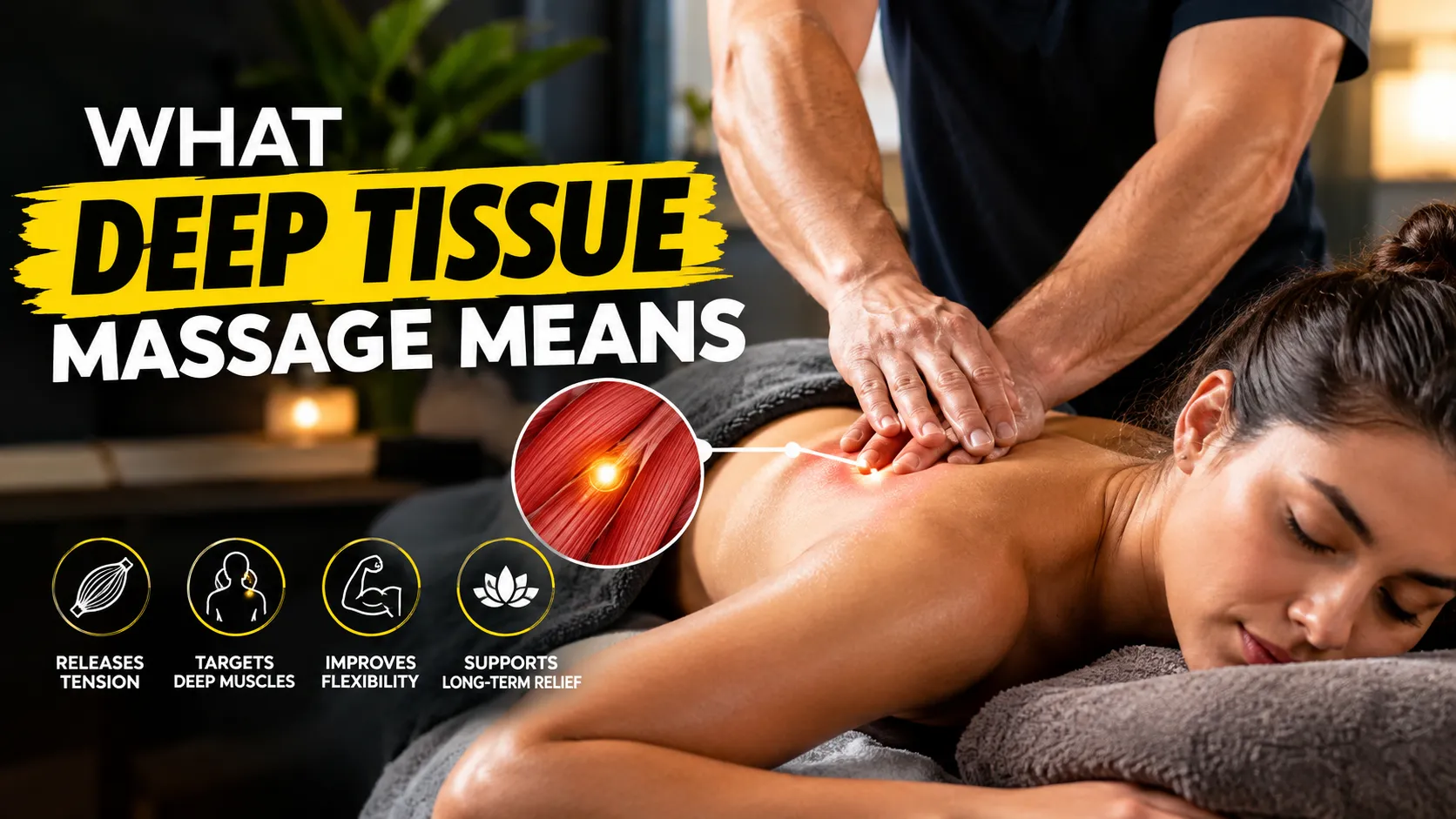
Deep tissue massage is a broader massage approach that commonly uses slow, deliberate pressure across deeper layers of muscle and connective tissue. It can be directed toward a larger region, such as the back, shoulders, hips, thighs, or calves.
Deep tissue does not mean “as hard as possible.” More pressure is not automatically better. A useful session should allow the person to communicate about intensity, especially when an area is already sensitive.
Depending on the session, the therapist may use longer strokes, compressions, kneading, or other techniques. The work can move across several muscles instead of staying on one small point.
Deep tissue is about broader tissue work
If your main complaint is widespread muscle tightness, stiffness after repetitive activity, or a generally tense back and shoulders, a broader approach may make more sense than concentrating on one spot for most of the appointment.
The best choice is still individual. A therapist may combine several techniques rather than treating “deep tissue” and “trigger point” as completely separate services.
Trigger Point vs. Deep Tissue at a Glance
The simplest distinction is this: trigger point work is usually more precise, while deep tissue work is usually broader. They can overlap because both may use sustained pressure and can be used around tense muscles.
Swipe left/right to see the full table →
| Feature | Trigger Point | Deep Tissue |
|---|---|---|
| Main focus | Specific tender spot | Broader muscle area |
| Pressure | Focused and adjusted | Slow and firm as appropriate |
| Coverage | Small, precise areas | Larger regions |
| Can they combine? | Yes | Yes |
This comparison is a practical guide rather than a rule that every therapist follows. Massage sessions often blend techniques based on the area being worked and how the person responds.
Where the approaches overlap
May use controlled pressure around tense muscles.
Can be adjusted according to comfort and sensitivity.
More attention goes to a specific tender location.
More attention usually goes across a broader region.
The practical takeaway is that these techniques are not competing categories in every appointment. A therapist may use broader work first and then spend time on a few specific points.
How Pressure and Coverage Change the Experience
People often judge massage styles by intensity, but pressure alone does not tell you which technique is being used. Two sessions can feel equally firm while having very different goals.
With trigger point work, you may notice a concentrated sensation in one small area. The therapist may pause, reassess, and move to another point. With deep tissue massage, the pressure may travel more continuously through a larger section of muscle.
A useful communication rule is to describe what you feel rather than simply asking for “harder.” Tell the therapist whether the pressure feels tolerable, too intense, sharp, burning, numb, or otherwise unusual.
What the pressure pattern can tell you
Swipe left/right to see the full table →
| What you notice | May fit better | Why |
|---|---|---|
| One very specific tender spot | Trigger point work | The approach is more targeted. |
| Several tight areas in one region | Deep tissue or blended session | Broader work may cover more tissue. |
| You dislike intense pressure | Gentler customized work | Firmness is not required for every goal. |
| You have unexplained severe pain | Professional evaluation | Massage should not replace assessment. |
Tip: Before a session, identify one or two areas you want to discuss. During the massage, give clear feedback about pressure instead of waiting until the appointment ends.
Which Approach May Make More Sense for You?
There is no universal winner. The more useful question is what you want the session to focus on. If you have a small, clearly localized area of muscular tenderness, a targeted approach may be worth discussing. If your discomfort feels spread across a larger muscle region, broader massage may be more appropriate.
Remember that a person’s description of a “knot” does not establish a specific medical cause. If discomfort is persistent, severe, or accompanied by other concerning symptoms, professional assessment is more appropriate than repeatedly increasing massage pressure.
A simple fit guide
Practical decision path
This guide is about choosing a conversation with a massage professional, not self-diagnosing the source of pain. Your symptoms and health history may change what is appropriate.
When a blended session may be useful
Massage does not always have to follow one technique from beginning to end. A therapist may spend some time using broader strokes around an area and then switch to focused work on a few sensitive spots.
This can be especially practical when the area feels generally tense but also contains one or two spots that seem more sensitive than the surrounding tissue. The exact combination should be based on comfort and the therapist’s assessment rather than a goal of making the pressure as intense as possible.
Typical routine priority — practical guide
These percentages are not clinical measurements. They simply illustrate a sensible priority: communication and comfort matter more than trying to make a massage maximally intense.
Common Mistakes When Choosing Between Them
One common mistake is assuming that “deep” automatically means better. A stronger sensation can be uncomfortable without adding value, and intense pressure is not a requirement for every massage goal.
Another mistake is booking a specific style without explaining what you actually want. Saying “my upper back feels generally tight” gives a therapist different information from “there is one small tender spot that I notice when I move my shoulder.”
A third mistake is treating massage as a way to explain unexplained pain. Massage may be part of a comfort routine, but persistent symptoms deserve appropriate evaluation when they do not improve or when other warning signs appear.
Mistake vs. better choice
Swipe left/right to see the full table →
| Common mistake | Better choice |
|---|---|
| Asking for maximum pressure | Ask for firm but tolerable pressure. |
| Choosing by name alone | Explain the location and pattern of tension. |
| Ignoring unusual sensations | Tell the therapist immediately. |
| Repeatedly massaging unexplained pain | Consider professional evaluation. |
Warning: Stop or change the technique if pressure produces sharp or severe pain, unusual numbness, weakness, or another concerning sensation. Do not treat increasing pain as proof that the massage is working.
When to Choose Self-Care and When to Seek Help

For mild, familiar muscle tightness without warning signs, gentle movement, comfortable stretching, heat or other routine comfort measures may be reasonable options to discuss or try. Massage can also be considered as part of a general comfort routine when appropriate.
The situation changes when pain is severe, worsening, unusual, persistent, or associated with symptoms that could indicate something beyond ordinary muscle tension. In those cases, increasing massage intensity is not a good substitute for evaluation.
Self-care vs. professional guidance
Swipe left/right to see the full table →
| Situation | Practical next step |
|---|---|
| Mild familiar tightness | Gentle self-care may be reasonable. |
| Persistent or recurring discomfort | Discuss it with a healthcare professional. |
| Severe or worsening pain | Seek prompt professional guidance. |
| Numbness or weakness | Do not rely on massage alone; seek evaluation. |
| Injury, fever, chest pain, or bladder/bowel changes | Seek urgent medical help as appropriate. |
Red-flag checklist
These warning signs do not identify a specific condition. They simply indicate that self-massage or choosing between massage styles should not be the only response.
When to contact a professional: Seek professional help for severe, worsening, unusual, or persistent pain, especially if you also have numbness, weakness, fever, a significant injury, chest pain, or loss of bladder or bowel control. Do not use increasingly intense massage to push through these symptoms.
A Few Practical Questions to Ask Before Your Session
If you are unsure whether trigger point or deep tissue massage is the better fit, you do not have to decide from the service name alone. A short conversation can make the appointment more specific.
Tell the therapist where you feel the problem, whether the area is small or widespread, how long you have noticed it, and whether movement changes the sensation. Also mention anything relevant about an injury or health concern that could affect whether massage is appropriate.
It is reasonable to ask how the therapist plans to adjust pressure if an area becomes too sensitive. A professional should be able to explain the approach in understandable terms rather than treating pain tolerance as the goal.
Before-and-during-session checklist
Describe the location and pattern of discomfort.
Share relevant injuries or health concerns.
Say when pressure feels too strong.
Notice whether symptoms are improving, unchanged, or worsening.
Good communication makes the technique more useful because it lets the therapist adjust the session instead of guessing how much pressure you want.
Frequently Asked Questions
Is trigger point massage deep tissue?
Not exactly. Trigger point massage is a targeted technique for specific tender areas, while deep tissue massage generally works more broadly through deeper muscle and connective tissue.
Can trigger point and deep tissue massage be combined?
Yes. A massage therapist may use broader work and then focus on selected tender areas during the same session, depending on the person’s needs and comfort.
Does trigger point massage have to hurt?
No. Focused pressure can feel intense, but severe or sharp pain is not a goal. Tell the therapist if the pressure becomes uncomfortable or produces an unusual sensation.
Is deep tissue massage always deeper than trigger point work?
Not necessarily. The depth and pressure of either technique can vary. Trigger point work is defined more by its focused target than by how hard the therapist presses.
Which is better for a specific muscle knot?
If the issue is a small, localized tender area, it may make sense to discuss targeted trigger point work. However, a professional should consider the wider area and your symptoms rather than assuming every knot has the same cause.
Can deep tissue massage be used for general muscle tightness?
It may be considered when tightness affects a broader muscle region. The appropriate pressure and technique should still be adjusted to the person’s comfort and circumstances.
When should I avoid choosing massage for pain?
Consider professional evaluation instead of relying on massage when pain is severe, worsening, unusual, or persistent, or when symptoms include numbness, weakness, fever, injury, chest pain, or loss of bladder or bowel control.
Final Thoughts
The simplest answer is that trigger point massage and deep tissue massage are related but not identical. Trigger point work is more targeted, while deep tissue massage generally covers broader areas, and a session can combine both. Choose based on the pattern of discomfort and communicate clearly about pressure; seek professional help if symptoms are severe, worsening, unusual, persistent, or not improving.
Author
-

I’m Alex Turner, a massage product reviewer and wellness writer at RemedyTip. I specialize in researching, evaluating, and comparing massage and recovery products to help readers make informed purchasing decisions. My focus is on practical, evidence-informed product guidance covering muscle recovery, relaxation, everyday comfort, and wellness.
I take a research-driven approach to every product I review. I examine product specifications, features, materials, performance claims, user feedback, durability, comfort, ease of use, and overall value. When appropriate, I also consult trusted industry and health-related sources to verify important information and provide readers with a more complete and balanced view.
I cover a wide range of products, including massage guns, handheld massagers, neck and shoulder massagers, foot massagers, massage chairs, foam rollers, and other recovery tools. Rather than focusing only on marketing claims, I look at how products compare in real-world use and who they are actually suitable for. I also consider different budgets, use cases, and user needs when making recommendations.
At RemedyTip, I’m committed to accuracy, transparency, and unbiased product information. I clearly distinguish between manufacturer claims, available evidence, and my own product analysis so readers can understand the basis of each recommendation. I continuously research new products, technologies, and developments in the massage and recovery space to keep my content current and useful.
My goal is simple: to provide trustworthy, easy-to-understand information that helps readers choose massage and recovery products with greater confidence.

