By Alex Turner · Recovery Drinks by Body Concern
Quick Answer: Massage oil can cause irritation or contribute to breakouts in some people, depending on the ingredients, skin sensitivity, amount used, and hygiene. A contaminated product or massage surface may also increase infection risk. Choosing a suitable product, using clean hands and linens, and stopping use when a reaction develops can reduce avoidable problems.
Can Massage Oil Cause Skin Problems?
Massage oil is designed to reduce friction and make massage easier, but that does not mean every formula works equally well for every person’s skin. A product that feels comfortable on one person’s arms or legs may feel too heavy, irritating, or unsuitable for another person’s face, chest, back, or other acne-prone areas.
Skin problems after massage can have several possible contributors. The formula itself may contain fragrance or another ingredient that does not agree with the skin. Heavy oil residue can also be a concern for people who are prone to clogged pores. Separately, poor hygiene involving hands, towels, sheets, bottles, or reusable massage tools can create a different type of skin-health concern.
The useful question is therefore not simply whether massage oil is “bad.” It is whether the particular product, application method, skin area, and hygiene routine are a good fit.
Health & Safety Note: This article is for general educational information only. It does not diagnose, treat, cure, or prevent any condition. It does not replace advice from a licensed healthcare professional. Readers should seek professional help for severe, worsening, unusual, or persistent symptoms.
Why Massage Oil May Irritate Skin
Skin irritation usually means the skin is reacting poorly to something in the product or to the way the product is being used. Fragrance is one possible concern, particularly for people who already know that scented personal-care products bother their skin. A formula with several botanical or aromatic ingredients can also make it harder to identify which ingredient is responsible if a reaction occurs.
Friction matters too. Massage involves repeated rubbing and pressure, so skin that is already dry, scraped, sunburned, recently shaved, or otherwise sensitive may respond differently than healthy, intact skin. Adding a product does not necessarily prevent every form of irritation.
Common Irritation Patterns
Possible signs include redness, itching, burning, dryness, tenderness, or small bumps. These signs do not identify one specific cause by themselves. If the reaction repeatedly appears after using the same product and improves after avoiding it, that is useful information to discuss with a healthcare professional if the problem persists.
Practical skin-reaction pathway
Notice how the skin feels during and after massage.
Redness, itching, burning, bumps, or unusual discomfort may appear.
Avoid continuing an obvious source of irritation.
Persistent, severe, spreading, or unusual symptoms need professional advice.
Think of this as a practical guide rather than a way to identify a medical condition. Skin reactions can have many causes, and a professional may be needed when the cause is unclear.
Can Massage Oil Contribute to Acne?
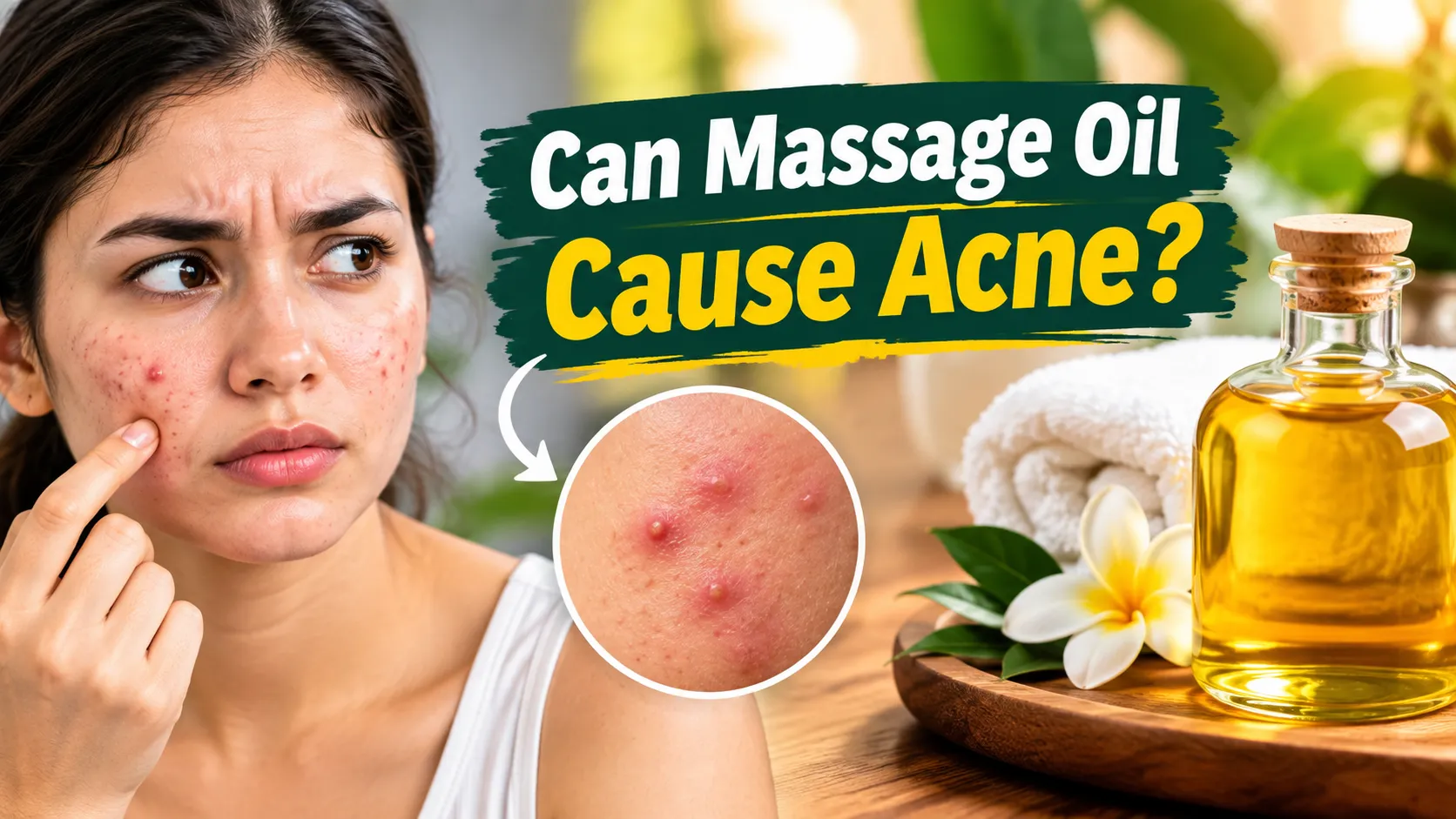
Yes, it can contribute to breakouts for some people, especially when a formula is not a good fit for acne-prone skin. The American Academy of Dermatology recommends looking for labels such as “oil-free,” “non-comedogenic,” or “won’t clog pores” when choosing products for acne-prone skin. :contentReference[oaicite:0]{index=0}
That does not mean every oil automatically causes acne. The important issue is how the overall product interacts with the person’s skin. A thick, oily residue may be less suitable for someone who regularly develops clogged pores, while a lighter product may be easier to tolerate.
Massage location also matters. A product used on the shoulders or legs is not necessarily a good choice for the face or another area that is especially prone to breakouts. If massage oil repeatedly seems to coincide with new bumps, review the product label and consider whether the area is acne-prone.
Signs That the Product May Be Contributing
Small bumps, whiteheads, or repeated breakouts in the area where an oily product is used can be a reason to reconsider the product. The American Academy of Dermatology notes that oily skin and hair-care products can contribute to clogged pores and breakouts, and recommends non-comedogenic or oil-free options for acne-prone skin. :contentReference[oaicite:1]{index=1}
However, timing alone does not prove that massage oil is the cause. Sweat, friction, clothing, other skincare products, and existing acne can also affect the skin.
Swipe left/right to see the full table →
| Pattern | Possible reason | Practical response |
|---|---|---|
| Itching or burning | Irritation or sensitivity | Pause use and monitor |
| New small bumps | Possible clogged pores | Review product fit |
| Problem after every use | Poor product fit | Stop using that formula |
| Persistent or worsening rash | Cause may need evaluation | Seek professional advice |
Can Massage Oil Cause an Infection?
The infection question is different from irritation or acne. Massage oil itself should not be assumed to cause an infection simply because it is oily. Hygiene is the more important consideration when thinking about contamination.
Shared or poorly cleaned surfaces, towels, hands, containers, or reusable massage equipment can potentially transfer microorganisms. The risk becomes more concerning when skin is already damaged or when contaminated materials contact vulnerable areas. Published case reports have described unusual skin infections associated with massage-related practices, although isolated cases cannot be used to estimate the usual risk for everyday massage. :contentReference[oaicite:2]{index=2}
The practical lesson is simple: keep the product and everything touching the skin clean. Do not share applicators or use visibly contaminated products. Clean reusable massage tools according to their manufacturer’s instructions, and use fresh linens between people.
Infection-risk checklist — practical guide
Hands should be clean before applying product.
Use clean towels and sheets for each person.
Reusable tools should be cleaned as directed.
Be cautious around cuts, open sores, or damaged skin.
These measures do not guarantee that a skin problem will never occur. They simply remove several avoidable hygiene problems from the routine.
Who Should Be More Careful?
People with acne-prone, sensitive, or easily irritated skin may need to pay closer attention to product selection. The same is true if the skin is already irritated or damaged. A massage product should not be treated as automatically suitable just because it is marketed for wellness or relaxation.
Swipe left/right to see the full table →
| Situation | What to consider | Safer approach |
|---|---|---|
| Acne-prone skin | Heavy residue may be undesirable | Look for non-comedogenic labeling |
| Sensitive skin | Fragrance may be irritating | Prefer a simple formula |
| Damaged skin | Products may sting or worsen irritation | Avoid applying to open or damaged areas |
| Unknown reaction | Cause may be unclear | Stop the suspected product and monitor |
How to Choose a More Skin-Friendly Massage Oil
Start with the area where the product will be used. A product intended for body massage does not automatically make the best choice for facial or acne-prone skin. Read the label rather than relying only on words such as “natural,” “botanical,” or “premium.” Those marketing terms do not tell you how your individual skin will respond.
Look at the Label
For acne-prone skin, labels such as “non-comedogenic,” “oil-free,” or “won’t clog pores” can be useful selection clues. The AAD recommends these types of labels for acne-prone skincare because products that clog pores can contribute to breakouts. :contentReference[oaicite:3]{index=3}
For easily irritated skin, a simpler formula may make product selection easier. If fragrance has caused problems for you before, a fragrance-free option may be worth considering.
Swipe left/right to see the full table →
| Label clue | Why it may matter | Use it as |
|---|---|---|
| Non-comedogenic | Designed with pore-clogging concerns in mind | Selection clue |
| Oil-free | May suit some acne-prone routines | Selection clue |
| Fragrance-free | Can be useful for fragrance-sensitive routines | Sensitivity clue |
| Long ingredient list | More ingredients can complicate troubleshooting | Read carefully |
Note: “Natural” does not automatically mean “non-irritating,” and “non-comedogenic” does not guarantee that every person will remain breakout-free. Skin response is individual.
Safe Use vs Risky Use
A safer massage routine is mostly about matching the product to the skin and maintaining basic hygiene. More product is not automatically better, and continuing a product after an obvious reaction is not a good way to “get used to it.”
Swipe left/right to see the full table →
| Safer routine | Riskier routine |
|---|---|
| Clean hands and fresh linens | Reusing visibly dirty towels or sheets |
| Use an appropriate amount | Applying excessive product and leaving heavy residue |
| Read the ingredient label | Choosing only because the marketing sounds natural |
| Stop when irritation develops | Continuing despite worsening symptoms |
Product-fit dashboard — typical routine priority
Acne-prone skin
Prioritize non-comedogenic or oil-free labeling.
Sensitive skin
Prioritize simple formulas and avoid known irritants.
Hygiene
Clean hands, linens, containers, and reusable tools.
These bars are practical priorities, not scientific measurements. They highlight where extra attention may be useful when building a massage routine.
Mistakes That Can Make Skin Problems More Likely
Using the Same Product Everywhere
Face, chest, back, arms, and legs can have different skin needs. A formula that works comfortably on one area may not be the best choice for another.
Ignoring the Label
Marketing language can be attractive, but the ingredient list and suitability claims are more useful when you are trying to avoid a known trigger.
Scrubbing the Skin Afterward
If you are worried about residue, aggressive scrubbing can create another source of irritation. The AAD advises gentle cleansing rather than abrasive scrubbing for acne-prone skin. :contentReference[oaicite:4]{index=4}
Continuing After a Reaction
A product that repeatedly causes discomfort is not a good candidate for continued use simply because it was expensive or marketed as a wellness product.
Overlooking Hygiene
Clean product handling matters. A clean formula cannot compensate for dirty towels, hands, or equipment.
Do / Don’t split panel
Do
Read labels, use clean linens, consider your skin type, and stop using a product that clearly causes discomfort.
Don’t
Assume natural means harmless, share dirty applicators, aggressively scrub irritated skin, or ignore worsening symptoms.
Warning: A skin reaction after massage does not automatically mean an infection. Irritation, acne, allergy, friction, and infection can look different and sometimes overlap. Avoid trying to identify a serious skin problem solely from appearance if symptoms are significant or worsening.
When to Stop Self-Care and Get Help

Minor, short-lived discomfort may improve after the suspected product is avoided, but persistent or worsening symptoms deserve more attention. Do not assume that every rash or bump after massage is simply “sensitive skin.”
Red-flag dashboard
Seek professional help rather than continuing the product.
Get evaluated if redness, swelling, or other symptoms are spreading.
Professional assessment is appropriate for unusual or worsening signs of infection.
Persistent symptoms should not simply be ignored.
If symptoms are severe, unusual, spreading, infected-looking, or persist despite stopping the suspected product, contact a licensed healthcare professional. Urgent medical attention is appropriate for a serious or rapidly worsening reaction.
Swipe left/right to see the full table →
| Situation | Self-care may be reasonable | Consider professional help |
|---|---|---|
| Mild temporary irritation | Stop suspected product | If persistent or worsening |
| Repeated breakouts | Review product choices | If acne continues or worsens |
| Spreading redness or swelling | Do not keep experimenting | Seek professional evaluation |
| Possible infection | Avoid further product exposure | Get medical advice |
When to contact a professional: Seek professional help for severe, worsening, spreading, unusual, infected-looking, or persistent skin symptoms. A clinician can determine whether the problem is irritation, acne, an allergic reaction, infection, or another skin condition.
Frequently Asked Questions
Can massage oil cause skin irritation?
Yes. Some formulas may irritate sensitive skin, particularly when they contain ingredients that a person does not tolerate or when the skin is already irritated.
Can massage oil cause acne?
It can contribute to breakouts in some people, especially when the product is not a good fit for acne-prone skin. Non-comedogenic or oil-free labeling may be useful when choosing skincare products for acne-prone areas.
Can massage oil cause an infection?
The bigger hygiene concern is contamination involving hands, towels, surfaces, containers, or reusable tools. Keep anything that touches the skin clean and avoid applying products to damaged skin.
What massage oil is best for acne-prone skin?
Look for products labeled non-comedogenic, oil-free, or “won’t clog pores,” while remembering that no label guarantees an individual reaction.
Should I stop using massage oil if it burns?
If a product causes clear burning or irritation, it is reasonable to stop using it rather than continuing exposure. Persistent or worsening symptoms should be assessed by a healthcare professional.
Does natural massage oil mean it cannot irritate skin?
No. “Natural” does not guarantee that a product will suit every person’s skin. Individual sensitivity and the full ingredient list still matter.
When should I see a doctor about a skin reaction after massage?
Seek professional help when symptoms are severe, worsening, spreading, unusual, infected-looking, or persistent, especially when the cause is unclear.
Final Thoughts
Massage oil is not automatically harmful to skin, but the wrong formula or poor hygiene can create avoidable problems for some people. If you are acne-prone or sensitive, pay attention to the label, keep massage materials clean, and stop using a product that repeatedly causes irritation or breakouts. Seek professional help if symptoms are severe, worsening, unusual, spreading, persistent, or not improving.
Author
-

I’m Alex Turner, a massage product reviewer and wellness writer at RemedyTip. I specialize in researching, evaluating, and comparing massage and recovery products to help readers make informed purchasing decisions. My focus is on practical, evidence-informed product guidance covering muscle recovery, relaxation, everyday comfort, and wellness.
I take a research-driven approach to every product I review. I examine product specifications, features, materials, performance claims, user feedback, durability, comfort, ease of use, and overall value. When appropriate, I also consult trusted industry and health-related sources to verify important information and provide readers with a more complete and balanced view.
I cover a wide range of products, including massage guns, handheld massagers, neck and shoulder massagers, foot massagers, massage chairs, foam rollers, and other recovery tools. Rather than focusing only on marketing claims, I look at how products compare in real-world use and who they are actually suitable for. I also consider different budgets, use cases, and user needs when making recommendations.
At RemedyTip, I’m committed to accuracy, transparency, and unbiased product information. I clearly distinguish between manufacturer claims, available evidence, and my own product analysis so readers can understand the basis of each recommendation. I continuously research new products, technologies, and developments in the massage and recovery space to keep my content current and useful.
My goal is simple: to provide trustworthy, easy-to-understand information that helps readers choose massage and recovery products with greater confidence.